

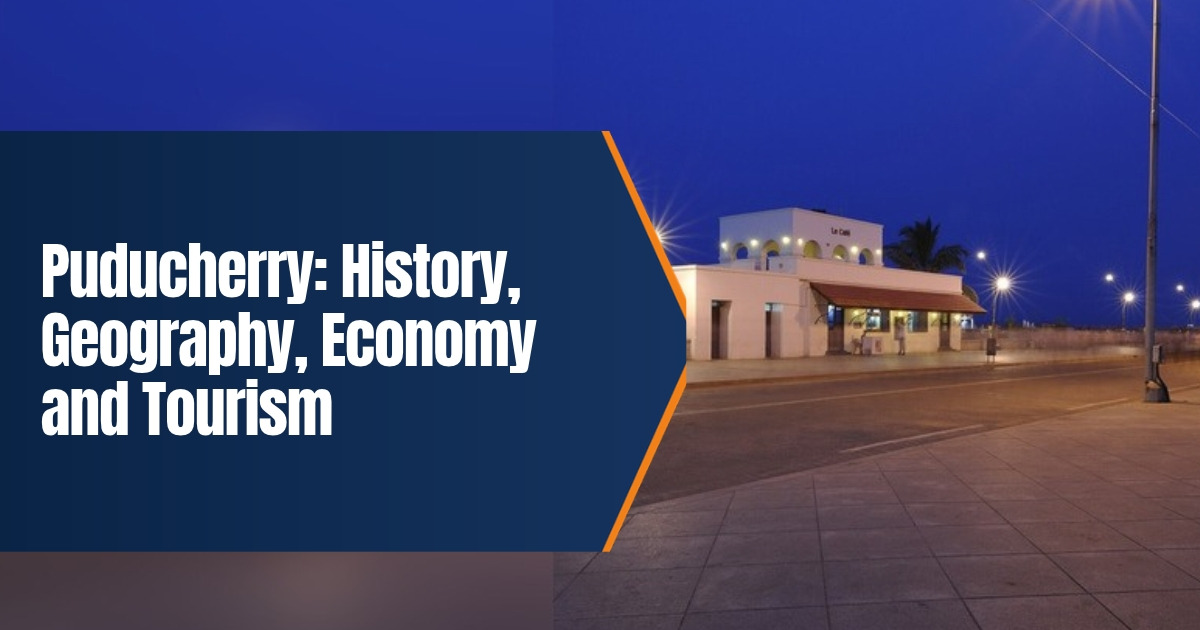
Puducherry: History, Geography, Economy and Tourism
Puducherry, long known as Pondicherry, is a union territory on the southeast coast of India, famous for its French quarter, its seafront promenade, the Sri Aurobindo Ashram and the township of Auroville nearby. It is also one of the oddest shapes on the map of India. Its four districts are scattered across three states, hundreds of kilometres apart, a leftover of the trading posts that France held for almost three centuries.
This guide covers the history of Puducherry, its geography and people, how its economy works and what visitors can see, with facts updated to November 2026.
Table of Contents
Puducherry at a Glance
| Item | Detail |
|---|---|
| Status | Union territory with its own elected assembly |
| Capital | Puducherry city |
| Districts | Puducherry, Karaikal, Yanam and Mahe |
| Total area | About 483 square kilometres |
| Population | 1,247,953 (Census 2011) |
| Main languages | Tamil, Telugu, Malayalam, with English and French also recognised |
| Joined India | De facto 1 November 1954, de jure 16 August 1962 |
| Lieutenant Governor | K. Kailashnathan, since 7 August 2024 |
| Chief Minister | N. Rangaswamy |
History of Puducherry
Before the Europeans
The coast here was a trading region long before Europeans arrived. At Arikamedu, just south of the modern city, archaeologists found Roman pottery, beads and amphora pieces from around the first century, showing that ships from the Mediterranean world traded here. Over the following centuries the area came under the Pallavas, the Cholas, the Pandyas and later the Vijayanagara empire. By the seventeenth century it was a modest weaving and fishing village.
The French period
The French East India Company set up its post at Pondicherry in 1674 under Francois Martin, who bought land from the local ruler and built a fort. The Dutch captured the town in 1693 but returned it in 1699 under a European peace treaty. In the eighteenth century, under governor Joseph Francois Dupleix, Pondicherry became the centre of French ambitions in India and a rival to British Madras. The two powers fought repeatedly, and the British captured and razed much of the town in 1761. It was handed back, taken again and finally returned to France in 1816.
From then until 1954, France held five small territories in India: Pondicherry, Karaikal, Yanam, Mahe and Chandernagore in Bengal. The French laid out the town on a grid, with a canal separating the European quarter by the sea from the Tamil quarter inland, a layout that still shapes the city.
Joining India
After Indian independence in 1947, pressure grew for the French settlements to join India. Chandernagore merged with West Bengal after a vote. For the rest, a transfer took effect on 1 November 1954, which is still celebrated as Liberation Day. A treaty followed in 1956, and the French Parliament ratified it in 1962, with the legal transfer completed on 16 August 1962. Under the agreement, people could choose French citizenship, and a small community of French citizens still lives here. In 2006 the name was officially changed from Pondicherry to Puducherry, meaning new town in Tamil.
Geography
The four districts sit in very different places:
| District | Area | Location |
|---|---|---|
| Puducherry | 293 sq km | Coast of Tamil Nadu, south of Chennai |
| Karaikal | 161 sq km | Kaveri delta coast, Tamil Nadu |
| Yanam | 20 sq km | Godavari delta, Andhra Pradesh |
| Mahe | 9 sq km | Malabar coast, Kerala |
The land is flat and low, with sandy coasts, lagoons and backwaters. The climate is hot and humid, with most rain arriving in the northeast monsoon from October to December. That is also cyclone season. Cyclone Fengal in late 2024 brought record rainfall to Puducherry and flooded large parts of the city, a reminder of how exposed the coast is.
Puducherry and Karaikal are wrapped by Tamil Nadu, whose history and travel routes are covered in our guide to Tamil Nadu.
People and Culture
About 88 percent of people speak Tamil, around 6 percent Telugu, mostly in Yanam, and around 4 percent Malayalam, mostly in Mahe. English is used widely in government, and French still appears on street signs in the old quarter and is taught in some schools. The French Institute of Pondicherry and the Alliance Francaise keep cultural links alive.
The town blends Tamil temple life, Catholic churches and French colonial buildings. The Manakula Vinayagar temple, dedicated to Ganesha, stands a short walk from the Basilica of the Sacred Heart of Jesus, with its Gothic arches and stained glass. Food reflects the mix too, with Tamil meals, Creole style curries and French bakeries side by side.
Government
Puducherry is a union territory with a legislature, which gives it an elected assembly and a Chief Minister while the Lieutenant Governor represents the President. The assembly has 30 elected seats and up to three nominated members. In the election held on 9 April 2026, turnout was about 89.87 percent, among the highest ever recorded. The National Democratic Alliance won 18 of the 30 elected seats, and N. Rangaswamy was sworn in as Chief Minister for the fifth time. K. Kailashnathan has served as Lieutenant Governor since August 2024.
Economy
The economy rests on services, tourism, light industry, fisheries and farming. Paddy, sugarcane and pulses grow in the Karaikal delta and around Puducherry. Fishing harbours along the coast supply markets across the region. Small and medium factories make textiles, chemicals, auto parts and food products, drawn partly by tax incentives offered in the past.
Tourism is one of the biggest earners, with weekend visitors from Chennai and Bengaluru as well as foreign tourists. Education and health are growing sectors too. Pondicherry University, JIPMER, the national medical institute, and many private colleges bring in students from across India.
Tourism in Puducherry
White Town and the Promenade
The French quarter, often called White Town, has yellow and white villas, bougainvillea over walls and quiet streets with French names. Rock Beach and the Goubert Avenue promenade are closed to traffic in the evenings, when families stroll by the sea. Heritage walks start near the old lighthouse and the Gandhi statue.
Sri Aurobindo Ashram and Auroville
The Sri Aurobindo Ashram was founded in 1926 and draws visitors seeking quiet reflection. About ten kilometres north, in Tamil Nadu, is Auroville, an experimental township founded on 28 February 1968. Its golden Matrimandir dome is the best known image of the area, and visitors can see it from a viewing point after registering at the visitor centre.
Beaches and backwaters
Paradise Beach, reached by boat through the Chunnambar backwaters, and Serenity Beach to the north are popular for a day out. Our list of beautiful beaches in India has more coastal ideas. Many travellers also add a temple circuit, and our guide to the famous Hindu temples of Tamil Nadu lists sites within driving distance.
Festivals
Several events give the town a special feel. Masi Magam, usually in February or March, sees temple deities carried to the sea for a ritual bath. Bastille Day on 14 July is still marked by the French community with a small parade near the war memorial. The International Yoga Festival, held each January, brings teachers and students from many countries. Pongal in January and Christmas in December fill the streets with lights and crowds.
Getting there and around
Puducherry is about 150 kilometres south of Chennai along the East Coast Road, a scenic drive past fishing villages and salt pans. Regular buses run from Chennai, Bengaluru and other cities in the south, and Villupuram is the nearest major railway junction, with a branch line into the city. Inside the old town, walking and cycling are the best options, since streets are narrow and parking near the sea is limited. Autorickshaws and app taxis are easy to find for longer trips to Auroville and the beaches.
Best time to visit
December to March is the most comfortable season. April to June is hot, and the northeast monsoon from October can bring heavy rain and cyclone warnings.
Bicycles and scooters are easy to rent in the old town and are the simplest way to explore it.
Fuel and some goods have often been cheaper in Puducherry than in neighbouring Tamil Nadu because of different tax rates.
The nearest major airport is Chennai, about three hours by road, though Puducherry has a small airport too.
Frequently Asked Questions
Why are Puducherry’s districts so far apart?
They were separate French trading posts in Tamil Nadu, Andhra Pradesh and Kerala, and they joined India together as one territory.
When did Pondicherry become Puducherry?
The name was officially changed on 1 October 2006.
Is French still spoken in Puducherry?
A small number of people speak it, and French remains visible in street signs, schools and institutes.
Who is the Chief Minister of Puducherry?
N. Rangaswamy, sworn in for a fifth term after the April 2026 election.