

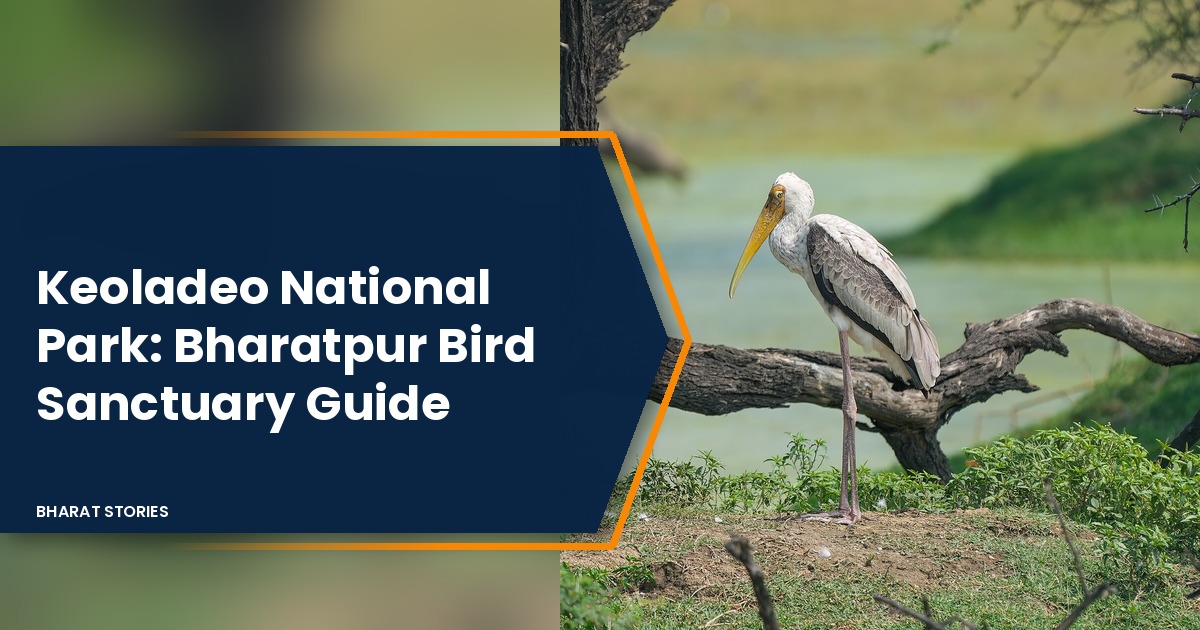
Keoladeo National Park: Bharatpur Bird Sanctuary Guide
Keoladeo National Park in Bharatpur, Rajasthan, is one of the world’s most famous bird reserves. Still widely called the Bharatpur Bird Sanctuary, this small, human made wetland draws painted storks, pelicans, cranes, ducks and eagles in huge numbers, and it is a UNESCO World Heritage Site and a Ramsar wetland. This guide covers where Keoladeo is, how a royal duck shooting ground became a protected park, the birds and animals you can see, the water crisis it faces, the best time to visit and how to get there.
Table of Contents
Where is Keoladeo National Park?
Keoladeo National Park lies about 2 km south east of Bharatpur city in eastern Rajasthan, roughly 55 km west of Agra.
The park covers only about 29 sq km, yet it is a mosaic of marshes, grasslands, woodland and scrub at the edge of the dry plains. Locally it is called Ghana, meaning a dense thicket. The name Keoladeo comes from an old Shiva temple, the Keoladeo temple, that stands inside the park. Its place close to Delhi, Agra and Jaipur makes it an easy addition to a Golden Triangle trip; see our guide to Rajasthan’s history, geography and tourism for more of the state.
| Fact | Detail |
|---|---|
| Location | Bharatpur, Rajasthan |
| Area | About 29 sq km (2,873 hectares) |
| Bird sanctuary | 1956 |
| Ramsar wetland | October 1981 |
| National park | 10 March 1982 |
| UNESCO World Heritage Site | 1985 |
| Bird species recorded | About 375 in official counts; some lists exceed 400 |
What is Keoladeo National Park famous for?
Keoladeo is famous for its extraordinary birdlife: large nesting colonies of storks, herons and cormorants, and thousands of migratory ducks, geese and cranes each winter.
A press note from the Ministry of Environment recorded 375 bird species in the park, of which 111 are migratory and 264 resident, as published by PIB. The park lies on the Central Asian flyway, so it works as both a wintering ground and a staging stop for birds travelling to other parts of India. It was also the last known wintering site in India of the western population of the critically endangered Siberian crane.
How did Keoladeo become a national park?
The wetland was created by the rulers of Bharatpur as a royal duck shooting reserve, then turned into a sanctuary through the efforts of ornithologist Salim Ali.
Low lying land near the city was flooded in the nineteenth century by damming seasonal floodwater, and the Maharajas of Bharatpur held famous duck shoots here for British officials and guests. After independence, Salim Ali pressed for protection, and the area was declared a bird sanctuary in 1956. It became a Ramsar site in 1981 and a national park in 1982. UNESCO listed it in 1985 as a wetland of global importance for migratory waterfowl, as described on the UNESCO World Heritage Centre page. When grazing was banned in 1982, protests followed and a police firing killed several villagers, a reminder of the conflicts that can come with conservation.
Which birds can you see at Keoladeo?
Common sightings include painted storks, Asian openbills, spoonbills, darters, cormorants, herons, sarus cranes, pelicans and many kinds of ducks and geese.
- Nesting waterbirds: painted stork, Asian openbill, black headed ibis, Eurasian spoonbill, darter, little and great cormorants, and several heron and egret species.
- Winter waterfowl: gadwall, northern shoveler, common teal, tufted duck, bar headed goose, knob billed duck and greater flamingo in some years.
- Cranes and pelicans: sarus crane all year; demoiselle crane, great white pelican and Dalmatian pelican in winter.
- Raptors: osprey, greater spotted eagle (which breeds here), imperial eagle, tawny eagle, Pallas’s fish eagle and crested serpent eagle.
- Land birds: warblers, babblers, bee eaters, bulbuls, buntings, painted francolin and Indian grey hornbill.
Several threatened species visit, including the spot billed pelican, lesser and greater adjutants and Baer’s pochard. For a wider look at India’s colourful species, read our list of the most beautiful birds in India.
Do Siberian cranes still come to Bharatpur?
No. The last Siberian cranes, a single pair, were seen in the winter of 2001 to 2002, and none have been recorded since.
As many as 41 Siberian cranes wintered here in 1984 to 1985, but their numbers fell steadily through the 1990s. Hunting along their long migration route through Afghanistan and Pakistan was a major cause. The central population that used Keoladeo is now considered extinct, though the species survives through an eastern population that winters in China. A joint project by India, Russia and international crane groups in the 1990s tried, without success, to rebuild the flock with captive bred birds.
Which animals live in Keoladeo besides birds?
The park has about 27 mammal species, including nilgai, chital, sambar, blackbuck, wild boar, jackals, jungle cats and fishing cats, plus pythons and turtles.
Rock pythons are often seen basking near their burrows on winter afternoons, a popular sight for visitors. The wetlands also hold several turtle species, monitor lizards, snakes such as cobras and Russell’s vipers, frogs, dozens of fish species and many butterflies. Nearly 400 kinds of flowering plants have been recorded, with kadam trees and babul scattered across the grasslands.
Where does Keoladeo get its water from?
Keoladeo depends on Ajan Bund, a reservoir south of the park that collects monsoon water from the Gambhir and Banganga rivers and releases it into the marshes.
The park has no large river of its own, and for most of the year only about 1,000 hectares stay wet. The Panchana dam built upstream on the Gambhir reduced the flow reaching Ajan Bund, and dry years have left the marshes short of water. Because of water shortages and grazing problems, the site was placed on the Ramsar Convention’s Montreux Record of threatened wetlands in 1990. Projects to bring water from the Govardhan drain and other sources have been planned to keep the wetland alive. The same story is seen at other Indian wetlands such as Harike in Punjab and Sultanpur in Haryana.
When is the best time to visit Keoladeo National Park?
The best time is from October to March, when migratory birds arrive; August to November is the peak season for nesting storks and herons.
December and January bring the largest flocks of ducks and geese, but mornings can be foggy and cold. By April the heat builds and most winter visitors have left. The monsoon refills the marshes and starts the breeding season, so the park looks very different from month to month. Arrive early, as birds are most active at dawn.
How do you explore the park?
Visitors explore on foot, by bicycle or by cycle rickshaw along the main paved road and side trails, since private motor vehicles are not allowed inside.
Many rickshaw pullers at Keoladeo are licensed and trained to spot and name birds, so hiring one doubles as a guided tour. Bicycles can be rented near the entrance. Carry binoculars, wear muted colours, keep noise low and stay on the paths. Entry fees and rickshaw rates are fixed by the forest department and revised from time to time, so check them at the gate or on the Rajasthan forest and tourism websites.
How do you reach Keoladeo National Park?
Bharatpur is well connected by road and rail; Agra is about 55 km away and Delhi and Jaipur are a few hours’ drive.
- By rail: Bharatpur Junction is on the Delhi to Mumbai main line, a short auto ride from the park gate.
- By air: Agra has the nearest airport; Jaipur and Delhi have more flights.
- By road: the park sits on the Agra to Jaipur highway, with regular buses and taxis.
While in Bharatpur, visit the Bharatpur fort, the Lohagarh fortress known for resisting British sieges.
Frequently Asked Questions
Is Keoladeo a Ramsar site?
Yes. Keoladeo was declared a Ramsar wetland of international importance in October 1981, one of India’s earliest Ramsar sites.
Who built Keoladeo National Park?
The wetland was developed by the former rulers of Bharatpur as a duck shooting reserve. Ornithologist Salim Ali later played a key role in getting it protected.
Is Keoladeo the same as Bharatpur Bird Sanctuary?
Yes. Bharatpur Bird Sanctuary is the older and still popular name for what became Keoladeo Ghana National Park in 1982.
How much time do you need at Keoladeo?
A full morning covers the main trail, but birdwatchers often spend two days to see different habitats at different times of day.