

Chittorgarh Fort: History, Sieges, Places to See and Timings
Chittorgarh Fort, also called Chittor Fort, is the hilltop citadel of Chittorgarh in southern Rajasthan and the old capital of the Mewar kingdom. It sits on a hill about 180 metres above the plains, covers roughly 700 acres inside a 13 km wall, and has been a UNESCO World Heritage Site since 2013 as part of the Hill Forts of Rajasthan. It is best known for the Vijay Stambh, the Kirti Stambh, Padmini’s Palace and the three great sieges of 1303, 1535 and 1568.
Table of Contents
Where Is Chittorgarh Fort?
The fort stands above Chittorgarh town in Chittorgarh district, in the south of Rajasthan, on the right bank of the Berach River. The modern town, sometimes called the Lower Town, grew on the plains below after 1568, when the rulers of Mewar moved their capital away from the hill.
Chittorgarh lies on National Highway 48, about 233 km from Ajmer. According to Rajasthan Tourism, the nearest airport is Maharana Pratap Airport at Dabok, Udaipur, about 90 km away, and the town has rail links to Udaipur, Jaipur, Ajmer, Ratlam, Delhi and Kota. The railway station is Chittaurgarh Junction.
Who Built Chittorgarh Fort?
The fort is traditionally credited to Chitrangada Mori, a ruler of the Mori (sometimes called Maurya) dynasty, in the 7th century CE. Its old name was Chitrakut, and one popular account says the fort takes its name from its builder. A local legend links the site to Bhima of the Mahabharata, and the Bhimlat Kund reservoir inside the walls carries his name.
The Guhila ruler Bappa Rawal is said to have taken the fort in 728 or 734 CE, and it remained the seat of the Guhila and later Sisodia rulers of Mewar for centuries. Much of what visitors see today, including the seven gates on the ascent and the Vijay Stambh, dates from the 15th century reign of Rana Kumbha, who ruled from 1433 to 1468.
Why Is Chittorgarh Fort Famous?
Chittorgarh is famous for its sheer size, its towers and temples, and the stories of Rajput resistance tied to three sieges. Incredible India describes it as the country’s largest fort complex, with 65 historic structures, including 4 palace complexes, 19 large temples, 20 large water bodies, memorials and a victory tower.
The fort is roughly the shape of a fish when seen from above. Beyond the outer wall the hill drops away steeply, which made attack very hard.
Is Chittorgarh Fort a UNESCO World Heritage Site?
Yes. The UNESCO listing for the Hill Forts of Rajasthan inscribed Chittorgarh in 2013 alongside Kumbhalgarh, Ranthambore, Gagron, Amber and Jaisalmer. UNESCO notes Chittorgarh as a former capital of the Sisodia clan, the target of three famous sieges, and a fort with an exceptional range of buildings from the 8th to the 16th centuries. It has been a Monument of National Importance since 1956.
What Happened in the Three Sieges of Chittorgarh?
The fort was attacked and taken three times: by Alauddin Khalji in 1303, by Bahadur Shah of Gujarat in 1535, and by the Mughal emperor Akbar in 1567 to 1568. Each siege is remembered in Rajasthan’s ballads for the saka, the last charge of the men, and the jauhar, the mass self immolation of women, though historians debate how much of each story is fact.
| Year | Attacker | Ruler of Chittor | What is recorded |
|---|---|---|---|
| 1303 | Alauddin Khalji, Sultan of Delhi | Ratnasimha (Ratan Singh) | Fort captured after an eight month siege; renamed Khizrabad after Khalji’s son Khizr Khan |
| 1535 | Bahadur Shah, Sultan of Gujarat | Rana Vikramaditya | Fort sacked; Rani Karnavati is said to have led a jauhar while the young Udai Singh II was taken to safety in Bundi |
| 1567 to 1568 | Akbar, Mughal emperor | Rana Udai Singh II (defence led by Jaimal and Patta) | Jaimal was killed on 22 February 1568; the fort fell the next day |
Akbar’s campaign was part of the wider Mughal push into Rajputana, a story told in our guide to the Mughal dynasty. The fort returned to Mewar under Jahangir after the 1615 treaty with Maharana Amar Singh; Rajasthan Tourism gives the year of return as 1616.
Was Rani Padmini a Real Person?
Historians are divided, and most modern scholars treat the Padmini story as legend rather than recorded history. Later poems say Alauddin attacked Chittor to win Ratan Singh’s queen, Padmini, and that she led a jauhar. Historian Kishori Saran Lal accepted that a jauhar took place after the 1303 conquest but called the Padmini legend unhistorical, while Banarsi Prasad Saksena argued that the jauhar account was a later invention, since Khalji’s courtier Amir Khusrow does not mention it. You can read the full legend and the debate in our post on Rani Padmini.
What Are the Main Places to See Inside Chittorgarh Fort?
The highlights are the Vijay Stambh, Kirti Stambh, Rana Kumbha Palace, Padmini’s Palace, the Meera and Kumbha Shyam temples, Kalika Mata Temple, the Gaumukh reservoir and the Fateh Prakash Palace museum. A circular road links the gates and monuments, so most visitors drive or take an autorickshaw between stops.
Vijay Stambh (Tower of Victory)
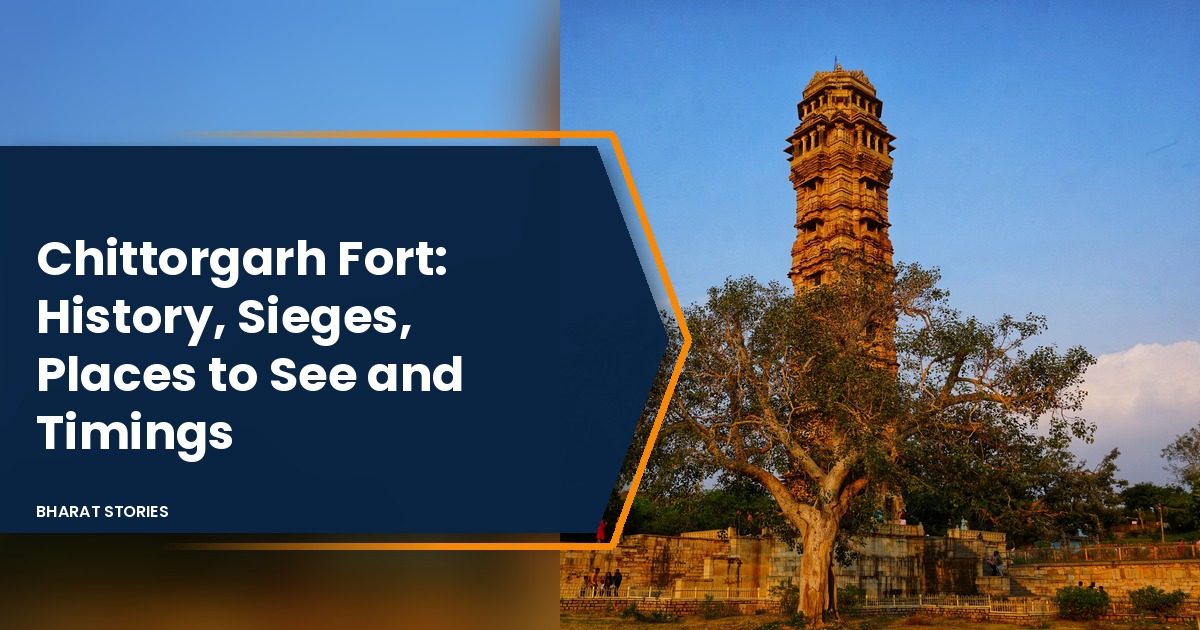
The nine storey Vijay Stambh is the symbol of Chittorgarh. Rana Kumbha built it to mark his victory over Mahmud Khalji, Sultan of Malwa, in 1440. Sources differ on the construction dates: Rajasthan Tourism gives 1440 to 1448, while other accounts give 1458 to 1468. The tower rises about 37 metres and is carved inside and out with Hindu gods and goddesses, with a narrow stairway of 157 steps. It is lit up in the evenings.
Kirti Stambh (Tower of Fame)
The older Kirti Stambh is a seven storey, roughly 22 metre Jain tower dedicated to Adinath, the first Tirthankara. It was built in the 12th century by a Jain merchant, usually dated to about 1179 to 1191 CE, and is decorated with figures of Digambar Jain monks. It stands near the Satbees Deori group of Jain temples.
Rana Kumbha Palace
This ruined palace near the Vijay Stambh is one of the largest structures on the hill. The original palace is older than Kumbha, who restored it. Folklore says Udai Singh II, the founder of Udaipur, was born here, and that his nurse Panna Dai saved him by putting her own son in his place when Banbir came to kill the young prince.
Padmini’s Palace
Padmini’s Palace is a white, three storey building in the southern part of the fort, set beside a pool. The present structure is a 19th century reconstruction of the original. Across from it is Kalika Mata Temple, which Rajasthan Tourism says began as an 8th century Sun temple and was rebuilt and dedicated to Goddess Kali by Rana Hammir in the 14th century.
Meera and Kumbha Shyam Temples
The Kumbha Shyam Temple was built in the 8th century, first for Varaha, and renovated by Rana Kumbha in the 15th century. Close by is the Meerabai Temple, linked with the saint poet Meera, who worshipped Krishna here. A small chhatri in front holds footprints associated with Guru Ravidas.
Gaumukh Reservoir and Fateh Prakash Palace
Gaumukh is a deep tank fed by a spring that flows from a rock shaped like a cow’s mouth. It was the fort’s main water source during sieges and is still treated as sacred. Fateh Prakash Palace, built by Maharana Fateh Singh, now houses a government museum with Bassi woodcraft, sculpture, weapons and paintings.
What Are Chittorgarh Fort Timings and Ticket Prices?
The fort is open from sunrise to sunset, according to Incredible India, and entry needs an Archaeological Survey of India ticket. Separate tickets apply for the museum and the evening show.
| What | Timings | Fee |
|---|---|---|
| Fort (ASI ticket) | Sunrise to sunset | Set by ASI; check the current rate when booking |
| Fateh Prakash Palace museum | 9:45 AM to 4:45 PM | ₹20 Indian adult, ₹10 child, ₹100 foreign adult, ₹50 foreign child |
| Light and sound show | 7 PM to 8 PM, Hindi and English | ₹150 adult, ₹75 child, ₹300 foreign national, plus 18% GST |
Travel listings in 2026 commonly quote about ₹40 for Indian visitors at the fort gate, with children under 15 free, but the Archaeological Survey of India published a draft revision of its ticketed monument schedule on 8 September 2026 that lists Chittorgarh Fort among Category A monuments. Fees can therefore change, so confirm the price on the official ASI booking page before you go. The evening light and sound show tells the fort’s story, from its rulers and battles to Alauddin Khalji’s attack, the sacrifice of Gora and Badal and the tale of Rani Padmini; show times can be confirmed on 01472 241238.
What Is the Best Time to Visit Chittorgarh Fort?
October to March is the most comfortable season, because the hilltop is exposed and summers are very hot. The monthly ranges published by Incredible India show daytime highs of about 30 to 34°C from November to February, against highs of 42.5°C in April and 44.5°C in May. Winter mornings can drop close to 3°C, so carry a light layer.
How Much Time Do You Need at Chittorgarh Fort?
Plan for at least half a day inside the fort, or a full day if you want the museum and the evening show. The monuments are spread over a long plateau, and walking between them in the sun is tiring. Start early at the Vijay Stambh and Rana Kumbha Palace, then head south to Padmini’s Palace and Kalika Mata Temple.
Practical Tips for Visitors
- Wear comfortable shoes; paths are uneven and the Vijay Stambh stairway is narrow.
- Carry water and a hat, as shade is limited on the plateau.
- Many temples inside the fort are active places of worship, so dress modestly and remove footwear where asked.
- Combine the visit with other Mewar sites; our Rajasthan travel and history guide lists more places in the state.
Quick Answers About Chittorgarh Fort
How many gates does Chittorgarh Fort have?
The ascent passes through seven gates, or pols, built in Rana Kumbha’s time: Padan Pol, Bhairon Pol, Hanuman Pol, Ganesh Pol, Jorla Pol, Laxman Pol and Ram Pol, the main gate. Suraj Pol is another notable gateway inside the fort.
How many temples are in Chittorgarh Fort?
Incredible India counts 19 large temples among the 65 historic structures. Rajasthan Tourism notes six Jain temples within the walls, the largest being the temple of Adinatha.