

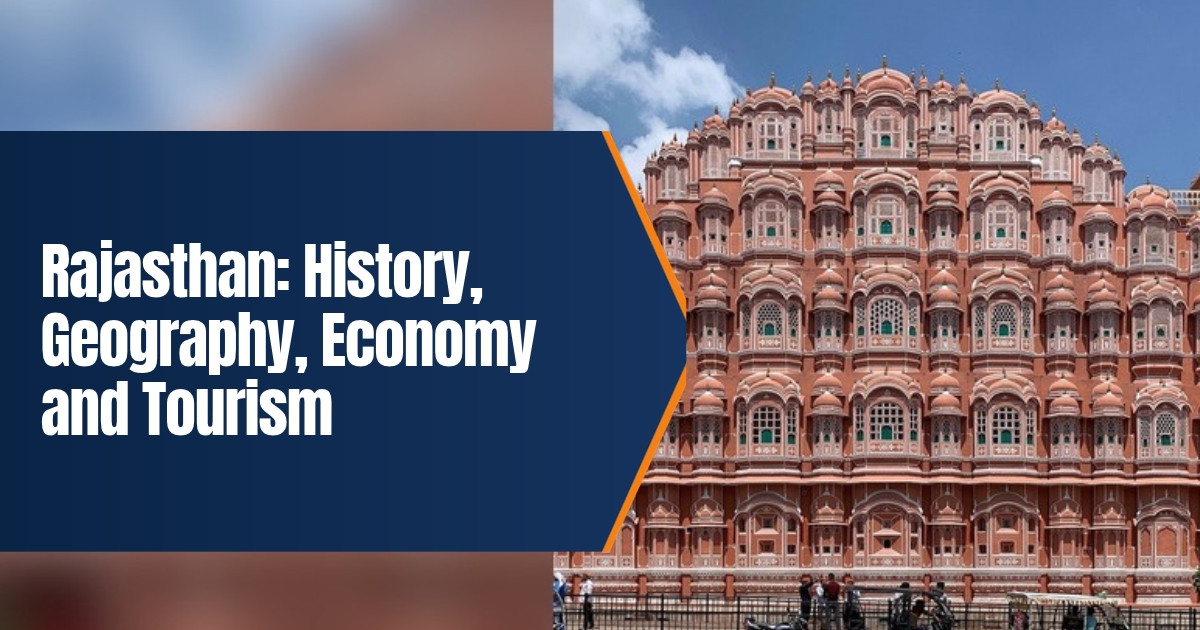

Rajasthan: History, Geography, Economy and Tourism
Rajasthan is India’s largest state by area, a land of desert dunes, old hill forts, painted towns and royal palaces in the country’s northwest. It shares a long border with Pakistan to the west and touches Punjab, Haryana, Uttar Pradesh, Madhya Pradesh and Gujarat. Its name means land of kings, a reminder of the many Rajput kingdoms that once ruled here. For its traditions in depth, see our guide to the culture of Rajasthan.
This updated profile covers Rajasthan’s history, geography, government, economy and tourism, with figures checked for November 2026. The old version of this page had several wrong dates and little hard information, so it has been rewritten in full.
Table of Contents
Rajasthan at a Glance
| Item | Detail |
|---|---|
| Capital | Jaipur |
| Area | 342,239 square km, the largest in India |
| Population | About 6.85 crore (Census 2011) |
| Districts | 41, grouped into 7 divisions |
| Chief Minister | Bhajan Lal Sharma (since December 2023) |
| Governor | Haribhau Kisanrao Bagade (since July 2024) |
| Legislature | 200 seat assembly; 25 Lok Sabha seats |
| Main languages | Hindi and Rajasthani dialects |
| Rajasthan Day | 30 March |
History of Rajasthan
Ancient times
People have lived in this region for many thousands of years. At Kalibangan in Hanumangarh district, archaeologists found a town of the Harappan or Indus civilisation, dating to roughly the third millennium BC, with fortified walls, a grid of streets and one of the oldest ploughed fields ever discovered. Later, parts of the region came under the Mauryan empire, and an edict of Emperor Ashoka was found at Bairat near Jaipur.
Rajput kingdoms
From around the seventh century, Rajput clans built kingdoms across the region, among them the Chauhans of Ajmer, the Sisodias of Mewar, the Rathores of Marwar and the Kachwahas of Amber. They are remembered for their forts and their fierce defence of them. Prithviraj Chauhan fought the invading armies of Muhammad of Ghor in the battles of Tarain in 1191 and 1192, and Maharana Pratap of Mewar faced the Mughal army at Haldighati in 1576.
Mughal and British periods
Many Rajput rulers later allied with the Mughal emperors and served as generals at court, while keeping control of their own lands. Raja Man Singh of Amber was among the most powerful. In the 19th century the kingdoms signed treaties with the British and became princely states within the Rajputana Agency. Jaipur’s planned city was founded in 1727 by Maharaja Sawai Jai Singh II, who also built the famous Jantar Mantar observatories; our profile of Maharaja Jai Singh II, the builder of Jaipur tells his story.
Formation of the state
After independence, the princely states were merged step by step between 1948 and 1956. The key merger that created Greater Rajasthan took place on 30 March 1949, now marked each year as Rajasthan Day. The process ended on 1 November 1956, when Ajmer and parts of nearby areas were added under the States Reorganisation Act.
Geography
The Thar Desert
About two thirds of the state lies west of the Aravalli hills, much of it in the Thar Desert. Districts such as Jaisalmer, Barmer and Bikaner have sand dunes, rocky plains and very low rainfall. Summer temperatures can pass 48 degrees Celsius, while winter nights can fall close to freezing.
The Aravalli range
The Aravallis, among the oldest mountain ranges in the world, run from southwest to northeast across the state. Their highest point is Guru Shikhar near Mount Abu, at about 1,722 metres. The hills act as a barrier against the desert’s spread and feed several rivers. Our guide to Mount Abu covers the area around the peak.
Rivers and water
The Chambal is the state’s main perennial river and forms part of the border with Madhya Pradesh. The Luni flows towards the Rann of Kutch and is salty in its lower reaches. The Indira Gandhi Canal, one of the longest in India, carries water from Punjab’s rivers into the northwestern desert and has turned large areas into farmland.
Administrative divisions
Rajasthan had 33 districts until 2023, when the previous government created many new ones. On 28 December 2024 the current state cabinet scrapped 9 of those districts and 3 divisions, leaving 41 districts in 7 divisions: Ajmer, Bharatpur, Bikaner, Jaipur, Jodhpur, Kota and Udaipur.
Wildlife and environment
Despite its dry climate, Rajasthan has rich wildlife. Ranthambore and Sariska are tiger reserves, Desert National Park near Jaisalmer protects the great Indian bustard and other desert species, and the Bishnoi community of western Rajasthan has protected blackbuck and chinkara for centuries on religious grounds. Water scarcity is the state’s biggest environmental challenge. Traditional systems such as johads, taankas and stepwells are being revived alongside modern canal and drip irrigation projects to make every drop count.
Government and Politics
The state has a 200 member legislative assembly and sends 25 members to the Lok Sabha and 10 to the Rajya Sabha. The Bharatiya Janata Party won the December 2023 assembly election, and Bhajan Lal Sharma became Chief Minister on 15 December 2023, with Diya Kumari and Prem Chand Bairwa as Deputy Chief Ministers. Haribhau Kisanrao Bagade became Governor on 27 July 2024.
Economy
Mining and minerals
Rajasthan is one of India’s richest states in minerals. It produces almost all of the country’s lead and zinc, much of it from mines in Bhilwara and Udaipur districts, and is a major source of marble, sandstone, limestone and gypsum. Makrana marble was used in the Taj Mahal.
Energy
Oil fields in Barmer district supply a large share of India’s onshore crude oil. The state is also a leader in solar power, thanks to strong sunshine and open land. Bhadla Solar Park in Jodhpur district, with a capacity of about 2,245 megawatts, is one of the largest solar parks in the world, and wind farms add more capacity in the west.
Agriculture and crafts
Farming depends heavily on the monsoon and on canals. Rajasthan is a leading producer of bajra, mustard and other oilseeds, as well as guar and spices such as coriander and cumin. Livestock, including camels, goats and cattle, is vital in desert districts. Handicrafts such as block printing, blue pottery, gems and jewellery and textiles support many families and exports.
Tourism
Tourism is one of the largest service industries, bringing visitors from India and abroad to palaces, forts, heritage hotels and fairs throughout the year.
Top Places to Visit
- Jaipur: the Pink City, home to Amber Fort, Hawa Mahal and the Jantar Mantar, a UNESCO World Heritage Site since 2010; the walled city itself was added in 2019.
- Udaipur: the city of lakes, with the City Palace and Lake Pichola.
- Jaisalmer: a golden sandstone fort that is still lived in, and dunes nearby at Sam.
- Jodhpur: the blue city below the towering Mehrangarh Fort.
- Hill forts: Chittorgarh, Kumbhalgarh, Ranthambore, Gagron, Amber and Jaisalmer forts together form a UNESCO site listed in 2013.
- Keoladeo National Park: the Bharatpur bird sanctuary, a UNESCO site since 1985 and a winter home for migratory birds.
- Ranthambore National Park: one of the best places in India to see wild tigers.
- Mount Abu: the state’s only hill station, with the Dilwara Jain temples.
- Pushkar: a holy town known for its lake and its yearly camel fair.
The best time to visit is October to March, when days are pleasant and nights are cool.
People and Culture
Rajasthan is known for colourful turbans and lehenga, folk music of the Manganiyar and Langa communities, puppet shows, and dances such as Ghoomar and Kalbelia, the latter recognised by UNESCO as intangible heritage. Festivals include Teej, Gangaur, the Desert Festival in Jaisalmer and the Pushkar fair. Food reflects the dry climate, with dishes such as dal baati churma, ker sangri and gatte ki sabzi.
Frequently Asked Questions
How many districts does Rajasthan have in 2026?
41 districts in 7 divisions, following the state cabinet decision of 28 December 2024.
Who is the Chief Minister of Rajasthan?
Bhajan Lal Sharma, in office since 15 December 2023.
What is the highest point in Rajasthan?
Guru Shikhar near Mount Abu, at about 1,722 metres, the highest point of the Aravalli range.
Why is Rajasthan Day celebrated on 30 March?
It marks the 1949 merger of princely states that created Greater Rajasthan, a key step towards the present state.
When is the best time to visit Rajasthan?
October to March, when the weather is mild.
Jaipur, Agra and Delhi together form the popular Golden Triangle tourist circuit.
The Palace on Wheels luxury train has carried visitors around the state’s heritage sites since 1982.
Stepwells such as Chand Baori at Abhaneri show how people stored water in dry country.
Rajasthan’s state animal is the camel and its state bird is the great Indian bustard, now critically endangered.
Rajasthan is linked by air through Jaipur, Udaipur, Jodhpur and other airports, and by a dense rail network that reaches even desert towns such as Jaisalmer.