

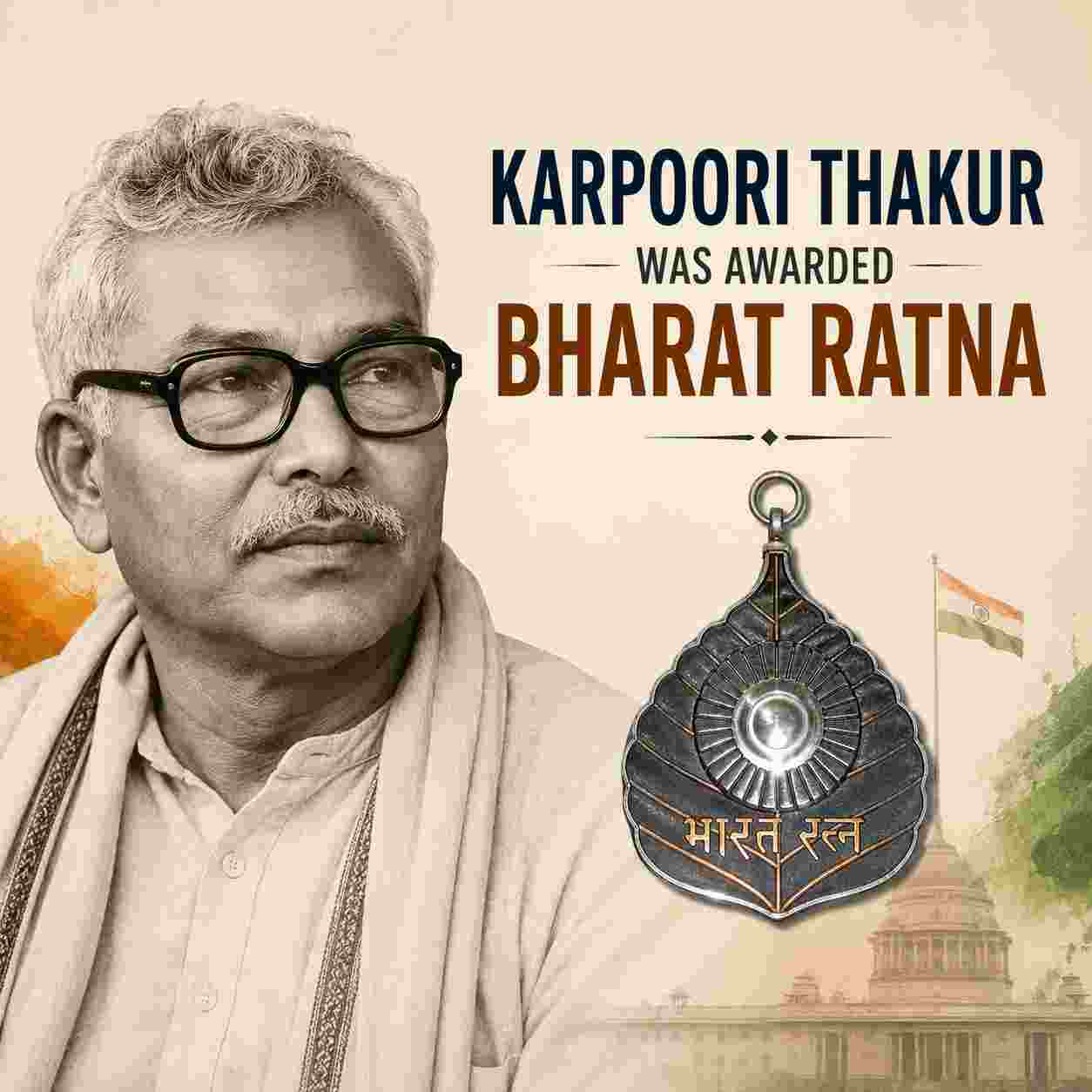
Why Karpoori Thakur Was Awarded Bharat Ratna
On January 23, 2024, the President of India announced that Karpoori Thakur will receive the Bharat Ratna posthumously. In Bihar, people already knew exactly who he was. Outside Bihar, many scrambled to find out. That gap itself tells you something — here was a man whose influence ran so deep in one state that the rest of the country somehow hadn’t fully caught up with him.
This piece is for anyone who wants to understand who Karpoori Thakur really was, why his Bharat Ratna felt so significant, and what his life actually stood for beyond the headlines.
Table of Contents
The Biography of a Man Who Started With Nothing
Karpoori Thakur was born on 24 January 1924 in Pitaunjhia village, Samastipur district, Bihar — a place now renamed Karpoori Gram in his memory. His father was a barber. The family was poor. He belonged to the Nai community, classified among the extremely backward classes.
Reading his biography, the first thing that strikes you is that none of those circumstances slowed him down even slightly. When the Quit India Movement came in 1942, he left college and joined it. He was arrested. He spent 26 months behind bars. When India finally became free, he didn’t look for rewards or positions — he went back home and taught at a village school.
That choice says more about him than most of his political achievements do. A man who’d risked his freedom for his country’s independence, choosing to teach village children rather than cash in on his sacrifices. That kind of person is genuinely rare.
The biography of Karpoori Thakur is essentially a biography of quiet, stubborn integrity — played out over several decades of public life.
How a Village Schoolteacher Became a Socialist Politician
His entry into politics came in 1952 when he won a Bihar Vidhan Sabha seat from Tajpur constituency, standing as a Socialist Politician. He was 28 years old. From that election onward, he barely left the legislature — he remained an MLA almost without interruption until he passed away in 1988.
As a socialist politician, his thinking was shaped heavily by Dr Ram Manohar Lohia. Lohia believed that India’s democracy couldn’t mean much without confronting caste directly — that economic equality and social equality had to move together. Karpoori Thakur didn’t just agree with that intellectually. He spent his career trying to make it real.
He became Bihar’s Deputy Chief Minister and then Education Minister. In that role, he did something quietly significant — he removed English as a compulsory subject in matriculation exams. Critics argued this hurt students. His reasoning was different: why should a child from a village in Samastipur fail an exam because nobody in their town ever taught them English? It was a very Lohia-ist position, and very much his own.
His first stint as Chief Minister came in December 1970. Short — just about six months — but he used it to push through total prohibition of alcohol in Bihar. Controversial, yes. Popular among the poor, absolutely.
The Reservation Formula That Defined His Legacy as a Bihar Leader
His second term as Chief Minister, from June 1977 to April 1979, is what most people remember him for. And the centrepiece of that period was the reservation model he introduced in 1978, built on the recommendations of the Mungeri Lal Commission.
The formula broke down like this:
- 12% for Other Backward Classes
- 8% for Most Backward Classes
- 3% for women
- 3% for economically backward sections within upper castes
On paper it looks like a numbers exercise. In practice, it was a political earthquake. What Karpoori Thakur as Bihar leader understood — and what many of his contemporaries did not — was that “backward classes” wasn’t one homogeneous group. The dominant backward castes were already capturing most of the benefits meant for OBCs. The truly marginalised, the ‘ati-pichhda’, the most backward communities, were being left behind within a system supposedly designed to help them.
His formula tried to fix that. The Most Backward Classes got their own separate category for the first time. It was far ahead of its time. It also, predictably, drew fierce backlash from upper caste groups. And the internal politics of the Janata Party turned on him. He resigned before completing his term.
The policy outlasted him. Many historians regard his reservation framework as a direct precursor to the Mandal Commission recommendations that reshaped national politics a decade later.
Jan Nayak — A Title Nobody Officially Gave Him
Jan Nayak. People’s leader. Nobody handed him that name at a ceremony. It just stuck, because of how he lived and what he stood for.
Things about him that were genuinely uncommon for someone in his position:
- He held power twice as Chief Minister and left office without having built personal wealth — in an era when that was far from standard
- He mentored the next generation across caste lines — Lalu Prasad Yadav, Nitish Kumar, Ram Vilas Paswan, Devendra Prasad Yadav, all different communities, all shaped by his influence
- He declared Urdu the second official language of Bihar, a decision rooted in inclusion, not politics
- He stood firmly against dynastic politics, at a time when it was already becoming entrenched
- He was a key participant in the Sampoorna Kranti movement with Jayaprakash Narayan, which challenged the Emergency and permanently altered India’s political future
He also had a quality that’s genuinely hard to manufacture — people believed he meant what he said. You don’t get called Jan Nayak through press releases. You get it through years of showing up, being consistent, and never losing sight of who you started out as.
The Bharat Ratna: 36 Years After His Death
Karpoori Thakur died on 17 February 1988. He was 64 years old. The Bharat Ratna came on 26 January 2024 — Republic Day — 36 years later. Announced three days earlier by President Draupadi Murmu, he became the 49th recipient of India’s highest civilian honour, and the 15th to receive it posthumously. The timing of the award in his birth centenary year wasn’t lost on anyone.
Prime Minister Narendra Modi described him as a stalwart of social justice and a champion of those who had been left behind. What was notable was that appreciation for the award cut across party lines fairly cleanly. Even people who had political disagreements with his decisions acknowledged that Karpoori Thakur the man had always been above reproach.
What He Left Behind
Governments in Bihar have named medical colleges, hospitals, train services, museums, and stadiums after him. A commemorative postage stamp was released on his birth centenary. His legislative speeches have been compiled and published.
But honestly, the real monument to Karpoori Thakur isn’t any of those things. It’s the fact that an entire generation of Bihar’s leaders — people who went on to hold national office — trace a direct line back to him. And it’s the fact that communities that had no political voice before his time gradually found one, in part because he spent his career insisting they deserved it.
Frequently Asked Questions
-
When exactly did Karpoori Thakur receive the Bharat Ratna?
President Draupadi Murmu announced the award on 23 January 2024, and it was formally conferred on 26 January 2024, Republic Day. The honour came posthumously, 36 years after his passing in February 1988.
-
Why is he called Jan Nayak?
Jan Nayak translates to ‘people’s leader’ in Hindi. It wasn’t an official designation — it was a name ordinary people in Bihar gave him over time, based on how he lived and what he consistently stood for.
-
How many times did Karpoori Thakur serve as Chief Minister of Bihar?
Twice. His first term lasted from December 1970 to June 1971, and his second ran from June 1977 to April 1979. He couldn’t complete his second term — internal conflict within the Janata Party over his reservation policy ultimately forced his resignation.
-
What exactly was his reservation formula?
In 1978, working from the Mungeri Lal Commission report, he introduced a 26% reservation in state government jobs — split between Other Backward Classes, Most Backward Classes, women, and economically weaker upper caste sections.
-
Which later leaders did Karpoori Thakur mentor?
Some of Bihar’s most consequential political figures acknowledge him as a major influence — Lalu Prasad Yadav, Nitish Kumar, Ram Vilas Paswan, and Devendra Prasad Yadav among them.