

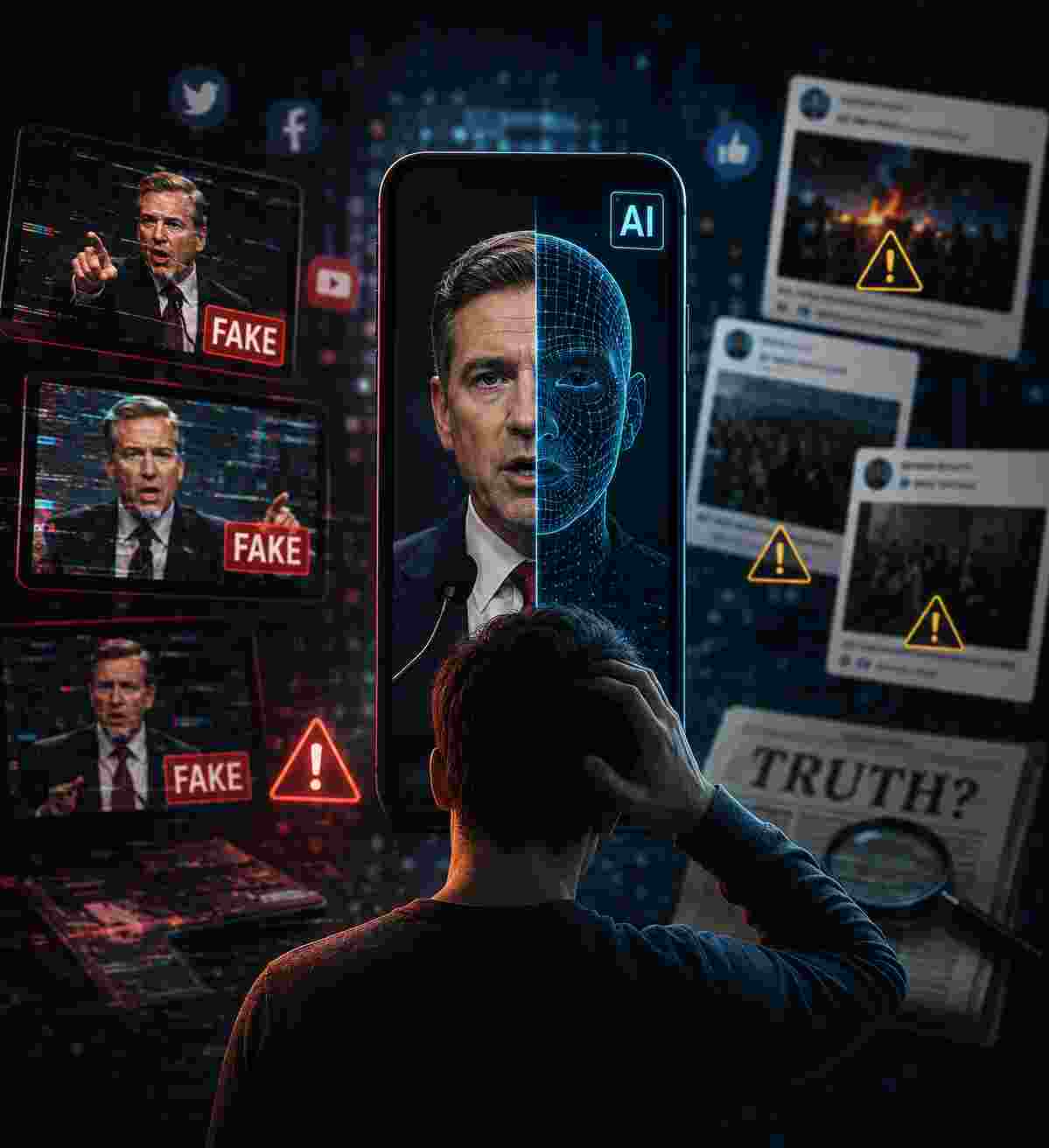
The Growing Problem of AI-Generated Misinformation
A few years ago, spotting fake content online was uncomfortable but mostly manageable. A blurry photo, a poorly worded article, a suspicious headline — the signs were usually there if someone looked carefully. That’s changed. AI misinformation doesn’t announce itself with obvious errors. It arrives polished, confident, and often completely indistinguishable from the real thing.
BharatStories examines why this problem is growing faster than most people realise and what can actually be done about it at both an individual and societal level.
Table of Contents
Why AI Misinformation Is Different From What Came Before
Misinformation isn’t new. People have been spreading false stories through pamphlets, newspapers, and social media for as long as mass communication has existed. What AI has changed isn’t the existence of fake information — it’s the cost, speed, and scale at which it can now be produced.
Before AI tools became widely available, creating convincing fake content required genuine skill. A forged photo needed an experienced editor. A fabricated article needed someone who could write credibly. A fake video required a studio. None of that is true anymore.
Today, AI misinformation can be produced in seconds by anyone with an internet connection. A convincing fake news article, a realistic fabricated image of a public figure, a voice clone — these are now within reach of people with no technical background and almost no budget. That accessibility is what makes the current situation genuinely different.
The Rise of Deepfake Content
Deepfake content sits at the more alarming end of the AI misinformation problem. A deepfake is a video, audio clip, or image where AI has been used to replace or alter someone’s likeness — making a real person appear to say or do something they never did.
The technology started as a research curiosity, then became a low-budget film tool, and has since spread into political manipulation, financial fraud, and non-consensual image creation. Deepfake content of political leaders giving speeches they never gave has already circulated during election periods. Audio deepfakes impersonating executives have been used to authorise fraudulent wire transfers.
What makes deepfake content particularly dangerous isn’t just that it can fool people. It’s that even when people know a deepfake exists, it introduces doubt about everything. If one video of a politician can be faked convincingly, it becomes harder to trust any video, including authentic ones.
Fake News at Scale: How AI Has Changed the Game
Fake news has existed for decades, but AI has changed both the volume and the convincingness of it. Before AI writing tools, producing large quantities of fake news required teams writing articles manually. Now a single person can generate hundreds of convincing-looking fake news articles in a day, each styled to match the tone of credible news outlets.
Volume is itself a tactic. When false claims spread across fifty different articles on different websites, each with slightly different wording, fact-checkers struggle to keep up. By the time corrections appear, the original fake news has already reached the people it was designed to mislead.
AI-generated fake news also targets emotional responses specifically — crafted to trigger outrage, fear, or tribal loyalty, making people less likely to verify before sharing. Emotional manipulation combined with AI-produced volume is more effective than either would be alone.
What Media Literacy Means in an AI Era
Media literacy — the ability to critically assess information sources, identify bias, and verify claims — has always mattered. But the skills that made it up before AI are no longer enough on their own.
Checking whether a photo looks edited used to be a reasonable first step. Now AI-generated images can look entirely natural under close inspection. Looking for spelling errors used to be a quick filter. Now AI-generated text reads as fluently as human writing.
Media literacy in the current environment needs to include:
- Checking the original source of a claim, not just the article reporting it
- Verifying images through reverse image search or AI detection platforms
- Being cautious with content that triggers strong emotions, since that’s often by design
- Cross-referencing breaking news with established outlets before sharing
- Understanding that a well-written article is no longer automatic evidence that a human wrote it
Media literacy isn’t about becoming a professional fact-checker. It’s about slowing down between seeing something and sharing it — that pause is where most preventable misinformation gets stopped.
AI Ethics and Who Bears Responsibility
The AI misinformation problem raises difficult questions about responsibility that haven’t been cleanly answered yet. When AI tools are used to create fake content that causes genuine harm — to a person’s reputation, to public health, to election integrity — who is responsible? The person who used the tool? The company that built it? The platform that distributed it?
AI ethics as a field is grappling with these questions. The EU has introduced regulations requiring that certain AI-generated content be labelled as such. The US has seen voluntary commitments from technology companies and patchwork state legislation. India is still working through its regulatory approach, though the harm is already visible.
The honest answer on AI ethics is that no single actor can solve this. Technology companies bear some responsibility for how their tools are misused. Platforms hosting content have obligations around amplification. Governments have a role in setting clear rules. And individuals bear responsibility for what they share and how carefully they verify it.
What Platforms and Governments Are Doing About It
Progress is happening, though slowly relative to the pace of the problem. Several major social media platforms have introduced AI content labelling policies requiring creators to disclose when content is substantially AI-generated. Search engines are working to surface more authoritative sources.
Government action includes the EU’s AI Act with provisions around deepfake content and transparency requirements. Some countries have introduced specific legislation targeting non-consensual deepfake content.
What Individuals Can Actually Do
It can feel powerless to be an individual trying to make good decisions inside an information environment this complicated. But individual choices do add up, and they shape how much AI misinformation spreads.
A few habits that genuinely help:
- Pause before sharing anything emotionally charged, especially content that confirms a strong existing belief
- Check whether a claim appears on established fact-checking sites before passing it on
- Look at who is behind a website or account before treating it as credible
- Be openly sceptical of any video that seems perfectly timed to confirm a political narrative
- Talk to others about deepfake content and AI misinformation — awareness in those around you matters just as much as your own
A Balanced Closing Thought
The problem of AI misinformation isn’t going away, and it’s reasonable to feel genuinely concerned about what it means for how societies form shared understandings of reality. At the same time, the response — better media literacy, stronger AI ethics frameworks, clearer regulation, and sharper detection tools — is also developing.
What seems clear is that passive trust in anything seen online is no longer a safe default. The new baseline has to be a habit of verification, even for content that feels entirely credible.
Frequently Asked Questions
-
What is AI misinformation and why is it harder to spot than traditional fake news?
AI misinformation is false or misleading content created or assisted by AI tools. It’s harder to spot because it can produce text, images, audio, and video that look and sound entirely credible. The obvious tells that used to flag fake content — poor writing, unnatural images — are no longer reliable filters.
-
How does deepfake content differ from other types of AI-generated misinformation?
Deepfake content specifically involves altering or fabricating the likeness of a real person — making them appear to say or do something they didn’t. It’s particularly concerning because it can damage individual reputations, influence elections, and undermine trust in authentic video evidence more broadly.
-
What does media literacy look like when AI can produce convincing text and images?
Media literacy now means verifying at the source level rather than the surface level. Checking who originally reported a claim, using image verification tools, cross-referencing across multiple credible sources, and being careful with emotionally charged content are all part of what media literacy requires today.
-
What are companies doing about AI ethics and the spread of AI-generated fake content?
Some platforms are introducing labelling requirements for AI-generated content. AI ethics policies at technology companies include provisions around misuse detection. Legislation in the EU is beginning to create legal accountability. However, enforcement and detection remain behind the pace of content creation.
-
Can individuals really make a difference against the scale of AI-generated fake news?
Yes. Not sharing unverified content reduces its reach. Flagging false information on platforms helps with removal. Talking about AI misinformation with family and friends builds awareness. Individual choices don’t eliminate the problem, but they affect how far fake news spreads and how much influence it carries.