

All About Ubiquitous Computing
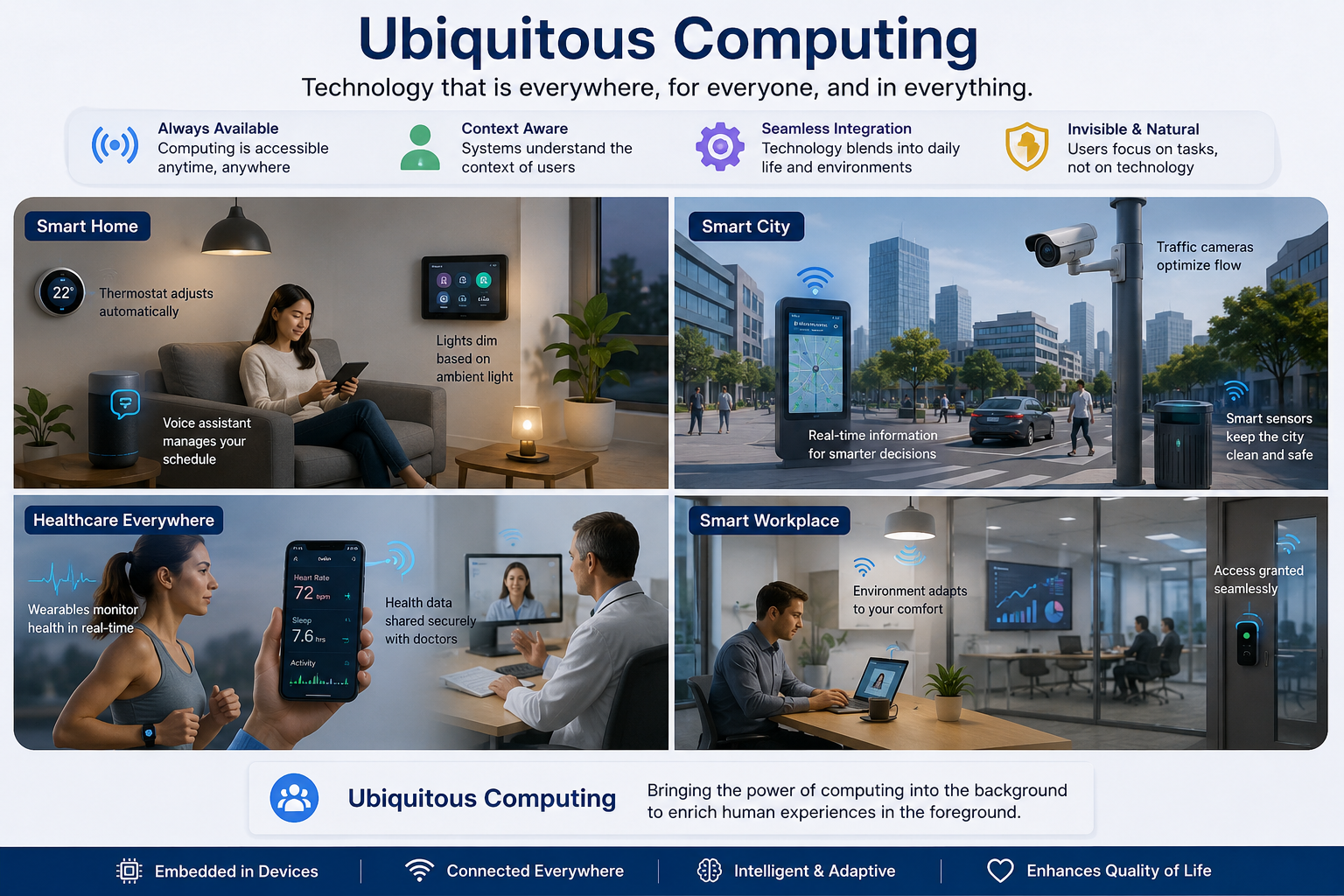
Though technology would be technology without technology itself, technology comes in so many shapes, indeed, technology without technology. These days, it’s ubiquitous; computing can be seen at home, at work, in motor vehicles, in healthcare facilities, and in other public areas. With this change, the era of ubiquitous computing has begun, meaning we are submerged in technology without realizing it, helping us in our daily lives. Computing has changed and is celebrated in all of our lives, such as Smart Home systems and Wearable devices.
Systems with connections can receive information, disseminate it, and act automatically. Consequently, users’ time spent on technology management decreases, and their activity increases. This article will clarify the concept of ubiquitous computing, how it functions, its pros and cons, emerging applications, the challenges involved, and why it is an important future trend in computing.
Table of Contents
What Is Ubiquitous Computing
Ubiquitous computing is a computing paradigm in which computing devices and other technological components are embedded in our surroundings and everyday objects. People use more than one computer system to solve problems jointly. It was coined by computer scientist Mark Weiser, who coined the term ” ubiquitous computing”. He believed that in the future, computers would be ubiquitous and easily integrated into everyday life.
For example, smart thermostats will automatically control the home’s temperature, and wearable devices will give you all-day health readings. Pervasive computing technology is another frequently used term, especially to define the pervasiveness of computing in daily life.
How Ubiquitous Computing Works
There are actually numerous technologies that assist the development of ubiquitous computing.
Sensors
Sensors collect data from the environment, such as:
- Temperature
- Movement
- Location
- Light levels
- Heart rate
Data is gathered and sent to any connected systems for analysis.
Connectivity
Devices are connected using mobile networks, Bluetooth, and Wi-Fi. These connections enable information to flow between gadgets promptly.
Data Processing
Software processes the data it receives and then reacts to it. A smart thermostat, for instance, can monitor and adjust the temperature up and down.
Smart Devices
Ubiquitous computing manifests in many forms of smart devices.
Examples include:
- Smartwatches
- Smart speakers
- Smart TVs
- Security cameras
- Smart lighting systems
All these devices provide a seamless, all-encompassing experience.
Ubiquitous Computing and the Internet of Things
Ubiquitous computing and IoT are two distinct concepts, where one is related to the other. The Internet of Things (IoT) encompasses many applications that facilitate ubiquitous computing, enabling devices to communicate information and perform actions without human intervention.
Examples include:
- Smart refrigerators
- Smart doorbells
- Health monitoring devices
- Connected vehicles
Some popular examples of Ubiquitous Computing are:
Smart Homes
One of the most typical and well-known examples of ubiquitous computing is smart homes.
Features often include:
- Smart lighting
- Smart thermostats
- Voice assistants
- Connected security systems
- Smart locks
These technologies help to save manpower and make it more convenient.
Wearable Technology
Health and fitness data is gathered day to day by wearable gadgets.
Users can monitor:
- Daily steps
- Sleep quality
- Heart rate
- Exercise activity
Spending more time connected to smart device technology helps individuals stay aware of their health.
Smart Transportation
More and more, connected technologies are employed in transportation services.
Examples include:
- GPS navigation
- Traffic monitoring
- Electronic toll collection
- Connected vehicle features
These help you make travel more efficient.
Retail Services
Connected systems can be used in retail in the following ways:
- Contactless payments
- Inventory tracking
- Automated checkout
- Personalized recommendations
A good illustration of the ubiquity of computing technology in business. Ubiquitous Computing offers several benefits. There are some advantages to Ubiquitous Computing.
Convenience
Having ubiquitous computing gives you conveniences. Routine tasks can be performed in an automated system without ongoing user input.
Better Efficiency
Connected systems are information processes that are fast and instantaneously responsive. Businesses use numerous capabilities in everyday use.
Real-Time Information
Users will be able to get instant updates on:
- Traffic conditions
- Weather alerts
- Security notifications
- Health information
This helps to improve decision-making
Personalized Experiences Many systems have learned users’ preferences over time. Smart devices can configure settings and provide recommendations in the form of routines tailored to the specific user. Services are customized to enable appropriate users to save time and obtain information pertinent to their needs, at home or at the workplace.
Applications Across Industries
Healthcare
Healthcare organizations are connected using technologies for:
- Remote patient monitoring
- Wearable health devices
- Connected medical equipment
- Emergency response systems
These tools enable healthcare professionals to access important information immediately.
Education
Technology can aid in learning at school in the following ways:
- Digital classrooms
- Online learning platforms
- Collaboration tools
- Smart attendance systems
Students and teachers can retrieve resources from various locations.
Manufacturing
Manufacturers can use connected systems for:
- Equipment monitoring
- Production tracking
- Maintenance planning
- Quality control
Numerous of these activities are big on Internet of Things uses.
Agriculture
Connected technologies that enable farmers to monitor crops and the environment.
Applications include:
- Soil monitoring
- Irrigation management
- Weather tracking
- Livestock monitoring
From the beginning, Ubiquitous Computing has faced certain challenges: Though successful, ubiquitous computing also has several problems.
Privacy Concerns
Significant information can be gathered on the connected devices. Such users may be concerned about privacy and security, especially the storage and sharing of the information.
Security Risks
The more devices that are connected, the higher the potential for a cybersecurity issue, such as gaining unauthorized access or data breaches.
Reliability Issues
Stable networks and software are the initial conditions for Ubiquitous computing to exist. Services and communications can be halted due to technical difficulties.
Implementation Costs
To deploy pervasive computing technology, investment in deployment hardware, software, maintenance, and security is often needed.
Before taking global adoption into the wash, organizations need to consider its implications in terms of costs and benefits.
The Role of Artificial Intelligence
Artificial Intelligence is integral to the prevalence of computers.
AI helps devices:
- Analyze information
- Recognize patterns
- Predict user needs
- Support automated decisions
The smart assistant can learn the user’s habits and remind the user at an appropriate time to take appropriate actions. Smart device technology is poised to become even more responsive and useful as AI continues to evolve. AI and connected systems create many of the modern-day digital services.
Future Computing Trends
The experts believe that greater connectivity and automation will be part of the future computing trends. Computers are increasingly getting involved in daily life.
Expected developments include:
- More connected homes
- Advanced wearable devices
- Faster communication networks
- Smarter transportation systems
- Expanded healthcare monitoring
The upcoming Computing Trends suggest that computing will be even more attainable and more commonplace in life. Concurrently, privacy and security issues will need to be addressed to build user trust and promote greater uptake.
Conclusion
With ubiquitous computing, people need not interact with technology as they have in the past, since computing becomes available practically everywhere. It is possible to combine pervasive computing technologies to gather, communicate, and relay information to other systems with very low user intervention.
Both the rise of Internet of Things applications and developments in smart device technology have enabled the rapid proliferation of these devices in the Healthcare, Education, Transportation, Manufacturing, Agriculture, and Retail sectors.
Whilst organizations and humanity are further committed to connected systems, as the trajectory of computerization shows, it will be more ingrained in everyday life in the future.
Although privacy and security concerns are still a high priority, ubiquitous computing will undoubtedly have a significant impact on people’s lives and work in the near future.
FAQs
What do you think ubiquitous computing is?
Ubiquitous computing is a computing paradigm in which technology is embedded in everyday environments, and built-in structures in things provide services without the user’s intervention.
How is ubiquitous computing related to IoT?
IoT is a way to connect things to the internet, and ubiquitous computing focuses on providing computing everywhere. There are a number of Internet of Things applications that can help achieve this.
What are some examples of ubiquitous computing?
These may be smart homes, fitness trackers, smart cars, voice-activated systems, or smart health products, to give just a few examples.
How can ubiquitous computing be important?
One of the most important future computing trends is the advancement of convenience, automation, efficiency, and real-time data availability.