

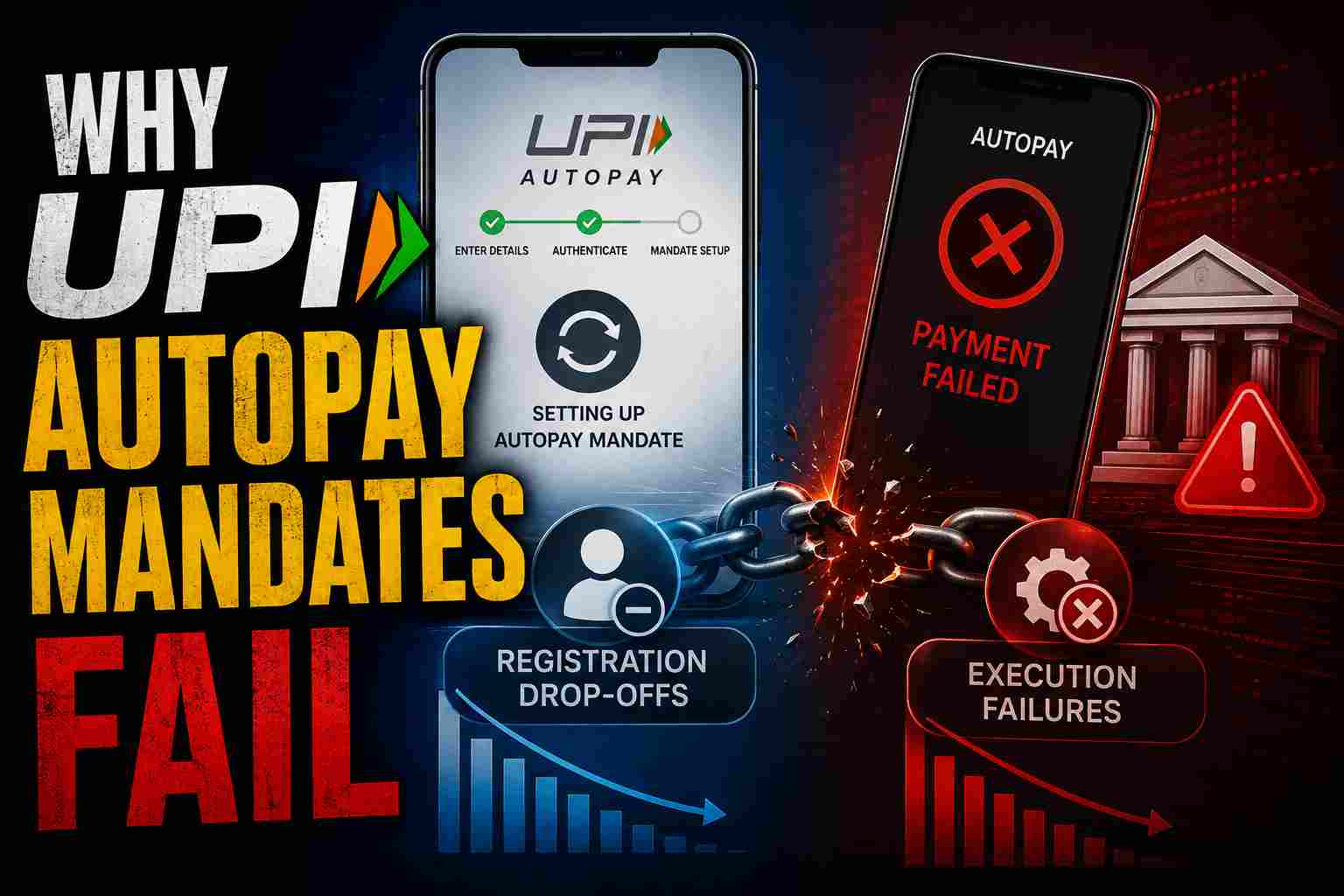
Why UPI Autopay Mandates Fail: Registration Drop-Offs, Execution Failures And How To Fix Both
The numbers tell an uncomfortable story. Over 20 million UPI Autopay mandates are revoked every single month in India, primarily because borrowers do not have enough in their accounts when the debit hits. Meanwhile, new registrations nearly doubled year on year, crossing 50 million in July 2025 alone. The infrastructure is scaling. The failure rate is scaling with it.
For NBFCs and fintech lenders building collections around UPI Autopay, the question is no longer whether to use it. It is why so many mandates that register successfully never produce a successful collection.
Table of Contents
Where Registration Drop-Offs Actually Happen
Registration looks simple from the product team’s side. The borrower taps approve, enters their UPI PIN, and the mandate is live. In practice, that sequence breaks more often than most lenders measure.
The first drop-off is the UPI app redirect. When your lending app hands the borrower to their UPI application for PIN authentication, a meaningful percentage never complete the step. They get confused by the app switch, their UPI app is outdated, or the session times out. Lenders who have tracked UPI Autopay failures at registration consistently find the redirect is where the largest share of incomplete mandates sits.
The second is PIN entry failure. The borrower reaches the right screen, enters an incorrect PIN, and either locks themselves out or abandons the attempt.
The third is a successful PIN entry that still results in a declined mandate. The borrower did everything right, but their bank rejected registration for reasons buried in backend logs. Mobile number not linked in the bank’s CBS. A dormant account flag. An IFSC mismatch following a branch merger. These are not borrower errors. They are data hygiene failures between the lending platform, the UPI rail, and the borrower’s bank.
None of these show up as a failed collection. They show up as a mandate that was never created, which means the borrower enters repayment with no automated debit in place.
Why Execution Fails Even When the Mandate Is Live
A confirmed mandate is not a guarantee. Across the top 50 banks in India, business decline rates on UPI Autopay executions averaged roughly 74 percent as of mid-2025, reflecting rejections driven by non-technical factors rather than system errors.
Insufficient balance is the dominant reason. The borrower authorised the debit at origination. Two months later, their salary cycle shifted, an unexpected expense hit, or the mandate pulls on the 5th while their paycheck lands on the 1st.
NPCI’s 2026 enforcement of execution windows adds a newer failure category. UPI Autopay debits during peak hours, roughly 10 AM to 1 PM, are now pushed to non-peak slots or declined outright to reduce congestion. A mandate firing at 10:30 AM may see a technical decline unrelated to the borrower’s balance or intent.
Pre-debit notification failures create another invisible wall. RBI’s E-mandate Framework requires a notification at least 24 hours before each debit. If delivery fails, some banks block the transaction automatically. Your mandate is active. Your borrower has funds. The debit still does not go through because a notification server had a bad day.
The Fixes That Actually Move Collection Rates
Registration and execution failures need different solutions. Treating them as one problem produces fixes too shallow for either.
For registration, the most effective intervention is in-app mandate completion rather than a redirect to an external UPI application. Lenders using intent-flow registration, where PIN entry happens within the lending app’s UPI SDK, report significantly lower drop-off rates. Where that is not feasible, a real-time retry prompt that catches a failed attempt and offers an immediate second try recovers a meaningful share of abandonments.
For execution, timing is the highest-leverage fix. Shifting presentation to the 1st or 2nd of the month, immediately after the most common salary credit window, catches borrowers when balance probability is highest. Configuring retries within NPCI’s allowed window of up to three attempts, spaced two to three days apart, recovers a further share of insufficient-funds failures without agent intervention.
For the notification problem, lenders need delivery confirmation infrastructure that flags undelivered pre-debit alerts before the debit date, not after the execution has already been blocked.
Conclusion
UPI Autopay is the right instrument for recurring loan collections in India. The scale is proven and borrower adoption is steep. What is not mature, in most lending operations, is the operational layer that catches mandates that never registered, debits that bounced for preventable reasons, and notifications that failed to deliver.
Lenders closing that gap are the ones whose UPI Autopay collection rates are pulling meaningfully ahead. The ones who are not are running the same infrastructure and wondering why the numbers refuse to move.