

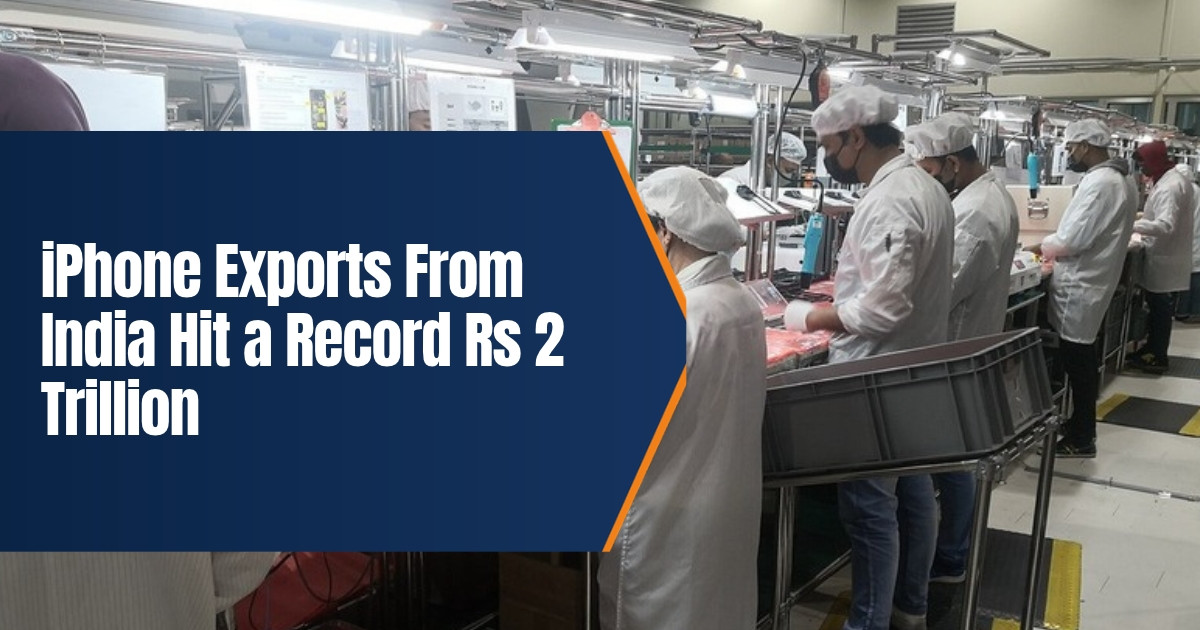
iPhone Exports From India Hit a Record Rs 2 Trillion
When this page was first written, the news was that Apple’s iPhone exports from India had roughly doubled in the five months from April to August 2023. Three years on, that growth has turned into something much bigger. In the financial year that ended in March 2026, iPhone exports from India reached a record of about Rs 2 trillion, and smartphones became the country’s largest branded export. This updated article explains how the numbers grew, who makes the phones, where they go and what comes next.
Table of Contents
Quick Facts
| Item | Detail |
|---|---|
| FY26 iPhone exports | About Rs 2 trillion (roughly $21 to 22 billion) |
| FY26 smartphone exports | About Rs 2.6 trillion ($29.4 billion) |
| iPhone share | More than 75 percent of smartphone exports |
| Calendar 2025 iPhone exports | About $23 billion |
| Main assemblers | Foxconn and Tata Electronics |
| Largest market | United States |
| Jobs | About 2.5 lakh direct jobs in the ecosystem |
The 2023 Starting Point
In September 2023, reports said iPhone exports from India in April to August 2023 were about $5 billion, roughly double the figure for the same months a year earlier. At the time, India made only a small share of the world’s iPhones, and most were still built in China. The rise was seen as an early sign that Apple wanted a second large production base in Asia, after COVID lockdowns and trade tensions had disrupted factories in China.
Key Milestones
| Year | Milestone |
|---|---|
| 2017 | Wistron begins assembling an older iPhone model in Bengaluru |
| 2019 | Foxconn starts assembling newer iPhone models near Chennai |
| 2020 | Government launches the PLI scheme for large scale electronics |
| 2022 | iPhone 14 assembled in India within weeks of its global launch |
| 2023 | Apple opens its first own stores; Tata buys Wistron’s iPhone plant |
| 2025 | Apple says most iPhones sold in the US that quarter would come from India |
| FY26 | Record exports of about Rs 2 trillion; PLI scheme ends |
The 2022 step mattered because, for years, new models were made in India only long after their launch. Making the newest phones in India from the start showed that Apple trusted its Indian supply chain with its most important products.
How Exports Grew Year by Year
| Financial year | iPhone exports |
|---|---|
| FY22 | Rs 9,351.6 crore |
| FY23 | Rs 44,269.5 crore |
| FY24 | Rs 85,013.5 crore |
| FY25 | About Rs 1.5 trillion |
| FY26 | About Rs 2 trillion |
In four years, exports grew more than twentyfold. Growth slowed in percentage terms as the base became larger, but each year still added tens of thousands of crores. In calendar 2025 alone, iPhone exports were reported at about $23 billion, an increase of around 85 percent over 2024.
Who Makes iPhones in India
Apple does not own the factories. It works with contract manufacturers that assemble phones to its designs.
- Foxconn, the Taiwanese company, runs the largest iPhone plant in India near Chennai in Tamil Nadu and has expanded in Karnataka.
- Tata Electronics became the first Indian company to assemble iPhones after it bought Wistron’s plant in Karnataka in 2023. It later took control of Pegatron’s India operations and has expanded in Tamil Nadu.
A growing network of component suppliers has also set up in India, making parts such as enclosures, chargers and some modules. Higher value parts like chips and displays are still mostly imported.
Where the Phones Go
The United States is the largest buyer of Indian made iPhones. Smartphone exports from India to the US rose from about $10.5 billion in FY25 to about $19.6 billion in FY26, according to reports. This shift followed rising US tariffs on Chinese goods in 2025, which made India a more attractive base for phones sold in America. Other important markets include the United Kingdom, the Netherlands, the UAE and other parts of Europe and the Middle East.
The US Shift in 2025
In May 2025, Apple’s chief executive Tim Cook told investors that the majority of iPhones sold in the United States in the April to June quarter would have India as their country of origin, while China would make most phones for other markets. This was a big change. It came as the US raised tariffs on many Chinese goods, although smartphones were largely kept out of the new reciprocal tariffs. The result can be seen in the export data, with shipments to the US nearly doubling in FY26.
Effect on Workers and Towns
The growth has changed industrial towns around Chennai, Hosur and Bengaluru. Large plants employ tens of thousands of workers each, many of them young women from rural districts who live in company provided housing. State governments have built roads, hostels and power links to support the plants. Suppliers making packaging, cables and metal parts have opened nearby, creating more jobs. Labour groups have raised issues about working hours and living conditions at some sites, and companies have said they follow local law and Apple’s supplier code.
Why India
Government incentives
The Production Linked Incentive (PLI) scheme for large scale electronics manufacturing paid companies a share of their extra sales over a base year. It ran for five years, and FY26 was its final year. Apple’s partners were among its largest users.
Workforce and scale
India has a large young workforce, and its factories have learned fast. The Apple ecosystem in India is estimated to support around 2.5 lakh direct jobs, many of them held by women in Tamil Nadu and Karnataka.
Supply chain diversification
Like many global companies, Apple has tried to reduce its dependence on any single country. India offers scale, political stability and a large home market.
A growing local market
Apple opened its first own stores in India, in Mumbai and Delhi, in April 2023, and added more stores in later years. Rising local sales help justify production in the country.
India and China Compared
China remains the centre of iPhone production, with decades of supplier networks and the world’s largest electronics workforce. India’s share has grown from a very small part of global iPhone output in 2020 to a meaningful one, with reports in 2025 estimating that roughly one in five iPhones worldwide was being made in India. Most components still come from China and other parts of East Asia, so the two countries are linked rather than simply competing.
What to Watch Next
Three questions will shape the next few years. First, whether the government launches a new incentive scheme, especially for components, now that the smartphone PLI has ended. Second, how US trade policy develops. Third, whether suppliers of higher value parts, such as camera modules and displays, build plants in India. Progress on these would raise the local share of each phone’s value, not just the number of phones shipped.
Challenges
- Value addition. Much of the value of an iPhone is in imported parts, so India’s share of the final price is still modest.
- End of the PLI scheme. With the scheme over after FY26, the industry has asked for new support for components.
- Trade policy. Changes in US tariffs could affect the cost advantage of making phones in India.
- Skills and infrastructure. Large plants need reliable power, housing and transport for workers.
What It Means for India
Smartphones, led by iPhones, have become India’s largest branded export. This shows that the country can attract high volume electronics production that once went almost entirely to China. It brings jobs, export income and supplier growth. The next test is whether more of the components, and the profits that come with them, can also be made in India.
For more on this topic, see our guide to the iPhone 17 price drop in India, our explainer on exporting to the USA from India, and our story on Lava’s Make in India units.
Export figures in rupees and dollars differ slightly because of exchange rate changes during the year.
Apple does not publish country level production figures, so most numbers come from industry and government data.
Phones sold in India are also mostly made in India now, which reduces import costs.
Other brands, including Samsung, also export phones from India, but iPhones make up most of the value.
State governments in Tamil Nadu, Karnataka and Uttar Pradesh compete to attract electronics plants.
We will update this page when official FY26 trade data is released.
What We Changed From the Old Post
The old post opened with an unrelated, copied line from another site about US work permits and gave general reasons for Apple’s move to India without dated figures. It also referred to Wistron as a current iPhone maker. We removed the copied line, updated the story with export figures from FY22 to FY26, added the US market shift, the end of the PLI scheme and the role of Tata Electronics, and kept the 2023 doubling as background.
Frequently Asked Questions
How much were iPhone exports from India in FY26?
About Rs 2 trillion, a record, according to industry data reported in April 2026.
Who makes iPhones in India?
Mainly Foxconn and Tata Electronics, under contract to Apple.
Where do Indian made iPhones go?
The United States is the largest market, followed by Europe and the Middle East.
Is the PLI scheme still running?
The smartphone PLI scheme ended with FY26. Industry has asked for a follow up scheme.