

Beautiful Indian Wedding Hairstyles for Every Bride
Ask any bride what she worried about most on the morning of her wedding, and hair comes up a lot. It makes sense. Your hairstyle has to sit under a heavy dupatta, carry jewellery, survive the heat and hours of rituals, and still look good in the five hundredth photo. No pressure.
The good news is that India has a huge range of bridal looks to borrow from. Think of the jasmine wrapped braids of Tamil Nadu, or the low bun and matha patti you see at so many Punjabi and Marwari weddings. Below are the main Indian wedding hairstyles, how to pick one for your hair and outfit, and how to make it last until the last dance.
Table of Contents
Quick Guide
| Hair length | Styles that work well |
|---|---|
| Short (above shoulders) | Soft waves with a side pin, small low bun with extensions, floral clip |
| Medium (shoulder to mid back) | Messy low bun, half up style, French or fishtail braid |
| Long (below mid back) | Long braid with gajra or jadai, large bridal bun, open curls |
| Thin or fine hair | Textured bun with padding, braided crown, volume at the crown |
| Thick or curly hair | Defined curls, structured braid, sleek bun |
Indian Wedding Hairstyles With Buns
There is a reason so many brides end up with a bun. It holds. A dupatta can be pinned straight into it, and your neck and back stay clear for the necklace and the blouse design you spent weeks choosing.
Classic low bun
A smooth, round bun at the nape of the neck. It has been around forever and it still works, with a lehenga or a saree. Most stylists slip a filler, the foam “donut”, underneath to give it that full, even shape.
Flower bun
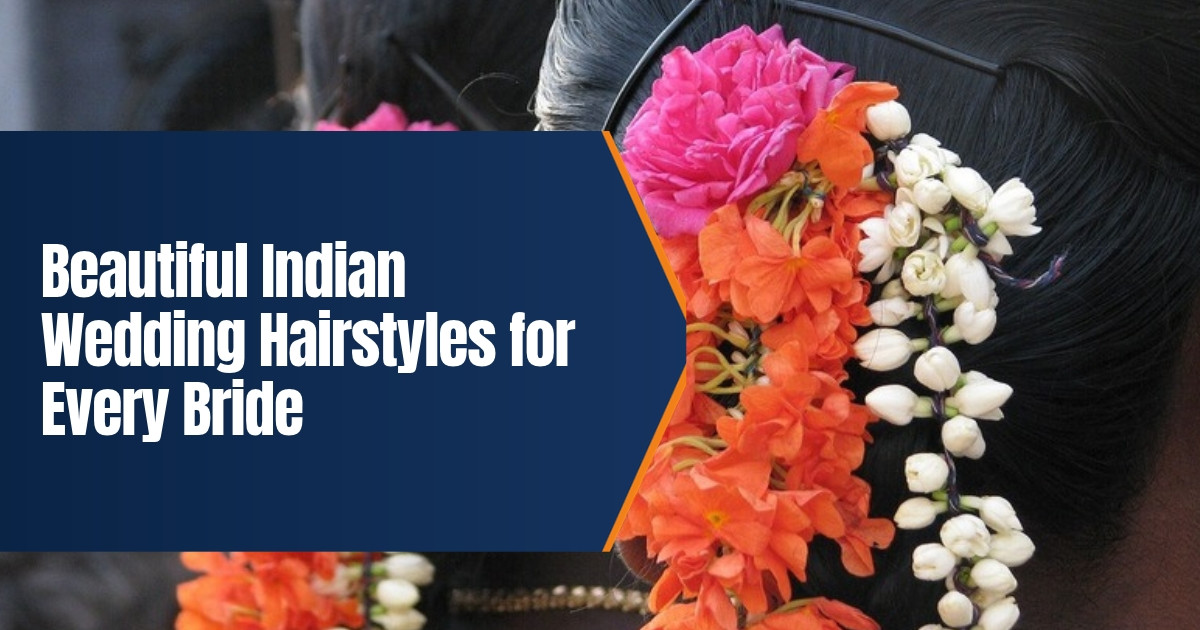
Wrap the bun in fresh jasmine, roses or small white flowers and you get one of the prettiest bridal looks there is. An all white flower bun against a red or maroon lehenga is striking. Pastel flowers suit lighter outfits better. One catch: real flowers wilt in heat. Plenty of brides quietly mix fresh flowers with good quality artificial ones, and nobody can tell in photos.
Braided bun
Here, several thin braids are twisted and pinned into a bun. It has lovely texture and it barely moves all day. If your hair refuses to hold a curl, this is a smart pick.
Messy bun
Looser, softer, with a few strands left out around the face. It is very popular for the mehendi, the haldi and other day functions, when you want to look relaxed rather than formal.
Braided Indian Wedding Hairstyles
The long traditional braid
Across much of South India, the bride wears one long braid covered in strings of jasmine. Some add a jadai, a long ornament of gold or temple jewellery pieces running down the length of it. At some traditional Tamil weddings you will see the naga jadai, which is shaped like a serpent’s hood at the top. It is heavy, so practise walking in it.
Paranda braid
In Punjab and the states around it, a paranda is a bright tasselled thread woven into the braid. It swings when you dance, which is half the fun. Brides tend to save it for the mehendi or sangeet.
French and fishtail braids
A French braid starts at the crown and picks up hair as it goes down. A fishtail has a finer, woven pattern. Stylists often combine the two, then gently tug the braid loose with their fingers so it looks fuller. On medium length hair, it works really well.
Side braid
A big, soft braid pulled over one shoulder. It shows off the back of your blouse, and you can tuck tiny pins, pearls or flowers along it.
Open and Half Up Styles
Open hair used to be rare at Indian weddings. Not anymore, at least for receptions and cocktail nights. Soft waves or loose curls with a jewelled pin or a floral tiara look modern without trying too hard.
Can’t decide between up and down? Go half up. The top section gets pinned back off your face, and the rest stays open so your length still shows.
Open styles struggle in humidity and get flattened under a heavy dupatta. That is why most brides keep them for functions where their head isn’t covered.
Regional Bridal Looks
Often the hairstyle is chosen by tradition as much as by fashion.
- Bengali brides usually wear a big bun, often with flowers, under a white shola mukut. The crown is made from the pith of a marsh plant.
- Maharashtrian brides often go for a round ambada bun with a gajra, plus a mundavalya, strings of pearls or flowers tied across the forehead.
- Tamil and Telugu brides commonly choose the long jasmine braid, sometimes with a jadai, or a decorated bun at the back.
- Malayali brides tend to keep it simple. A braid or bun, and lots of jasmine.
- Rajasthani brides may wear a borla, a round forehead ornament, with a low bun under the odhni.
These lines blur now. It is completely normal to wear a South Indian braid for the wedding and switch to open curls for the reception, whatever your family background.
Hair Jewellery and Accessories
- Maang tikka. The pendant that sits on your centre parting. It goes with almost anything.
- Matha patti. Bigger, and it runs along the hairline. Best with a centre parting and a low bun.
- Passa or jhoomar. Worn on one side of the head. You see it at Muslim weddings and some North Indian ones.
- Gajra. Strings of jasmine or other flowers, wrapped round a bun or laid along a braid.
- Pins and combs. Small jewelled or pearl pins pushed into a bun or braid.
Plan the jewellery and the hair together, not separately. A heavy matha patti on top of a large bun looks gorgeous at 10 am. By midnight it can feel like a headache. Comfort counts.
Matching the Style to Your Face Shape
- Round face. Add height at the crown and leave a few loose strands at the sides.
- Oval face. Lucky you. Most styles suit, from a sleek bun to open waves.
- Square face. Soft curls and a side parting soften the jaw.
- Long face. Volume at the sides and a lower bun balance things out.
- Heart shaped face. Side swept styles and loose curls near the chin.
Matching the Style to the Outfit
Wearing a heavy lehenga with the dupatta over your head? A low bun is your friend, because it gives the dupatta pins something solid to grip. A saree with a low back looks lovely with a long braid or a side braid. For a lighter outfit or a gown at the reception, open curls or a soft high bun feel right. High neckline, go for an updo. Deep neckline, open or half up hair balances it.
How to Prepare Your Hair Before the Wedding
- Book a trial. Do it two to four weeks out, wearing the actual dupatta and jewellery. Take photos from the front, both sides and the back.
- No big experiments late. Skip new colour, keratin or any chemical treatment in the final weeks. A reaction now is the last thing you need.
- Trim early. A small trim a few weeks before gets rid of split ends without losing length.
- Wash the day before. Most stylists prefer this. Freshly washed hair is slippery and won’t hold pins well.
- Look after your scalp. Gentle washing, proper sleep and decent food help. If you notice sudden or heavy hair loss, see a doctor or dermatologist.
For more on hair health, see our tips to reduce hair fall.
Making the Look Last All Day
Indian weddings go on for hours, often in serious heat. Ask your stylist to use enough pins to hold everything without dragging on your scalp. Then pack a tiny kit: spare pins, a comb, light hairspray, a few extra flowers.
Changing outfits during the day? Plan styles that flow into each other. A braid can become a bun in ten minutes.
Planning a different kind of celebration? See our ideas on how to look glamorous at a beach wedding, and our list of memorable wedding gifts for guests.
What We Changed From the Old Post
The old post was a list of 18 short entries, such as a white flower bun, a French and fishtail braid and a bun with a one sided braid, each with only a line or two of description. We grouped those styles into sections on buns, braids and open hair, added advice by hair length, face shape and outfit, explained traditional hair jewellery, and added practical prep tips. We also fixed the title case and updated the internal links.
Frequently Asked Questions
Which bridal hairstyle lasts the longest?
A low bun or a braided bun. Both hold up best through long ceremonies and under a dupatta.
Can I wear open hair at my wedding?
Yes, especially at the reception. If it’s humid, use a strong setting product.
When should I have a hair trial?
Two to four weeks before the wedding, with your dupatta and hair jewellery on.
Do I need hair extensions?
Not always. They help if your hair is short or fine and you want a full bun or a long braid.