

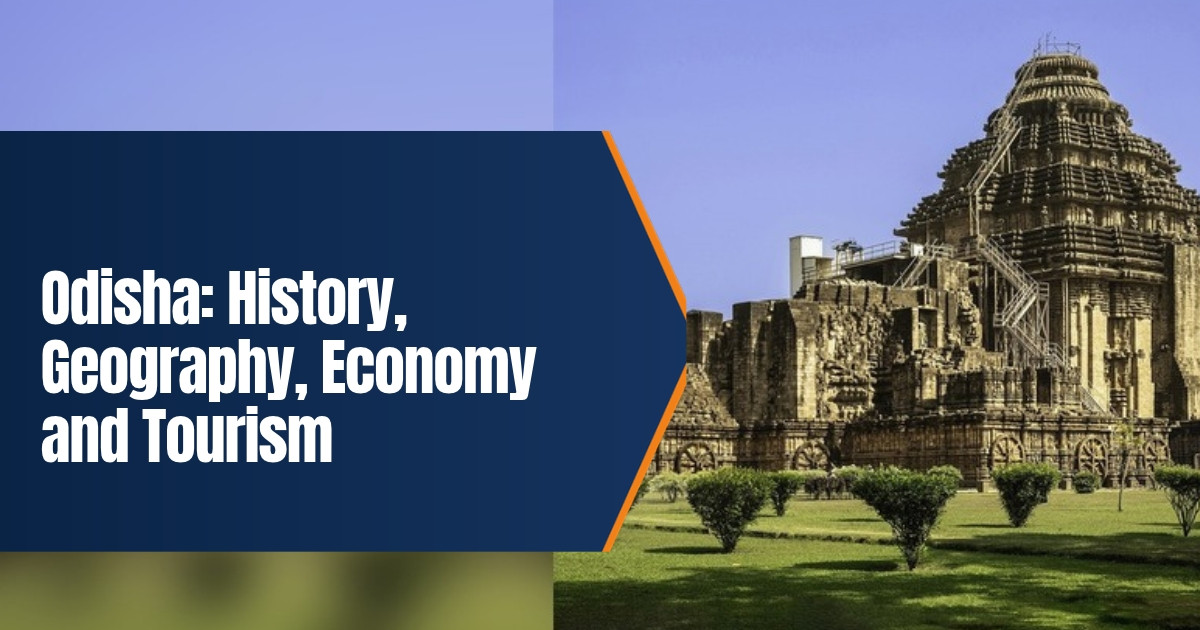
Odisha: History, Geography, Economy and Tourism
Odisha, known as Orissa until 2011, is a coastal state in eastern India facing the Bay of Bengal. It is famous for the Jagannath Temple at Puri, the Sun Temple at Konark, Chilika lake, Odissi dance and some of the richest mineral deposits in the country. This guide explains the history of Odisha, its geography, people and culture, how its economy works and what to see on a visit in 2026.
Table of Contents
Odisha at a Glance
| Item | Detail |
|---|---|
| Formed as a province | 1 April 1936 |
| Capital | Bhubaneswar |
| Area | 155,707 square kilometres |
| Population | 41,974,218 (Census 2011) |
| Districts | Thirty |
| Official language | Odia, a classical language since 2014 |
| Main river | Mahanadi |
| Chief Minister | Mohan Charan Majhi, since June 2024 |
Why the Name Changed
In 2011 Parliament passed a law that changed the spelling of the state’s name from Orissa to Odisha and the name of its language from Oriya to Odia. The new spellings are closer to how the words are pronounced in Odia. The change came into force in November 2011, which is why older books and maps still use Orissa.
History of Odisha
Ancient Kalinga
In ancient times the region was known as Kalinga, a powerful kingdom with busy ports that traded with Sri Lanka and Southeast Asia. Around 261 BCE the Mauryan emperor Ashoka invaded Kalinga. The war caused such loss of life that Ashoka turned to Buddhism and gave up conquest, a change recorded in his rock edicts at Dhauli and Jaugada. Our story on the Kalinga War and Emperor Ashoka covers this in detail.
About two centuries later, the Jain king Kharavela ruled Kalinga and recorded his deeds in the Hathigumpha inscription at Udayagiri, near Bhubaneswar. The caves of Udayagiri and Khandagiri, carved for Jain monks, can still be visited.
The temple builders
Between the seventh and thirteenth centuries, dynasties such as the Shailodbhavas, Bhaumakaras, Somavamshis and Eastern Gangas made Odisha a centre of temple building. Bhubaneswar alone has hundreds of temples, including the Lingaraj and Mukteshwar. The Eastern Ganga king Anantavarman Chodaganga began the Jagannath Temple at Puri in the twelfth century, and Narasimhadeva I built the Sun Temple at Konark in the thirteenth century, shaped like a giant chariot with stone wheels and horses.
Gajapatis, Mughals, Marathas and the British
The Gajapati kings ruled from the fifteenth century and extended their power far to the south. Later, Odisha came under Afghan and Mughal control, and in 1751 the Marathas took over much of the region. The British East India Company captured Odisha in 1803. A terrible famine in 1866, known as the Na Anka, killed about a million people and pushed the government to build canals and roads.
For decades the Odia speaking areas were split between Bengal, Bihar, Madras and the Central Provinces. Leaders such as Madhusudan Das and Gopabandhu Das campaigned for a single Odia province. Their efforts succeeded on 1 April 1936, when Orissa became the first Indian province created on the basis of language. The day is celebrated every year as Utkala Dibasa, and 2026 marked ninety years since then. After independence, princely states joined Odisha, and the capital moved from Cuttack to the planned city of Bhubaneswar.
Geography and Climate
Odisha has four broad regions: the coastal plains, the central river valleys, the Eastern Ghats hills and the northern and western plateaus. The Mahanadi, Brahmani, Baitarani, Subarnarekha and Rushikulya rivers flow to the sea and form fertile deltas along the coast.
- Chilika lake. The largest brackish water lagoon in India and a Ramsar wetland since 1981. In winter it hosts large flocks of migratory birds, and Irrawaddy dolphins live near Satapada.
- Bhitarkanika. A mangrove forest known for saltwater crocodiles.
- Gahirmatha and Rushikulya. Beaches where olive ridley turtles nest in large numbers.
- Simlipal. A tiger reserve in Mayurbhanj with waterfalls and dense sal forest.
- Hirakud Dam. On the Mahanadi near Sambalpur, one of the longest earthen dams in the world.
The climate is hot and humid on the coast and drier inland. The monsoon brings most of the rain from June to September. Cyclones from the Bay of Bengal strike the coast often, especially in October and November. After the 1999 super cyclone, Odisha built shelters and an evacuation system that is now widely praised for saving lives.
People, Language and Culture
Odia is spoken by most people and was recognised as a classical language in 2014. The state is also home to more than sixty Scheduled Tribe communities, including the Santal, Kondh, Gond, Bonda and Juang, who make up close to a quarter of the population.
Religion and culture centre on Lord Jagannath. The Rath Yatra at Puri, held every year in June or July, draws huge crowds as the deities ride giant wooden chariots through the town. Read our article on the history of the Jagannath Temple to learn more.
Odissi, one of India’s classical dance forms, developed in the temples of Odisha. Folk forms such as Chhau, Sambalpuri and Ghumura are popular too; see our piece on Ghumura dance of Odisha. Crafts include Pattachitra paintings, silver filigree from Cuttack, appliqué work from Pipli and handloom saris such as Sambalpuri ikat. Food lovers know Odisha for pakhala (fermented rice), dalma, chhena poda and the mahaprasad of Puri.
Festivals through the year
Beyond the Rath Yatra, Odisha has a full calendar of festivals. Raja, in mid June, celebrates the earth and womanhood, and for three days girls play on swings and farm work stops. Kartika Purnima, in November, recalls the old sea traders with Boita Bandana, when people float small paper or banana bark boats on rivers and ponds. Durga Puja is big in Cuttack, where artisans make silver decorations for the goddess, and Nuakhai, the new rice festival, is the most important event in western Odisha. Tribal communities hold their own seed and harvest festivals, often with music and dance through the night.
Economy of Odisha
Odisha is one of the most mineral rich states in India. It holds most of the country’s chromite and large shares of its bauxite, iron ore and coal. This has made the state a major base for steel, aluminium and power. Big plants operate at Rourkela, Kalinganagar, Angul and Jharsuguda, and Paradip is one of the busiest ports on the east coast.
Farming still employs a large share of people, with rice as the main crop, along with pulses, oilseeds and vegetables. Fishing is important along the coast and around Chilika. Tourism, handloom and information technology in Bhubaneswar add to the mix.
The state government has been seeking new investment. In October 2026 Chief Minister Mohan Charan Majhi unveiled 46 industrial projects worth about Rs 39,383 crore. Mining and industry have also raised hard questions about displacement, forest rights and pollution, and tribal communities in areas such as the Niyamgiri hills have challenged projects on their land.
Tourism in Odisha
- Puri. The Jagannath Temple and a long beach on the Bay of Bengal.
- Konark. The Sun Temple, a UNESCO World Heritage Site since 1984, and the Konark Dance Festival every December.
- Bhubaneswar. The Lingaraj and Mukteshwar temples and the Udayagiri and Khandagiri caves.
- Chilika. Birdwatching at Nalabana and dolphin trips from Satapada.
- Koraput. Hills, coffee gardens and weekly tribal markets.
- Simlipal and Bhitarkanika. Forests, waterfalls and wildlife.
Travel Tips for 2026
October to March is the best time to visit, when the weather is cooler and birds arrive at Chilika. Keep an eye on cyclone warnings if you travel in October or November. Bhubaneswar has the main airport, and Puri, Konark and Bhubaneswar form an easy triangle that can be covered in three or four days. Non Hindus are not allowed inside the Jagannath Temple, but they can view it from nearby rooftops and libraries.
Local buses and trains link Bhubaneswar with Puri, Cuttack and Berhampur several times a day.
Temple towns get very crowded during festivals, so book rooms early if your trip falls in Rath Yatra week.
Weekly markets in Koraput and Rayagada are best visited with a local guide who can explain customs and etiquette.
Boat operators at Chilika should keep a safe distance from dolphins; choose those who follow forest department rules.
Raghurajpur, a crafts village near Puri, lets visitors watch Pattachitra artists at work.
Carry light cotton clothes, sunscreen and water, since the coast stays warm even in winter afternoons.
Respect dress codes and photography rules at temples, which are strictly enforced at Puri and Lingaraj.
Frequently Asked Questions
Why was Orissa renamed Odisha?
The 2011 change brought the English spelling closer to how the name is said in Odia.
When was Odisha formed?
Odisha became a separate province on 1 April 1936, celebrated as Utkala Dibasa.
What is Odisha famous for?
The Jagannath Temple, the Konark Sun Temple, Chilika lake, Odissi dance and its minerals.
What is the best time to visit Odisha?
October to March, when it is cooler and the coast is calmer.