

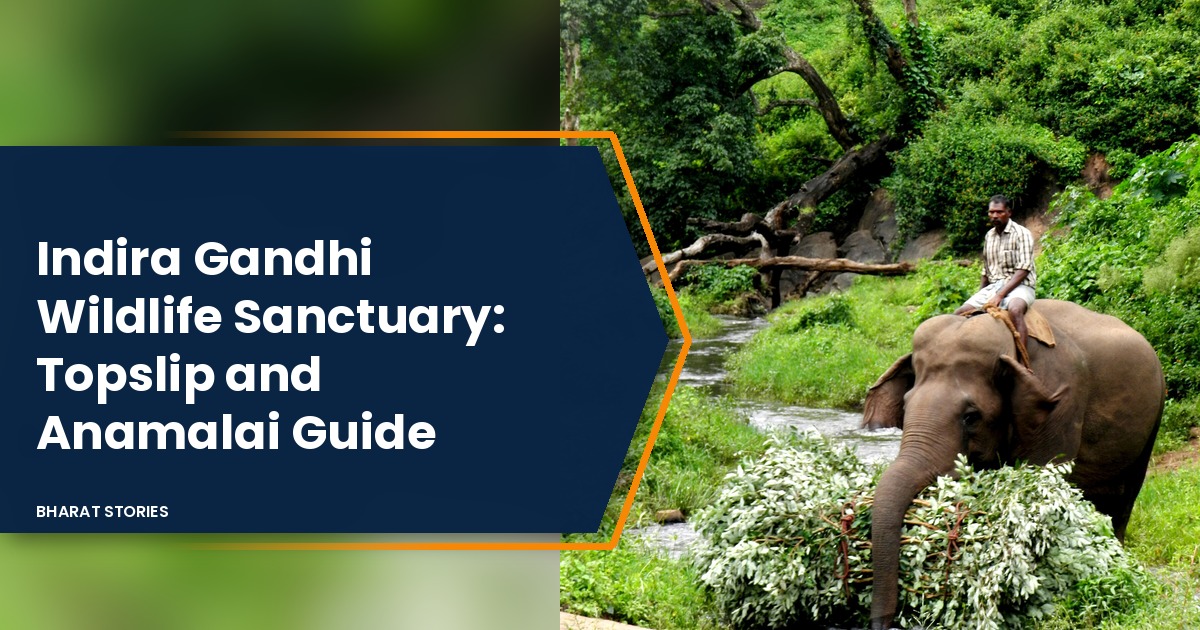
Indira Gandhi Wildlife Sanctuary: Topslip and Anamalai Guide
The Indira Gandhi Wildlife Sanctuary is the old name of the forest we now call the Anamalai Tiger Reserve, a large protected area in the Anaimalai Hills of western Tamil Nadu. Most visitors know it through Topslip, the small forest base near Pollachi where elephant camps, jungle safaris and old teak forests sit close together. This guide covers where the reserve is, how it got its names, what lives there, the places worth seeing and how to plan a trip.
Table of Contents
What is the Indira Gandhi Wildlife Sanctuary?
It is a protected forest in the Anaimalai Hills of Coimbatore and Tiruppur districts, Tamil Nadu, first notified as the Anaimalai Wildlife Sanctuary in 1974 and later renamed after Indira Gandhi. Since 2007 it has formed the core of the Anamalai Tiger Reserve.
The reserve covers parts of Pollachi and Valparai taluks in Coimbatore district and Udumalaipettai taluk in Tiruppur district. It sits in the southern Western Ghats, between the plains of Pollachi and the high ranges along the Kerala border. Because of its many renamings, you will see it called Indira Gandhi Wildlife Sanctuary and National Park (IGWLS and NP), Anaimalai Wildlife Sanctuary, Annamalai Tiger Reserve and ATR. They all point to the same forest.
Why is it named after Indira Gandhi?
The sanctuary was named after Indira Gandhi, who visited the area on 7 October 1961, a few years before she became Prime Minister.
The name stayed on maps and signboards for decades. When the Tamil Nadu Environment and Forests Department notified the tiger reserve on 27 June 2007, an area of 958.59 sq km covering the old sanctuary became the Anamalai Tiger Reserve under the Wild Life (Protection) Act, 1972, according to Wikipedia’s page on the reserve.
How big is the Anamalai Tiger Reserve?
The core area is 958.59 sq km and the buffer zone is 521.28 sq km, giving a total of about 1,479.87 sq km, as per National Tiger Conservation Authority figures.
| Fact | Detail |
|---|---|
| Sanctuary notified | 1974, as Anaimalai Wildlife Sanctuary |
| National park | About 108 sq km in 1989 (Karian Shola, Grass Hills, Manjampatti Valley) |
| Tiger reserve | Notified 27 June 2007 |
| Total area | About 1,479.87 sq km (core plus buffer) |
| Elevation | About 340 m to 2,513 m above sea level |
| Managed by | Tamil Nadu Forest Department |
The national park inside the sanctuary protects three special habitats: the evergreen Karian Shola near Topslip, the high Grass Hills, and Manjampatti Valley in the east. Rainfall varies a lot across this small distance, from about 500 mm on the drier eastern side to about 4,500 mm on the wet side, which is why the forest types change so quickly as you drive up.
Why is the place called Topslip?
Topslip got its name from a 19th century practice of sliding cut teak logs down the hill slopes from this point.
In the British period, the Anaimalai forests were cut heavily for teak, which went to the Bombay Dockyard for shipbuilding and later for railway sleepers. From 1855 the new forest department began managing the area for teak plantations, and parts of the old forest, such as the Karian Shola, were protected in the early 1900s. Many teak plantations from that era still stand around Topslip, mixed with natural forest.
Which animals live in the Indira Gandhi Wildlife Sanctuary?
The reserve is home to tigers, Asian elephants, leopards, dholes, gaur, sloth bears, Nilgiri tahr and the lion tailed macaque, along with more than 250 kinds of birds.
Mammals you may see or hear about include:
- Big animals: Bengal tiger, Indian elephant, Indian leopard, gaur, sambar, chital and wild boar.
- Hill specialists: Nilgiri tahr on the Grass Hills and the Nilgiri langur in wet forest.
- Primates: lion tailed macaque, bonnet macaque, grey langur and the grey slender loris.
- Smaller mammals: dhole (wild dog), sloth bear, smooth coated otter, Indian giant squirrel, pangolin, porcupine, civets and mongooses.
Bird watchers come for the great hornbill, Malabar grey hornbill, trogons, barbets, flycatchers and many raptors. The reserve holds 15 of the 16 bird species found only in the Western Ghats. Reptile and frog life is just as special, with king cobras, Malabar pit vipers, shield tail snakes and rare frogs such as the purple frog and the Anaimalai flying frog. Around 315 butterfly species have been recorded in the Anaimalai Hills.
What kind of forest grows here?
Over 2,000 plant species grow in the reserve, from wet evergreen forest and shola grassland high up to dry deciduous forest and thorn scrub on the eastern slopes.
About 400 of these plants are known for medicinal use. Tall trees such as Hopea parviflora, Mesua ferrea, Vateria indica and Cullenia excelsa form the canopy in wet areas. Bamboo stands and reed beds line streams, and the rare south Indian conifer Podocarpus wallichianus also grows here. The forest feeds rivers that fill major reservoirs, including Aliyar, Parambikulam, Thirumoorthy, Sholayar and Amaravathi, so the reserve matters for farm water and power far beyond its borders.
Who lives inside the reserve?
More than 4,600 Adivasi people from tribes such as the Kadar, Malasar, Pulaiyar, Mudugar and Eravallan live in about 34 settlements in and around the reserve.
Many of them work as guides, trackers and elephant handlers. Their knowledge of animal tracks and forest paths is one reason guided walks here feel different from a plain jeep ride. Since 1997, Topslip has also hosted an annual Elephant Pongal, where decorated camp elephants are fed pongal, banana and sugarcane as part of the harvest festival.
What can you see at Topslip and nearby?
The main sights are the Topslip jungle safari, the Kozhikamuthi elephant camp, Monkey Falls, Aliyar Dam, the Attakatti hornbill viewpoint and the Valparai plateau.
The official Anamalai Tiger Reserve website lists these places and activities:
- Topslip: the main entry for wildlife safaris and nature walks with forest guides, plus forest rest houses.
- Kozhikamuthi elephant camp: an elephant camp near Topslip where you can watch camp elephants being bathed and fed.
- Monkey Falls (Kaviyaruvi): a small waterfall on the Pollachi to Valparai road, reopened to visitors from 15 July 2026.
- Aliyar Dam and Attakatti: a reservoir with a park at the foot of the ghat road, and a hornbill viewpoint and orchidarium higher up.
- Valparai: tea estates, rainforest fragments and viewpoints such as Nallamudi Poonsholai.
- Amaravathi: a dam and crocodile park on the Udumalpet side.
Valparai is also a good place to look for lion tailed macaques in forest patches between tea gardens. For more on the hill town, read our Anaimalai Hills and Valparai guide.
How do you book a safari or stay?
Safaris, nature walks and forest rest houses at Topslip, Valparai, Amaravathi and other ranges are booked through the reserve’s official website or at the Topslip reception.
Rooms are limited and get full on weekends and holidays, so book early. Safari timings, fees and rules change, so check them on the official site before you travel. Entry needs a valid ID, and plastic and alcohol are not allowed inside the reserve.
When is the best time to visit?
The drier months from around December to May are usually best for wildlife, while the monsoon from June to September brings heavy rain and some closures.
Animals gather near water sources in the summer months, which helps sightings. The monsoon makes the forest very green but leeches, landslips and road closures are common. Some areas may close for short periods during fire season or for elephant movement, so call ahead.
How do you reach Topslip?
Pollachi is the nearest town, about 35 km from Topslip; Coimbatore has the nearest airport and a large railway station.
- Fly or take a train to Coimbatore.
- Drive or take a bus to Pollachi, which also has a railway station.
- From Pollachi, take a taxi or the local bus towards Topslip via Sethumadai, where the reserve checkpost is located.
For Valparai, take the ghat road from Pollachi via Aliyar and its many hairpin bends. Drive slowly, as elephants and gaur often cross these roads.
Is the reserve linked to other forests?
Yes. It joins Parambikulam Tiger Reserve in Kerala on the west and Chinnar Wildlife Sanctuary on the south, forming one of the largest connected forest blocks in the Western Ghats.
This link lets tigers, elephants and other wide ranging animals move between states. The Western Ghats, which UNESCO added to its World Heritage list in 2012, include parts of this landscape. If you enjoy these forests, you may also like our guides to Silent Valley National Park, Tamil Nadu’s history and tourism and the full list of national parks of India.
Frequently Asked Questions
Is Indira Gandhi Wildlife Sanctuary the same as Anamalai Tiger Reserve?
Yes. The old Indira Gandhi Wildlife Sanctuary and National Park was declared the Anamalai Tiger Reserve in 2007. The old name is still used on some signboards.
Is the Indira Gandhi Wildlife Sanctuary in Tiruppur or Coimbatore?
Both. Most of it, including Topslip and Valparai, is in Coimbatore district, while the Amaravathi and Udumalpet ranges fall in Tiruppur district.
Can you see tigers at Topslip?
Tigers live in the reserve but sightings are rare because the forest is dense. Elephants, gaur, deer, langurs and birds are far more common on a safari.
Is Topslip good for a day trip from Coimbatore?
Yes, but leave early. The drive takes a few hours each way, and morning safaris give the best chance of seeing animals.