

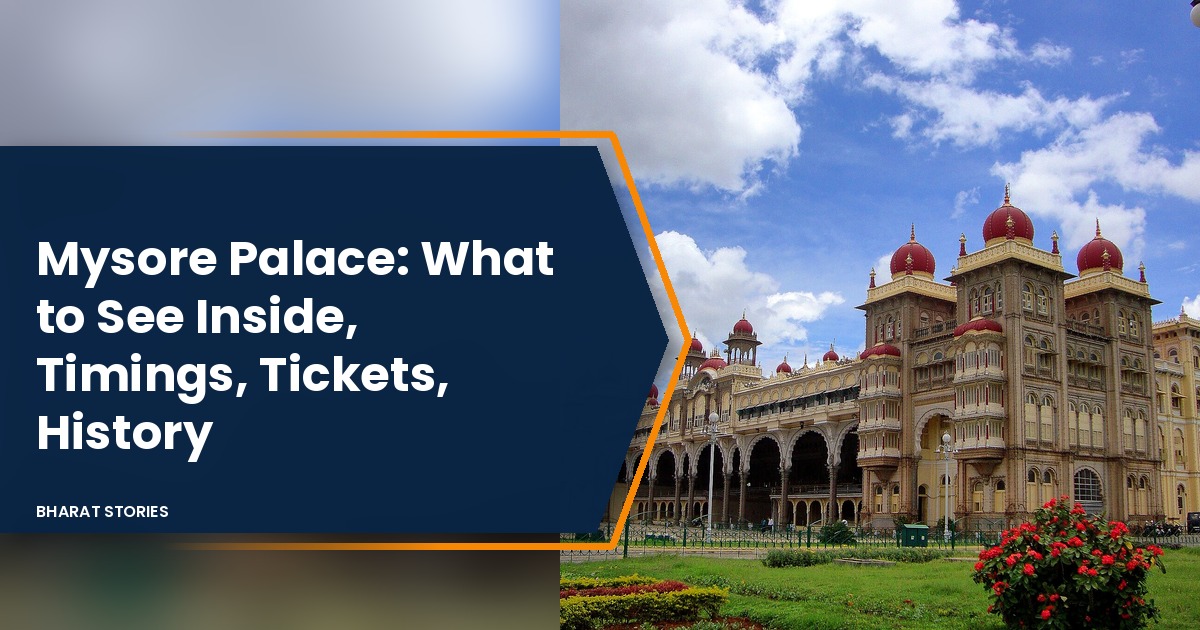
Mysore Palace: What to See Inside, Timings, Tickets, History
Few buildings in India look as grand as Mysore Palace when its domes catch the morning sun, and none glows quite like it on a Dasara night when tens of thousands of bulbs outline every arch. Also called Amba Vilas Palace, it was the seat of the Wadiyar kings of Mysore and is now one of India’s most visited monuments, drawing around four million visitors a year. Many people walk through it in an hour and miss half of what makes it special.
This guide tells you what to see inside, how the palace came to be, current timings and tickets, the evening illumination, the Dasara connection and practical tips for your visit.
Table of Contents
What is Mysore Palace?
Mysore Palace, or Amba Vilas Palace, is the royal palace of the Wadiyar dynasty in Mysuru, Karnataka, completed in 1912 in the Indo Saracenic style and now run as a public museum by the Mysore Palace Board.
The palace blends Hindu, Indo Islamic, Rajput and Gothic features: onion domes, pointed arches, carved pillars and stained glass. The official Mysuru Palace website gives its length as about 245 feet, breadth about 156 feet and the gold plated central dome about 145 feet above the ground. The present head of the Wadiyar family still lives in a private part of the complex.
Who built Mysore Palace, and when?
The present palace was designed by British architect Henry Irwin and built between 1897 and 1912, after a fire destroyed much of the older wooden palace in February 1897.
A palace stood on this site within the Mysore fort from at least the 17th century. It was demolished by Tipu Sultan in 1793 and rebuilt in wood after his death in 1799. On 20 February 1897, during a royal wedding, fire tore through the northern part of that palace. Regent Kempananjammanni Devi, ruling for the young Krishnaraja Wadiyar IV, commissioned Irwin, with E. W. Fritchley, to design a new palace of stone, brick and iron. According to Wikipedia’s Mysore Palace page, the final cost was about Rs 41.47 lakh, and hundreds of carvers and thousands of masons worked on it.
| Fact | Details |
|---|---|
| Other name | Amba Vilas Palace |
| Built | 1897 to 1912 |
| Architect | Henry Irwin, with E. W. Fritchley |
| Style | Indo Saracenic |
| Cost at the time | About Rs 41.47 lakh |
| Illumination | About 97,000 bulbs (Palace Board figure) |
| Visitors | Around 4 million in 2023 to 24 |
What should you see inside Mysore Palace?
The highlights are the Kalyana Mantapa (marriage hall), the public Durbar Hall, the private Durbar Hall, the Dolls’ Pavilion with the golden howdah, the Residential Museum and its armoury, and the temples inside the palace grounds.
Kalyana Mantapa
The octagonal marriage hall has a stained glass dome with peacock motifs, held up by cast iron pillars made by Walter MacFarlane and Co. in Glasgow. The patterned floor and the oil paintings of the Dasara procession around the walls are worth slowing down for; you can spot the elephants, soldiers and royal carriages in remarkable detail.
Public Durbar Hall (Diwan e Aam)
On the first floor, this long open hall faces east towards Chamundi Hills. It is about 155 feet long, lined with carved, painted pillars, and its ceiling carries paintings of Hindu deities. Works by Raja Ravi Varma hang in the palace galleries. Kings once addressed the public from here during Dasara.
Private Durbar Hall (Diwan e Khas)
Also called Amba Vilas, this smaller hall was used for private audiences. Look for its heavy carved teak and rosewood doors inlaid with ivory, the stained glass ceiling and the marble floor with pietra dura inlay. Many visitors find it the most beautiful room in the palace.
Dolls’ Pavilion and the golden howdah
The Gombe Thotti near the entrance displays traditional dolls, Indian and European sculpture and ceremonial objects. Its star is the golden howdah, a gilded wooden seat of about 750 kg that carries the idol of Goddess Chamundeshwari during the Dasara procession.
Residential Museum and armoury
The rear section, which survived the 1897 fire, is a separate museum run by the royal family with its own ticket. It displays paintings, toys, musical instruments and an armoury of more than 700 weapons, including swords associated with Hyder Ali and Tipu Sultan.
Temples in the palace complex
Several temples stand within the walls, including Lakshmiramana, where the five year old Krishnaraja Wadiyar III was crowned in 1799, the Varahaswami and Prasanna Krishnaswami temples with old murals, and the 20th century Bhuvaneshvari and Gayatri temples. Unusually, they face the palace rather than east.
What are the Mysore Palace timings and ticket prices?
The palace is open from 10 AM to 5:30 PM on all days, except the last two days of Navaratri; recent reports put the entry fee at Rs 120 for Indian adults and Rs 1,000 for foreign nationals. Visitors enter through the Varaha gate on the south side.
Fees for children, the Residential Museum, audio guides and the evening show are separate and are revised from time to time. Check the counter or the official website before your visit rather than relying on old blog figures.
When is Mysore Palace lit up?
The palace is illuminated with about 97,000 bulbs on Sunday and public holiday evenings, usually for a short window after 7 PM, and every night during the Dasara festival.
The lighting is the moment most people remember. Arrive by 6:45 PM, find a spot on the lawns in front of the main facade and wait; the switch on, with the whole outline appearing in a second, draws applause every time. A sound and light show is held on most other evenings. Timings can change for events, so confirm locally.
How is Mysore Palace linked to Dasara?
Mysore Dasara, held over the ten days of Navaratri and Vijayadashami, is centred on the palace, with nightly illumination, cultural programmes and the Jamboo Savari elephant procession on the final day.
The procession begins at the palace’s Balarama gate. A decorated lead elephant carries the golden howdah with the idol of Chamundeshwari to the Bannimantap grounds, followed by other elephants, bands and tableaux. Tickets for seats inside the palace grounds sell out quickly, so plan months ahead if you want to watch it from there.
What are the rules for visiting Mysore Palace?
You must leave footwear at the counter, follow the marked one way route, avoid touching exhibits and follow the current photography rules shown at the entrance.
- Arrive soon after opening on weekdays to avoid the heaviest crowds.
- Wear comfortable socks; the floors can be hot or cold depending on the season.
- Large bags may need to be deposited at the cloakroom.
- Allow at least two hours for the main palace and grounds, more if you add the Residential Museum.
- Hire only licensed guides or use the official audio guide.
How do you reach Mysore Palace?
The palace is in the centre of Mysuru, about 2 km from Mysuru Junction railway station and a short ride from the central bus stand; Bengaluru airport is about four hours away by road.
- Take a train or bus from Bengaluru to Mysuru, roughly 145 km.
- From the railway station or bus stand, an auto or cab to the palace takes 10 to 15 minutes.
- Combine the visit with Chamundi Hills, St Philomena’s Church and Brindavan Gardens.
Plan more of your trip with our guides to the best sightseeing places in Mysore, weekend getaways near Bangalore, our overview of Karnataka, and the story of Dussehra across India.
Frequently Asked Questions
Who built Mysore Palace?
The present palace was commissioned by the Wadiyar royal family under Regent Kempananjammanni Devi and designed by British architect Henry Irwin. It was completed in 1912.
Does the royal family still live in Mysore Palace?
Yes. The current head of the Wadiyar family lives in a private section of the palace, while the rest is open as a museum.
How long does it take to see Mysore Palace?
Plan two to three hours for the palace, grounds and temples, and come back on a Sunday or holiday evening for the illumination.
Is Mysore Palace open every day?
Yes, from 10 AM to 5:30 PM, except on the last two days of Navaratri when it is closed for Dasara rituals.