

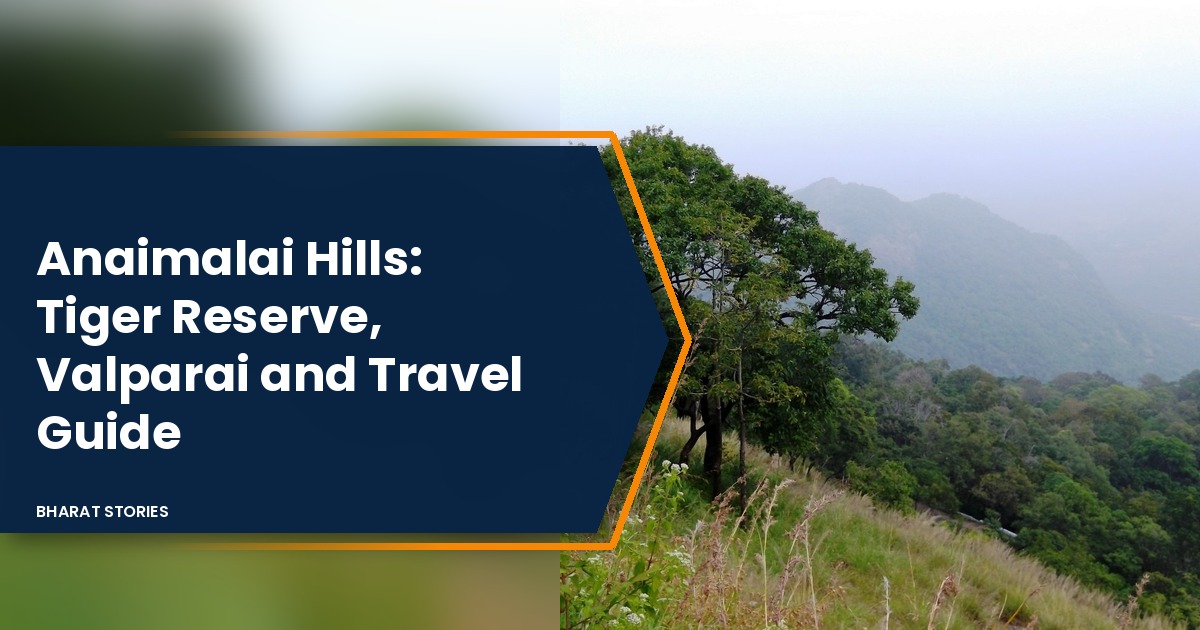
Anaimalai Hills: Tiger Reserve, Valparai and Travel Guide
The Anaimalai Hills, also spelt Anamalai, are one of the wildest and most scenic parts of the southern Western Ghats. Spread across the Tamil Nadu and Kerala border, they hold tiger habitat, tea country around Valparai, rainforest home to the lion tailed macaque, and the highest peak in India south of the Himalayas.
Table of Contents
Where are the Anaimalai Hills located?
The Anaimalai Hills lie in the southern Western Ghats, straddling Coimbatore and Tiruppur districts of Tamil Nadu and the neighbouring districts of Kerala. The range begins just south of the Palakkad Gap, the broad break in the Ghats that separates it from the Nilgiris, and continues south towards the Palani and Cardamom Hills.
The town of Anaimalai sits in the foothills near Pollachi in Coimbatore district. Pollachi is the usual gateway for visitors, about 40 km south of Coimbatore city.
What does Anaimalai mean?
Anaimalai means “elephant hill”, from the Tamil words aanai (elephant) and malai (hill). The name suits the range well, since it remains one of the most important elephant landscapes in South India.
Why are the Anaimalai Hills important?
They are a core part of a global biodiversity hotspot and a UNESCO World Heritage Site. The Anamalai sub cluster was included when the Western Ghats were inscribed on the World Heritage List in 2012. Older articles describing it as merely “under consideration” are out of date.
The range acts as a water tower for the plains. Rivers such as the Aliyar, Chalakudy and Amaravati rise here, feeding dams, canals and farms in both states.
What is the highest peak in the Anaimalai Hills?
Anamudi, at about 2,695 metres, is the highest peak in the range and in all of India south of the Himalayas. It lies inside Eravikulam National Park in Kerala, which protects the largest population of the Nilgiri tahr.
What is the Anamalai Tiger Reserve?
The Anamalai Tiger Reserve is the main protected area on the Tamil Nadu side of the range, covering about 1,480 sq km. It grew out of the former Indira Gandhi Wildlife Sanctuary and National Park and was brought under Project Tiger in 2008.
| Fact | Detail |
|---|---|
| Total area | 1,479.87 sq km |
| Core (critical tiger habitat) | 958.59 sq km |
| Buffer | 521.28 sq km |
| Districts | Coimbatore and Tiruppur, Tamil Nadu |
| Visitor hub | Topslip, near Pollachi |
| Adjoining reserves | Parambikulam Tiger Reserve, Eravikulam National Park, Chinnar Wildlife Sanctuary |
The area figures come from the National Tiger Conservation Authority’s brief note on the reserve.
Can we see tigers in the Anamalai Tiger Reserve?
Tigers live here, but sightings are rare in the dense forest. According to a January 2026 New Indian Express report, the reserve recorded 25 tigers in the 2022 estimation, up from 15 in 2018 and 10 in 2014, with another seven or eight using both Anamalai and Parambikulam. Field work for the 2026 All India Tiger Estimation began in the reserve in January 2026; the new figures had not been released at the time of writing.
What wildlife lives in the Anaimalai Hills?
The range supports elephants, tigers, leopards, gaur, dholes and a long list of species found only in the Western Ghats. Highlights include:
- Lion tailed macaque: an endangered rainforest monkey, seen in forest fragments around Valparai.
- Nilgiri tahr: a mountain goat of the high grasslands, including the Grass Hills.
- Nilgiri langur and Malabar giant squirrel: common in the forest canopy.
- Great hornbill: one of several hornbill species in the evergreen forests.
- Amphibians and reptiles: many endemic frogs, lizards and snakes, some described only in recent decades.
Several Adivasi communities, including the Kadar, Malasar and Muduvar, live in and around the forests and have long depended on them.
What are the best places to visit in the Anaimalai Hills?
The most popular stops are Topslip, Valparai, Aliyar Dam, Monkey Falls and the Masani Amman temple. Each shows a different side of the range.
Topslip
Topslip is the visitor centre of the tiger reserve, with forest department safaris, guided walks and an elephant camp. Entry is controlled by permit, and private vehicles may not go beyond set points. Book through the Tamil Nadu Forest Department and confirm timings before you travel.
Valparai
Valparai is a hill town surrounded by tea and coffee estates, reached by a road with around 40 hairpin bends from the Aliyar side. Wildlife often moves through the plantations, so drive slowly, especially at dusk, and never approach elephants or gaur.
Aliyar Dam and Monkey Falls
Aliyar Dam, at the foot of the Valparai ghat road, has a park and boating, and is a common picnic spot. Monkey Falls is a small waterfall on the same road where visitors can bathe when water levels are safe.
Masani Amman Temple
The Masani Amman temple at Anaimalai town is a major shrine to the goddess Masani, visited by large numbers of devotees, particularly during its annual festival. Devotees believe the goddess grants justice and relief from troubles. For more shrines across the state, see our guide to famous Hindu temples of Tamil Nadu.
What conservation challenges do the hills face?
The main pressures are habitat fragmentation, roads, plantations, forest fires and conflict between people and wildlife. Large stretches of the plateau around Valparai were cleared for tea and coffee more than a century ago, leaving rainforest in scattered patches between estates.
Lion tailed macaques in these fragments often cross roads to move between trees, and elephants regularly walk through estates and settlements. Speed limits, canopy bridges for monkeys and early warning systems for elephant movement are among the measures used to reduce harm on both sides.
Inside the tiger reserve, roads, power lines, reservoirs and canals also break up animal movement routes. Visitors can help by following speed limits, not feeding monkeys, avoiding plastic and never stopping to photograph elephants at close range from a vehicle.
Are there common mistakes about the Anaimalai Hills?
Yes, the Anaimalai Hills are often confused with other places of similar name. A few corrections help:
- Annamalai University is in Chidambaram, far to the east, not in the Anaimalai Hills.
- The Jain cave beds known as one of the eight Jain hills are at Anaimalai (Yanaimalai) near Madurai, a different hill.
- Mudumalai National Park lies in the Nilgiris, north of the Palakkad Gap, and the Jawadhu Hills are in northern Tamil Nadu. Neither is part of this range.
- Annamalai, the sacred hill at Tiruvannamalai, is also a separate place.
When is the best time to visit?
November to March is usually the most comfortable time, with clear skies and cool hill air. April and May are warmer but still pleasant at higher elevations. The monsoon brings very heavy rain, especially around Valparai, which can close trails and cause landslips. The forest department sometimes restricts entry during fire season or for wildlife reasons, so check before you go.
How do you reach the Anaimalai Hills?
- By air: Coimbatore International Airport is the nearest airport.
- By rail: Pollachi Junction is closest, with Coimbatore Junction as a larger hub.
- By road: buses run from Coimbatore and Pollachi to Topslip, Aliyar and Valparai.
Frequently Asked Questions
Which district is Anaimalai located in?
Anaimalai town is in Coimbatore district, Tamil Nadu. The wider hill range extends into Tiruppur district and into Kerala.
Are the Anaimalai Hills part of the Western Ghats?
Yes. They form part of the southern Western Ghats and are included in the Western Ghats UNESCO World Heritage Site.
What are some things to do in the Anaimalai Hills?
Take a forest department safari at Topslip, drive to Valparai, visit Aliyar Dam and Monkey Falls, look for lion tailed macaques, and visit the Masani Amman temple.
Explore responsibly
The Anaimalai Hills reward slow travel. Stay on permitted roads, follow forest department rules and give wildlife space. If you enjoy these forests, the rainforest of Silent Valley National Park just north of the Palakkad Gap is another Western Ghats treasure.