

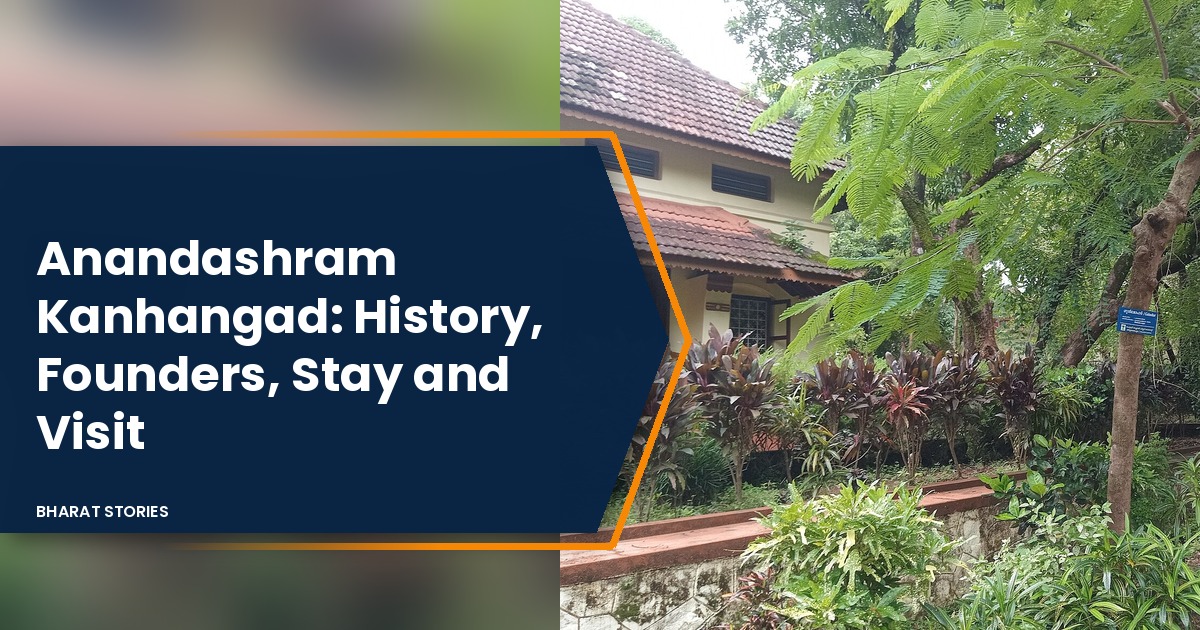
Anandashram Kanhangad: History, Founders, Stay and Visit
Anandashram Kanhangad is one of Kerala’s best known spiritual retreats, founded in 1931 by Swami Ramdas and Mother Krishnabai. Visitors of every faith come to its quiet campus in Kasaragod district to chant, reflect and share simple meals, much as they have for more than nine decades.
Table of Contents
What is Anandashram Kanhangad?
Anandashram is a spiritual centre in Kanhangad, Kerala, dedicated to the chanting of the divine name and to service, open to people of all religions and backgrounds. The name means “abode of bliss”. The ashram was founded by Swami Ramdas, lovingly called Papa, and his disciple Mother Krishnabai, known as Pujya Mataji.
At its opening, Swami Ramdas described its ideal as universal love and service, based on a vision of divinity in all beings. That message still frames life at the ashram, as the official Anandashram website explains.
Where is Anandashram located?
Anandashram is in Ramnagar, on the outskirts of Kanhangad town in Kasaragod district, in the far north of Kerala. Its postal address is Anandashram P.O., Kanhangad 671531. Before the ashram was built, the area around the nearby Manjapati hill was known by that name; it later came to be called Ramnagar after Swami Ramdas.
Who founded Anandashram?
The ashram was founded on 15 May 1931 by Swami Ramdas (1884 to 1963) and Mother Krishnabai. Their story shapes much of what visitors experience today.
Swami Ramdas
Swami Ramdas was born P. Vittal Rao in Kanhangad in 1884. After years as a householder and businessman, he renounced worldly life in his late thirties, took the name Ramdas, and wandered across India as a mendicant, repeating the Ram mantra and relying entirely on what came to him. He wrote widely about his experiences; books such as In Quest of God and In the Vision of God remain popular with seekers.
Mother Krishnabai
Mother Krishnabai became Swami Ramdas’s foremost disciple and, after his passing in 1963, led the ashram until her own death in 1989. She is remembered for her humility and for her care of everyone who arrived, especially the poor.
Leadership after the founders
| Period | Head of the ashram |
|---|---|
| 1931 to 1963 | Swami Ramdas, with Mother Krishnabai |
| 1963 to 1989 | Mother Krishnabai |
| 1989 to 2008 | Swami Satchidananda, who joined in 1949 |
| 2008 onward | Swami Muktananda, spiritual head and managing trustee |
Swami Muktananda, born in 1944 in Wayanad, gave up a professional career to join the ashram. Under his guidance it has supported value education programmes for schools and teachers, known as VSET and VITAL, alongside its spiritual work.
Why did Swami Ramdas move to Kanhangad?
Swami Ramdas and Mother Krishnabai had first lived at an earlier ashram nearby, but left it in 1931 after Mother Krishnabai was physically attacked by strangers. Devotees in Kanhangad then suggested building a new home near Manjapati hill, and the new Anandashram opened soon after, on 15 May 1931.
What did Swami Ramdas teach?
Swami Ramdas taught that God dwells in every being, and that constant remembrance of the divine name, together with selfless service, leads to lasting peace. His approach was simple and practical rather than scholarly.
- The divine name: repeating Ram’s name with love was, for him, the most direct spiritual practice, open to anyone at any time.
- Surrender: accepting whatever life brings as the will of God, which he practised during years of wandering with no possessions.
- Universal vision: seeing the same divinity in people of every faith, caste and nation.
- Service: treating help to others as worship, not charity.
Many visitors first meet these ideas through his autobiographical books, which describe his travels with warmth and humour. Reading one before you go makes the ashram’s routine easier to understand, since the chanting, the shared meals and the open door all grow directly from these teachings.
What happens at Anandashram every day?
Daily life centres on chanting the Ram mantra, devotional singing (bhajans), quiet reflection and community meals. The mantra associated with Swami Ramdas is “Om Sri Ram Jai Ram Jai Jai Ram”, repeated individually and together.
- Morning: the day begins early with prayers and chanting in the Bhajan Hall.
- Daytime: visitors may join bhajans or sit quietly at the samadhi shrines of the founders.
- Evening: collective chanting and aarti close the day.
- Festivals: anniversaries of the founders and major Hindu festivals draw larger gatherings.
Exact timings change with seasons and occasions, so check the current schedule with the ashram office on arrival.
Can you stay at Anandashram, Kerala?
Yes, sincere visitors can usually stay for a limited period, but you should write to the ashram and receive confirmation before travelling. The ashram has long offered free food to all visitors and simple accommodation for a short stay, with separate arrangements for wandering sadhus.
Guests are expected to follow the ashram’s rhythm and rules:
- Request permission in advance and carry identification.
- Dress modestly and keep the campus calm and quiet.
- Join the common meals at the set times.
- Respect the simple vegetarian life of the ashram; do not bring alcohol or smoke on the campus.
- Offer donations only through the official office, if you wish to give.
What service work does the ashram do?
Service has always been part of Anandashram’s identity. Over the years the ashram has supported free meals, medical help, schools and welfare work in the surrounding villages. Many buildings it constructed were later handed to staff or to the government for social welfare and education, according to accounts of the ashram’s history.
It also publishes Swami Ramdas’s writings and a journal called The Vision, which carries talks and reflections for devotees around the world.
What does “Ananda Ashram” mean in English?
Ananda means bliss or joy, and ashram means a hermitage or spiritual retreat, so Anandashram means “abode of bliss”. Several unrelated ashrams in India and abroad use the same name, so it helps to specify Anandashram Kanhangad when searching or travelling.
What is Kanhangad famous for?
Kanhangad is known for Anandashram, the Nityananda Ashram, the old Hosdurg fort and its closeness to Bekal Fort and the beaches of Kasaragod. The town was historically known as Hosdurg, a name the local taluk still carries.
Visitors often combine the ashram with a trip to Bekal Fort, the backwaters of Valiyaparamba and the Theyyam performances held in local shrines during the festival season. Our overview of Kerala’s history, geography and tourism covers more of the state, and our feature on the Aranmula Vallamkali boat festival describes one of its best known celebrations.
How do you reach Anandashram?
Kanhangad railway station on the Mangaluru to Kozhikode line is the nearest railhead, and the ashram is a short taxi or auto ride away.
- By air: Mangaluru International Airport and Kannur International Airport are the closest airports.
- By rail: many trains on the west coast route stop at Kanhangad.
- By road: National Highway 66 runs along the coast past Kanhangad, with regular buses from Mangaluru, Kannur and Kasaragod.
When is the best time to visit?
October to February brings drier, more comfortable weather. The southwest monsoon from June to September is very wet in north Kerala, though the green campus is beautiful in the rain.
Frequently Asked Questions
Is Anandashram open to people of all religions?
Yes. From its founding, the ashram has welcomed people of every faith, caste and nationality without asking them to adopt any creed.
Is there a fee to visit Anandashram?
No entry fee is charged for visiting. Accommodation for staying guests must be arranged in advance, and donations are voluntary.
Who heads Anandashram today?
Swami Muktananda is the spiritual head and managing trustee, having succeeded Swami Satchidananda after 2008.
A place of quiet
Anandashram offers no spectacle, only a calm campus, steady chanting and the example of its founders’ lives. For many visitors, that simplicity is the reason to come. India’s spiritual traditions have travelled far beyond its borders, a story we explore in how yoga became a global movement.