

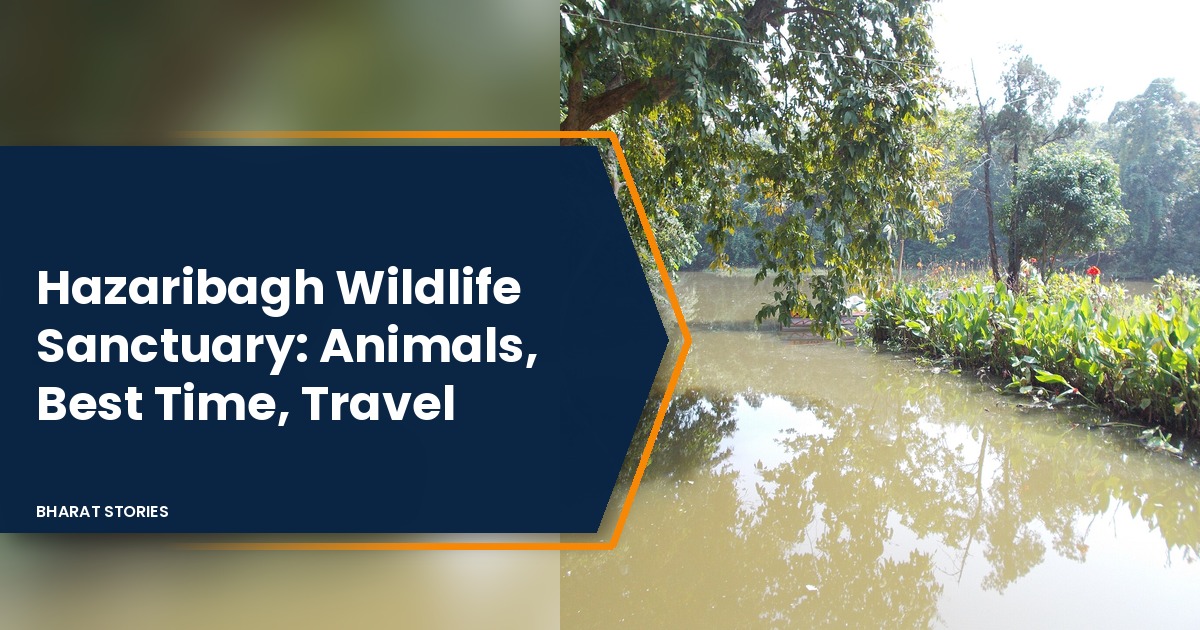
Hazaribagh Wildlife Sanctuary: Animals, Best Time, Travel
Hazaribagh means “a thousand gardens”, and the forested hills around this Jharkhand town live up to the name. Just outside the town lies Hazaribagh Wildlife Sanctuary, a stretch of sal forest, grassy clearings and small lakes that was once a royal hunting ground and, for two decades, was popularly called Hazaribagh National Park. It is a quiet, uncrowded place for a forest drive, birdwatching and a day away from the city, especially for families from Ranchi, Dhanbad and Bokaro.
This guide explains what the sanctuary is, how its status changed, which animals you can realistically expect, the best season and how to get there.
Table of Contents
Where is Hazaribagh Wildlife Sanctuary?
The sanctuary is in Hazaribagh district of Jharkhand, on the Chota Nagpur plateau, about 89 km north of Ranchi and close to Hazaribagh town. The main road towards Barhi and Koderma runs past it.
The land is low and hilly, with an average height of about 615 metres. Seasonal streams cut through the forest and several small water bodies hold water into the dry months, which makes them the best places to wait for animals. Before Jharkhand was formed in November 2000, the sanctuary was in Bihar, which is why older books list it as a Bihar destination.
Is Hazaribagh a national park or a wildlife sanctuary?
It is a wildlife sanctuary. It was established in 1955 and was informally known as Hazaribagh National Park from 1955 until 1976, which is why both names are still used.
The difference matters. In a national park, almost all human use is barred, while a sanctuary can allow some regulated rights. Hazaribagh was never notified as a national park, so official documents refer to Hazaribagh Wildlife Sanctuary, as summarised on Wikipedia’s page on the sanctuary. Search results and signboards still say “national park”, and both refer to the same forest.
| Fact | Details |
|---|---|
| Status | Wildlife sanctuary |
| Established | 1955 |
| Area | About 184 sq km |
| Average elevation | About 615 metres |
| Forest type | Mixed dry deciduous forest dominated by sal |
| Distance from Ranchi | About 89 km |
What is the history of the Hazaribagh forest?
Before it became a sanctuary, the forest was a private hunting reserve of the kings of Ramgarh, and their old hunting lodge at Rajderwa still stands inside it.
Hunting and the cutting of trees over many decades emptied the forest of much of its large wildlife. The sanctuary was created to stop that decline. Rajderwa, once the royal shooting lodge, later became the area around which visitors gathered, and an enclosure there was used to keep wild boar, barking deer and nilgai. The story is common across central India: forests that survived because they were royal hunting grounds later became protected areas.
Which animals live in Hazaribagh Wildlife Sanctuary?
Visitors most often see chital (spotted deer), sambar, wild boar, nilgai, langurs and peafowl; striped hyenas, sloth bears and foxes also live here but are shy and seldom seen.
Older articles promise tigers and leopards, but be realistic. Deforestation and hunting wiped out tigers and wolves here long ago. There was excitement in January 2024 when villagers filmed a tiger in the sanctuary; forest officials said it had wandered in from Chhattisgarh by way of Palamu Tiger Reserve. That was a passing animal, not a resident population.
Mammals you may see
- Chital and sambar: deer that graze in clearings and come to water in the early morning and evening.
- Nilgai and wild boar: often seen at the forest edge.
- Langurs and rhesus macaques: common along roads and near watchtowers.
- Sloth bear, striped hyena and jungle cat: present but largely nocturnal.
Birds
Sal forests are good for birding. Look for Indian peafowl, red junglefowl, hornbills, drongos, orioles, woodpeckers, bulbuls, parakeets and raptors such as the crested serpent eagle. Water bodies attract herons, egrets, cormorants and kingfishers, with ducks arriving in winter.
What does the forest look like?
The sanctuary is mostly sal forest mixed with other dry deciduous trees, broken by grassy meadows, rocky hillocks and small reservoirs.
Sal trees shed leaves briefly in spring and flush bright green before the monsoon. After the rains the undergrowth is thick and the forest feels closed in; by late winter it opens up again and animals become easier to see. Mahua, palash, kendu and bamboo grow among the sal, and palash flowers turn parts of the forest orange in February and March.
What challenges does the sanctuary face today?
The main pressures are the forest’s small size, fires in the dry season, grazing and firewood collection, and busy roads that cut through animal routes.
At under 200 sq km, Hazaribagh is too small on its own to hold large predators, so its future depends on forest links with neighbouring districts. Summer fires, often started to clear undergrowth or collect mahua flowers, can sweep through dry leaf litter. Villages on the fringe rely on the forest for fuel and fodder, and wild elephants that move through the wider Hazaribagh region sometimes raid crops, which creates conflict.
Protection work here is less about headline animals and more about steady habitat care: fire lines before summer, water holes that last through May, controls on grazing, and support for fringe villages so the forest is worth more standing than cut. The 2024 tiger visit showed that animals can still find their way back if those corridors survive.
When is the best time to visit Hazaribagh Wildlife Sanctuary?
October to March is the most comfortable time; February to April is often better for sightings near water, though afternoons get hot. The monsoon months bring heavy rain and thick undergrowth, and some forest roads may be closed.
| Months | What to expect |
|---|---|
| October to January | Green forest, cool mornings, winter birds at the lakes |
| February to April | Palash in flower, thinner cover, animals near water |
| May and June | Very hot middays; visit only early morning |
| July to September | Monsoon rain, dense growth, limited access |
How do you visit the sanctuary?
Most visitors drive through the forest roads with a vehicle and guide arranged at the entry point or through the Jharkhand forest department, stopping at watchtowers to scan clearings and lakes. Entry charges, vehicle rules and timings are set by the forest department and change, so confirm them locally before you go.
- Arrive at opening time; animals are most active in the first two hours of daylight.
- Climb the watchtowers quietly and wait. Patience brings more sightings than driving fast.
- Wear dull colours, carry binoculars and keep music and loud talk off.
- Do not feed monkeys or deer, and carry all plastic back out.
- Mobile signal can be weak inside; tell someone your plan.
What else can you see around Hazaribagh?
Canary Hill, Hazaribagh Lake and the drive to the Konar and Tilaiya dams are popular nearby stops, and Betla National Park is a longer trip to the southwest.
Canary Hill, on the edge of town, has a viewpoint tower with wide views over Hazaribagh, best at sunrise or sunset. Hazaribagh Lake, a group of connected lakes in town, is pleasant for an evening walk. Further afield, Jharkhand’s best known forest is Betla in Palamu, with elephants, gaur and old forts.
How do you reach Hazaribagh Wildlife Sanctuary?
Ranchi’s Birsa Munda Airport is the nearest airport, about two to three hours by road; Hazaribagh Town and Koderma railway stations are the closest rail options.
- Fly to Ranchi or take a train to Ranchi, Koderma or Hazaribagh Town.
- Drive or take a bus to Hazaribagh town on the Ranchi to Patna road.
- Head a short distance north of town towards the sanctuary entry.
- Stay in Hazaribagh town, where there are hotels in every budget.
Explore more of Jharkhand and Indian wildlife with our guides to Betla National Park, Jharkhand’s history and places to visit, the best wildlife sanctuaries in India, and our list of national parks of India.
Frequently Asked Questions
In which state is Hazaribagh National Park located?
It is in Jharkhand, in Hazaribagh district. Before 2000 the area was part of Bihar.
What is Hazaribagh National Park famous for?
It is known for its sal forest, deer such as chital and sambar, wild boar, nilgai, birdlife and its history as a royal hunting reserve. Tigers are not resident.
Is Hazaribagh worth visiting?
Yes, if you enjoy quiet forests, birds and a relaxed drive. It is not a big cat park, so go for the landscape and smaller wildlife.
How far is Hazaribagh from Ranchi?
About 89 km by road, usually a drive of two to three hours depending on traffic.