

Amarkantak Jain Temple: Sarvodaya Tirth, Adinath Idol
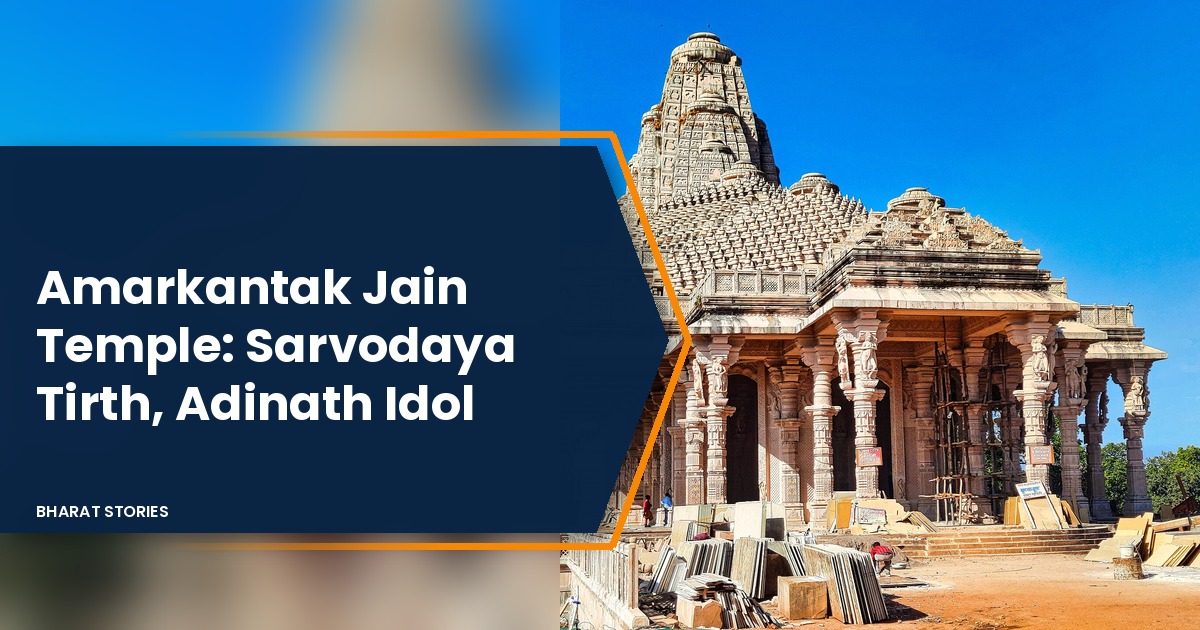
High on the Maikal hills, where the Narmada river begins its long journey west, a pink sandstone temple rises above the forest town of Amarkantak. This is the Sarvodaya Digambar Jain temple, popularly called the Amarkantak Jain Temple. It is built without cement or steel, houses one of the heaviest seated metal idols of Bhagwan Adinath in India, and has become a major stop for Jain pilgrims as well as for anyone visiting Amarkantak for the Narmada.
This guide covers the temple’s history, design and idol, visiting etiquette, what else to see in Amarkantak, the best season and how to get there.
Table of Contents
Where is the Amarkantak Jain Temple?
The temple stands in Amarkantak, a pilgrim town in Anuppur district of Madhya Pradesh, near the Chhattisgarh border, at an average height of about 1,048 metres. It is a short drive or walk from the Narmada Udgam temple complex at the centre of town.
Amarkantak is where the Vindhya and Satpura ranges meet, with the Maikal hills between them. Three rivers rise here: the Narmada, the Son and the Johila, a tributary of the Son. The town has a population of under ten thousand, but it receives large numbers of pilgrims, especially during festivals.
What is the Sarvodaya Jain Temple?
It is a large Digambar Jain temple dedicated to Rishabhanatha, also called Adinath, the first Tirthankara, built under the guidance of the Digambar monk Acharya Vidyasagar.
The main idol was consecrated and the temple formally inaugurated in a Panch Kalyanak celebration held from 25 March to 2 April 2023, according to Wikipedia’s page on the temple. Work had begun in the mid 2000s, and the then Vice President of India, Bhairon Singh Shekhawat, laid the foundation stone in April 2007.
The name Sarvodaya means “the rise or welfare of all”, an idea close to the Jain ideal of nonviolence towards every living being. Locals and travel guides often just call it the Jain mandir or the Adinath temple, and you will see all three names on signboards and maps around town.
| Fact | Details |
|---|---|
| Full name | Shri Sarvodaya Digambar Jain Temple, Amarkantak |
| Main deity | Bhagwan Rishabhanatha (Adinath) |
| Guidance | Acharya Vidyasagar |
| Foundation stone | April 2007, by Vice President Bhairon Singh Shekhawat |
| Idol consecration | 25 March to 2 April 2023 |
| Material | Pink sandstone from Rajasthan and lime, no cement or iron |
| Planned size | About 151 feet high, 125 feet wide and 490 feet long |
What makes the temple’s design special?
The temple uses traditional stone construction with lime mortar and no cement or iron, a method chosen so the structure can last for centuries the way old Indian temples have.
Steel reinforcement rusts and expands over time, cracking concrete from within. Temples built of interlocking stone, like those at Dilwara or Ranakpur, have stood for many hundreds of years without it. Sarvodaya follows that tradition. The pink sandstone was brought from Rajasthan and carved by craftsmen into pillars, brackets and spires covered with fine detail. The complex covers about four acres and is often compared in scale to the Akshardham temple in Delhi.
When fully complete, the main shikhara is planned to rise about 151 feet. Some parts of the complex were still being finished after the 2023 consecration, so you may see stone work in progress.
How big is the Adinath idol at Amarkantak?
The main idol is a seated image of Rishabhanatha about 24 feet tall, cast in ashtadhatu (an alloy of eight metals), weighing about 24 tonnes and resting on a lotus shaped ashtadhatu pedestal of about 28 tonnes.
The idol is in padmasana, the seated meditative posture typical of Digambar images. Its size and weight make it one of the largest metal Jain idols in India. Moving and installing it required special planning, and the consecration in 2023 drew large crowds of devotees from across Madhya Pradesh, Chhattisgarh, Maharashtra and beyond.
Who was Acharya Vidyasagar?
Acharya Vidyasagar was one of the most respected Digambar Jain monks of modern India, known for his scholarship, strict asceticism and the many temples and institutions built under his inspiration.
Born in Karnataka, he took monastic vows young and spent decades walking barefoot across central India. He wrote in Sanskrit and Hindi and encouraged handloom work, cow shelters and schools for girls. Sarvodaya at Amarkantak and the great temple at Kundalpur in Damoh are among the best known projects associated with him. He passed away in February 2024 at Dongargarh in Chhattisgarh.
What should you know before visiting the temple?
Dress modestly, remove footwear at the entrance, avoid carrying leather items or food inside, keep your voice low, and follow any photography rules posted by the temple trust.
- Shoulders and knees should be covered. Shorts and sleeveless tops are not suitable.
- Leather belts, wallets and bags are best left in your vehicle.
- Do not touch the idol or step into restricted areas.
- Photography may be restricted in the sanctum. Ask before taking pictures.
- A Jain dharamshala and bhojanshala are run near the temple; ask at the office about stay and meals.
What else is there to see in Amarkantak?
Amarkantak’s main sights are the Narmada Udgam temple at the river’s source, Sonmuda, Kapildhara and Dudhdhara waterfalls, Mai ki Bagiya, Kabir Chabutra and the old Kalachuri temples.
- Narmada Udgam: the temple complex built around the kund regarded as the source of the Narmada. The Narmada temple was built under the Kalachuris and later renovated by Rani Ahilyabai Holkar.
- Kalachuri temples: a group of stone temples from around the 11th and 12th centuries near the Narmada kund.
- Sonmuda: the origin point of the Son river, with a viewpoint over forested valleys.
- Kapildhara: a waterfall where the young Narmada drops about 100 feet, linked to the sage Kapila.
- Dudhdhara: a smaller waterfall downstream whose white spray gives it the name “stream of milk”.
- Mai ki Bagiya: a garden associated with the goddess Narmada.
- Kabir Chabutra: a platform where the poet saint Kabir is said to have meditated.
The forests around Amarkantak form part of the Achanakmar Amarkantak Biosphere Reserve and connect with the Kanha landscape. The Anuppur district administration lists these among the main places to visit, and Wikipedia’s Amarkantak page covers the town’s history and the Puranic references to it.
When is the best time to visit Amarkantak?
October to March is pleasant, with cool days and cold nights; the monsoon from July to September makes the waterfalls spectacular but roads can be slippery. Summers are milder than the plains because of the altitude. Festivals such as Narmada Jayanti and Mahashivratri bring big crowds, so book stays early if you visit then.
How do you reach the Amarkantak Jain Temple?
Pendra Road in Chhattisgarh, about 40 km away, and Anuppur in Madhya Pradesh are the nearest railway stations; Bilaspur airport is about 120 km away, and Jabalpur and Raipur airports are other options.
- Take a train to Pendra Road or Anuppur, or fly to Bilaspur, Jabalpur or Raipur.
- Hire a taxi or take a bus up the ghat road to Amarkantak.
- The temple is within the town, a short drive from the Narmada Udgam complex.
- Stay in Amarkantak’s ashrams, the Jain dharamshala, hotels or the state tourism property.
Read more about the region in our guides to the Narmada river pilgrim trail, Kanha National Park, the famous Dilwara Jain temples of Mount Abu, and our overview of Madhya Pradesh.
Frequently Asked Questions
Which Tirthankara is worshipped at the Amarkantak Jain temple?
Bhagwan Rishabhanatha, also known as Adinath, the first of the 24 Jain Tirthankaras.
Is Amarkantak a hill station?
Amarkantak sits at over 1,000 metres in the Maikal hills and has a cool climate, so many people treat it as a hill retreat, though it is mainly known as a pilgrim town.
Is the Sarvodaya Jain temple open to everyone?
Yes. Visitors of all faiths can visit respectfully, following the dress code and temple rules.
Why is the temple built without cement?
Traditional stone and lime construction avoids rusting steel inside concrete, so the temple can last for centuries like ancient Indian stone temples.