

Guindy National Park: Blackbucks, Snake Park and Timings
Guindy National Park is a patch of thorn forest and grassland in the middle of Chennai, squeezed between Raj Bhavan, IIT Madras and some of the city’s busiest roads. At about 2.7 square kilometres it is one of the smallest national parks in India, and one of very few inside a metropolitan city. Yet it shelters hundreds of blackbuck, around two thousand spotted deer, jackals and more than 130 kinds of birds, which is why locals call it one of the green lungs of Chennai.
This guide explains the park’s history, its wildlife, how the Snake Park and Children’s Park fit in, and how to plan a visit.
Table of Contents
Where is Guindy National Park?
Guindy National Park is in the Guindy area of south Chennai, Tamil Nadu, next to Raj Bhavan and IIT Madras, on Sardar Patel Road. Guindy railway and metro stations and the Chennai airport are all a short drive away.
The park is an extension of the grounds around Raj Bhavan, the official residence of the Governor of Tamil Nadu. It encloses forest, scrub, lakes and streams, and a 9.5 km perimeter wall separates it from the city around it.
How big is Guindy National Park and when was it declared?
The park covers about 2.70 sq km (270.57 hectares); the remaining forest was handed to the Tamil Nadu Forest Department in 1977 and declared a national park in 1978.
Its history goes back to the 1670s, when Governor William Langhorne built a country residence called Guindy Lodge here. The Government of Madras bought the remaining forest from Gilbert Rodericks in 1821, and an area of 505 hectares became a reserve forest in 1910. Over the following decades large parts were given away: land for IIT Madras in 1958, for the Guindy Deer Park and Children’s Park the same year, and for memorials to Rajaji and Kamaraj in 1974 and 1975. Between 1961 and 1977 about 172 hectares went to various government departments. These dates are summarised on Wikipedia’s Guindy National Park page.
| Fact | Detail |
|---|---|
| Location | Guindy, Chennai, Tamil Nadu |
| Area | About 2.70 sq km |
| Reserve forest | 1910 |
| National park | 1978 |
| Managed by | Tamil Nadu Forest Department |
| Habitat | Tropical dry evergreen scrub, thorn forest, grassland, ponds |
| Best known for | Blackbuck, spotted deer, birds, Snake Park next door |
What is Guindy National Park famous for?
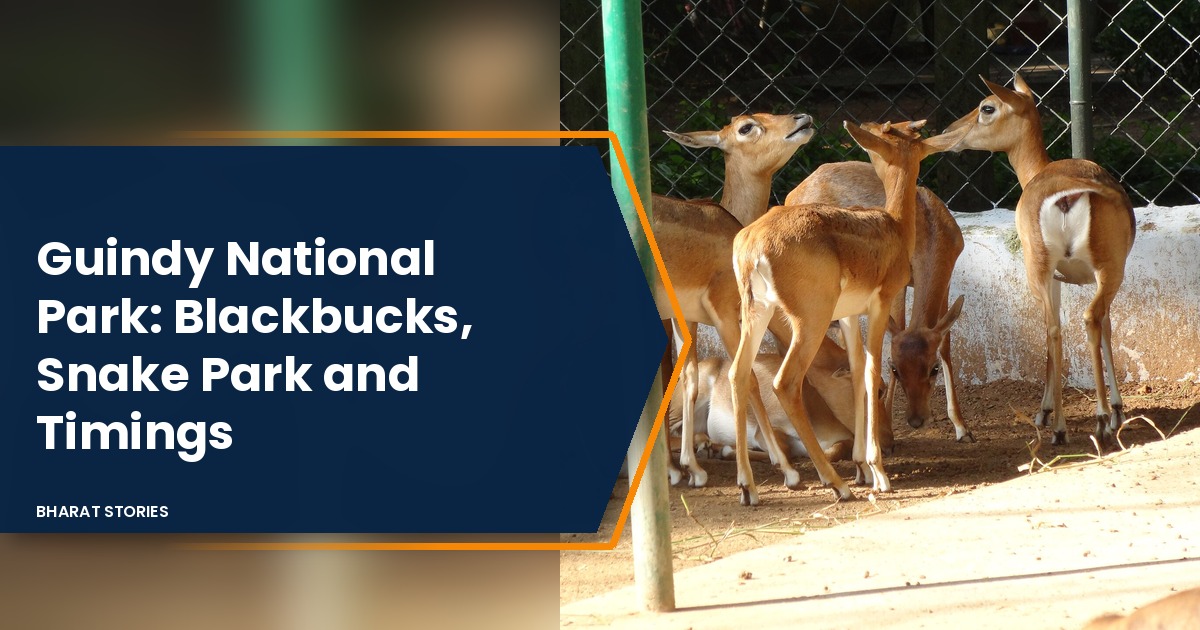
The park is famous for its free ranging blackbuck and spotted deer, its role as a last remnant of the Coromandel coast’s tropical dry evergreen forest, and the Snake Park and Children’s Park that share its campus.
Wikipedia, drawing on forest department sources, lists about 400 blackbuck, 2,000 spotted deer (chital) and 24 jackals, along with over 14 mammal species, over 130 bird species, and more than 60 species each of butterflies and spiders. Roughly a sixth of the park is kept as open grassland, because blackbuck need open ground to graze and to see predators coming.
Which animals and birds live in the park?
Mammals include blackbuck, chital, jackal, small Indian civet, common palm civet, bonnet macaque, pangolin, hedgehog, mongoose and Indian palm squirrel; reptiles include many snakes, geckos and tortoises.
Birdwatchers come for the mix of scrub and water birds. Common sightings include peafowl, grey hornbills, kingfishers, shikras, bee eaters and egrets around the tanks, while migratory birds visit in winter. The two large tanks, Kathan Kollai and Appalam Kolam, and the smaller ponds usually dry up in summer, which concentrates animals near the remaining water.
What plants grow in Guindy?
The park has dry evergreen scrub and thorn forest with over 350 plant species, including shrubs, climbers, herbs and grasses, and over 24 kinds of trees such as neem, wood apple and sugar apple. Palmyra palms rise above the scrub, and introduced acacias and cactus show how long people have shaped this land.
What is the Guindy Snake Park?
The Chennai Snake Park, run by the Chennai Snake Park Trust, sits next to the national park on the same campus and displays Indian snakes, crocodiles, turtles and lizards with talks on snake safety. It was once also the home of the Madras Crocodile Bank Trust before that moved to the East Coast Road.
The Snake Park was founded in the early 1970s by herpetologist Romulus Whitaker, and it helped change how people in India see snakes. Its regular snake talks explain which species are venomous, how to avoid bites, and why most snakes are harmless and useful in controlling rats. It is one of the most popular stops for school groups in Chennai.
Can you enter Guindy National Park itself?
Most visitors see the Children’s Park and the Snake Park, which are open to the public; entry into the national park forest is restricted and allowed only with permission from the forest department.
This restriction protects a small, fragile habitat that is surrounded by a city of millions. The forest department runs nature walks and education programmes for students and nature groups from time to time. If you want to walk inside, contact the Tamil Nadu Forest Department in advance; do not try to enter through gaps in the wall.
What are Guindy National Park timings and entry fee?
The Children’s Park and Snake Park open during the day and have traditionally closed on Tuesdays, with separate small tickets for adults, children and cameras. Fees and hours are revised from time to time, so check the latest details with the Tamil Nadu Forest Department or the Snake Park before you go.
- Arrive early in the morning when animals are active and the heat is lower.
- Weekdays are quieter than weekends and school holidays.
- Carry water and a cap; shade is limited on some paths.
- Do not feed animals or tease snakes through enclosures.
- Keep plastic out of the park; bins are provided.
When is the best time to visit?
November to February is the most comfortable time, with cooler mornings, green scrub after the northeast monsoon and migratory birds. April and May are very hot, though animals gather near the last water.
The park’s climate is tropical, with mean maximum temperatures near 33°C and an average annual rainfall of about 1,215 mm, most of it during the wet season from June to December.
How do you reach Guindy National Park?
Take a suburban train or metro to Guindy, then a short auto ride; city buses also stop on Sardar Patel Road near the gate. If you are coming from the airport, it is about 20 minutes by car outside peak traffic.
- Metro: Guindy station on the airport line, then an auto or walk.
- Suburban rail: Guindy station on the Chennai Beach to Tambaram line.
- Bus: many city routes pass Raj Bhavan and the Guindy industrial estate.
- Car: limited parking near the Children’s Park entrance on busy days.
Why does Guindy National Park matter?
It is a rare piece of native coastal habitat inside a megacity, a recharge zone for groundwater, and a place where city children can see wild deer and snakes up close.
Pressure from roads, buildings and noise has grown around the park, and each proposal to take more land is watched closely by citizens. Its survival shows that even small, well protected areas can hold real wildlife.
For more in Tamil Nadu, read our guide to Mudumalai Wildlife Sanctuary and our overview of Tamil Nadu’s history and tourism. To see blackbuck in a larger grassland, read about Blackbuck National Park in Velavadar, and browse our list of national parks of India.
Frequently Asked Questions
Is Guindy National Park the smallest in India?
It is one of the smallest. At about 2.7 sq km it is far smaller than most, but a few island parks in the Andamans are smaller still.
Which animal is Guindy National Park famous for?
The blackbuck, an antelope of open grassland, together with spotted deer.
Is the Snake Park inside Guindy National Park?
It shares the same campus and boundary area but is run separately by the Chennai Snake Park Trust.
How many national parks are there in Tamil Nadu?
Tamil Nadu’s best known national parks are Guindy, Gulf of Mannar Marine, Indira Gandhi (Anamalai), Mudumalai and Mukurthi; some recent lists also include newer parks.