

Chandoli National Park: Tigers, Plateaus and Travel Tips
For years Chandoli National Park was the quiet corner of the northern Western Ghats, a place that birdwatchers and trekkers knew but most travellers drove past on the way to Kolhapur or the Konkan coast. That has changed. Since late 2025, tigresses moved from Tadoba have settled in its forests, and the park has become the stage for one of the most closely watched tiger recovery efforts in western India.
This guide explains where Chandoli lies, how it fits into the Sahyadri Tiger Reserve, what its landscape and wildlife are like, what the tiger recovery project involves and how to plan a visit. For other protected areas in the state and beyond, see our list of national parks of India.
Table of Contents
Chandoli National Park at a Glance
| Item | Detail |
|---|---|
| State | Maharashtra |
| Districts | Mainly Sangli, touching Kolhapur, Satara and Ratnagiri |
| Area | About 317.67 sq km |
| Sanctuary declared | 1985 |
| National park declared | 2004 |
| Tiger reserve | Part of Sahyadri Tiger Reserve since 2010 |
| World Heritage | Part of the Western Ghats World Heritage Site |
| Ecotourism centre | Manadur village, Shirala taluka, Sangli district |
Where Chandoli Lies
Chandoli sits on the crest of the Sahyadri range, where the hills drop steeply west to the Konkan and roll more gently east towards the Deccan plateau. Most of the park is in Sangli district, but its edges reach into Kolhapur, Satara and Ratnagiri. Koyna Wildlife Sanctuary lies to the north and Radhanagari Wildlife Sanctuary to the south, so Chandoli forms a link in a chain of protected forests running along the ghats.
The park takes its name from the Chandoli dam on the Warna river. The reservoir behind it, known as Vasantsagar, spreads through the valleys on the eastern side of the park and is the first thing most visitors see. The area was declared a wildlife sanctuary in 1985 and upgraded to a national park in 2004.
Part of the Sahyadri Tiger Reserve
In 2010 Chandoli National Park and Koyna Wildlife Sanctuary were combined to create the Sahyadri Tiger Reserve. According to the Sahyadri Tiger Reserve administration, the reserve covers about 1,165.57 sq km, of which roughly 600 sq km is core and 565 sq km is buffer, across the districts of Satara, Sangli, Kolhapur and Ratnagiri. It is the northernmost tiger reserve in the Western Ghats and the only one in this part of the range.
The reserve also falls within the Western Ghats World Heritage Site, inscribed by UNESCO in 2012, which recognises the mountain chain as one of the richest regions of the world for plants and animals found nowhere else.
Landscape: Forests, Plateaus and Old Forts
Chandoli is not a single type of forest. Sheltered valleys and western slopes hold semi evergreen and evergreen patches, while the drier eastern side has moist deciduous trees. Monsoon rain is heavy, and from June to September the hills turn a deep green and streams pour off every ridge.
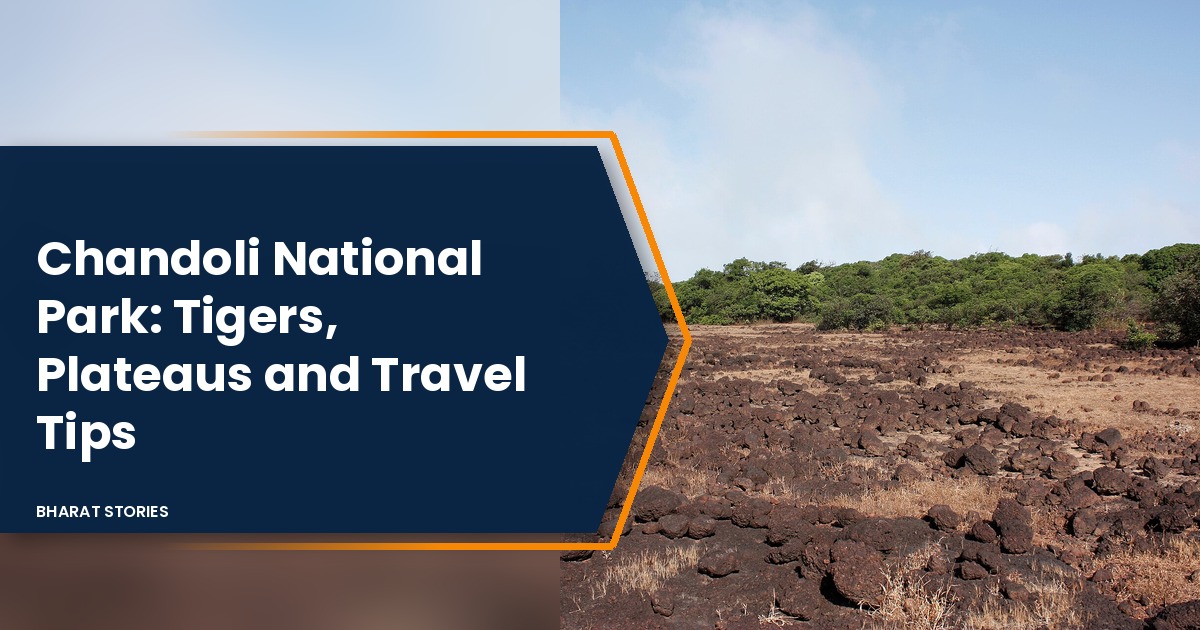
Between the forested valleys lie flat, rocky plateaus known locally as sadas. Their thin soil over hard laterite supports only grasses and small herbs for most of the year, yet after the rains they burst into colour with short lived wildflowers, much like the better known Kaas plateau further north. Zolambi sada, reached by a trail from the eastern side, is one of the most visited.
History is woven into the landscape too. The hill forts of Prachitgad and Bhairavgad stand on the ridges in and around the park, reminders of the time when these ghats were the frontier between the Deccan and the coast. Reaching them involves a long trek through forest and usually needs permission and a local guide.
Wildlife of Chandoli
Indian gaur are the largest animals visitors are likely to see, often grazing at the forest edge in the early morning. Sambar, barking deer, the tiny Indian mouse deer and wild pig make up most of the prey base. Leopards are present across the reserve, and sloth bears, dholes, jackals and civets are recorded by camera traps. The Indian giant squirrel, with its maroon and cream coat, is a common sight in the taller trees.
Birdlife is rich, with hornbills, Malabar whistling thrushes, paradise flycatchers, raptors and many forest species of the Western Ghats. The reserve runs regular bird, butterfly and moth surveys, and its biodiversity lists continue to grow. Reptiles and amphibians are also diverse, including several species of frog that are only active during the monsoon.
The Return of the Tiger
Tigers never fully vanished from the Sahyadri landscape, but for years only a handful of males were known to move through the reserve, and there was no breeding population. To change that, the Maharashtra Forest Department began a tiger recovery project in collaboration with the Wildlife Institute of India and the National Tiger Conservation Authority. The first phase concentrated on improving habitat and increasing prey.
The second phase began in late 2025. As recorded on the reserve’s tiger recovery page, three founder tigresses have been moved so far. Two came from Tadoba Andhari Tiger Reserve and were released into Chandoli after time in acclimatisation enclosures: the first, named Chanda, on 20 November 2025, and the second, named Tara, on 18 December 2025. A third tigress from Pench Tiger Reserve in Maharashtra was released directly into the wild in February 2026 without an enclosure stage.
By April 2026 both Chanda and Tara had established territories in the Chandoli area, and their radio collars were removed, with monitoring continuing through camera traps and field signs. Resident males, given local names such as Senapati and Subhedar, have been recorded in the same forests, which raises hopes of breeding. The overall plan reported by officials is to move a total of eight tigers, five females and three males, into the reserve over time.
The tigers have also brought visitors. Tourist numbers at Chandoli rose sharply in the 2025 to 2026 season, giving a welcome boost to homestays and small businesses in villages such as Manadur. Officials stress, however, that the priority is a stable, breeding population and that sightings remain rare.
Visiting Chandoli
The Chandoli ecotourism zone is run from the centre at Manadur in Shirala taluka, beside the Vasantsagar reservoir. The reserve lists vehicle safaris on routes such as Jadhavwadi to Zolambi and Manadur to Nandoli, nature trails, a bird hide and the Zolambi plateau trek. Eco guides from local villages accompany visitors.
The main tourism season runs from October to March or April, and bookings are announced through the reserve’s official channels. Parts of the reserve close during the monsoon, when roads become slippery and wildlife disperses. Plastic, loud music and leaving vehicles on safari routes are not allowed, and visitors are expected to stay with their guide.
How to Reach
The nearest airport is Kolhapur, with larger airports at Pune and Mumbai. The nearest railway stations are Karad and Kolhapur, both well connected to the rest of the state, and Chiplun on the Konkan side. From these towns, state transport buses and taxis run to Shirala and on to Manadur. Roads in the hills are narrow and winding, so allow extra time, especially after dark.
Best Time to Visit
October to February is pleasant, with green hills and cool mornings. The months just after the monsoon are best for plateau flowers and waterfalls. March to May is hotter, but animals gather at water and can be easier to see. The monsoon brings spectacular scenery but limited access.
Tips for a Responsible Visit
- Book only through the official reserve channels and carry the identity document used for booking.
- Keep voices low and never get out of the vehicle on a safari route.
- Do not pick flowers on the plateaus; many plants complete their whole life cycle in a few weeks.
- Carry your rubbish back with you, since villages around the park have limited waste collection.
- Support local homestays and guides, which gives villagers a stake in protecting the forest.
For more on the state’s geography and other places to explore, see our guide to Maharashtra.
Frequently Asked Questions
In which district is Chandoli National Park?
Most of the park is in Sangli district of Maharashtra, with parts touching Kolhapur, Satara and Ratnagiri districts.
Are there tigers in Chandoli National Park?
Yes. Two tigresses moved from Tadoba Andhari Tiger Reserve were released in Chandoli in November and December 2025, and resident male tigers have been recorded in the same area. Sightings are still uncommon.
When was Chandoli declared a national park?
Chandoli became a wildlife sanctuary in 1985 and a national park in 2004. It became part of the Sahyadri Tiger Reserve in 2010.
How can I book a safari at Chandoli?
Safaris and treks start from the ecotourism centre at Manadur. Check the Sahyadri Tiger Reserve’s official website or contact the reserve office for current booking details and fees.
What is the best time to visit Chandoli?
October to February offers pleasant weather and green scenery, while March to May can be better for seeing animals near water. Access is limited during the monsoon.
What is the Chandoli dam?
It is a dam on the Warna river at the eastern edge of the park. Its reservoir, Vasantsagar, supplies water for irrigation and power and is a scenic viewpoint for visitors.