

Campbell Bay National Park: Great Nicobar Wildlife Guide
Few Indians will ever set foot in Campbell Bay National Park, and that is part of what makes it remarkable. The park covers the northern half of Great Nicobar, the largest and southernmost island of the Nicobar group, closer to Sumatra than to the Indian mainland. Its forests have never been logged on any scale, its rivers run clear from hills to sea, and several of the animals that live here are found nowhere else on earth.
This guide explains where the park is, what lives in it, who the people of the island are, how the park fits into the larger Great Nicobar Biosphere Reserve and why the island is now at the centre of one of the country’s biggest debates about development and conservation. For other protected areas across the country, see our list of national parks of India.
Table of Contents
Campbell Bay National Park at a Glance
| Item | Detail |
|---|---|
| Location | Northern Great Nicobar Island, Nicobar district, Andaman and Nicobar Islands |
| Area | About 426 sq km |
| Declared | 1992 |
| Part of | Great Nicobar Biosphere Reserve, along with Galathea National Park |
| Forest type | Tropical wet evergreen forest with tree ferns, orchids and coastal mangroves |
| Signature species | Nicobar megapode, Nicobar pigeon, robber crab, Nicobar long tailed macaque |
| Nearest settlement | Campbell Bay town on the east coast |
| Visitor access | Restricted; prior permission from the island administration is required |
Where the Park Lies
Great Nicobar is roughly the shape of a teardrop, about 50 km from north to south. Campbell Bay town, the main settlement and administrative centre of the island, sits on the eastern coast, and the national park that shares its name spreads west and north from there across the island’s interior hills. Mount Thuillier, the highest point in the Nicobar Islands at a little over 640 metres, rises in the island’s northern hills.
To the south lies Galathea National Park, a smaller protected area of about 110 sq km around the Galathea river. A belt of forest roughly 12 km wide separates the two parks, and together they form the core of the Great Nicobar Biosphere Reserve. The reserve was declared by India in 1989 and joined UNESCO’s World Network of Biosphere Reserves in 2013. Our separate guide to Galathea National Park covers the southern half of the island.
Indira Point, the southern tip of Great Nicobar, is the southernmost point of Indian territory. From there the northern end of Sumatra is less than 200 km away across the sea, which explains why so much of the island’s wildlife has closer relatives in Southeast Asia than in peninsular India.
A Forest That Has Stayed Wild
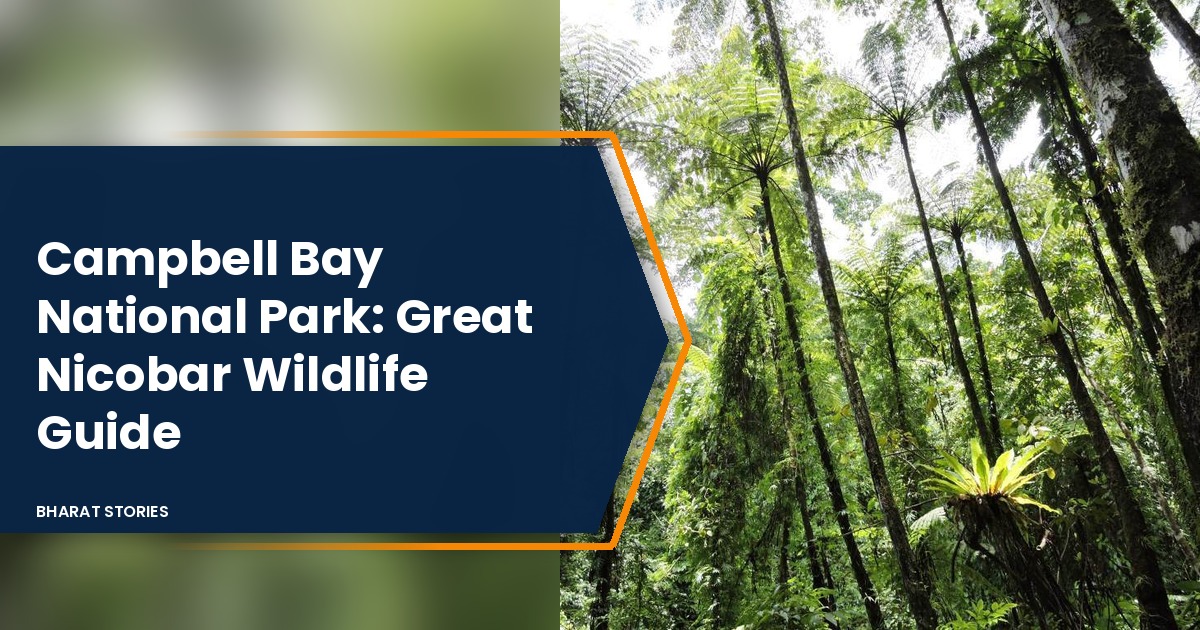
Most of the park is tall, wet evergreen forest. Rainfall is high and spread across much of the year, and the canopy is dense enough that the forest floor stays dim and damp even at midday. Giant tree ferns, some taller than a two storey house, grow in the hill valleys and give parts of the park an almost prehistoric look. Orchids, climbing palms, wild betel and screw pines fill the gaps, and the island is known for many plant species that grow nowhere else.
Along the coast the forest changes. Mangroves line creeks and river mouths, beach forest with Pandanus and Barringtonia grows behind the sand, and coral reefs lie just offshore. Several rivers, among them the Alexandra, the Dagmar and the Galathea, drain the hills and carry fresh water to the sea all year round, something that sets Great Nicobar apart from many smaller and drier islands.
Wildlife Found Here
The animals of Campbell Bay are not the tigers and elephants of a mainland park. They are island specialists, many of them endemic to the Nicobars, and they are best appreciated as a whole community rather than a checklist.
- Nicobar megapode: a ground bird that does not sit on its eggs. Instead it builds a large mound of sand and leaf litter near the shore and lets the heat of decay incubate them. It is found only in the Nicobar Islands.
- Nicobar pigeon: a striking bird with metallic green and copper plumage and a white tail, closely related to the extinct dodo.
- Robber crab: also called the coconut crab, the largest land living arthropod in the world, able to climb trees and crack coconuts with its claws.
- Nicobar long tailed macaque: a local form of the crab eating macaque, often seen near the forest edge and along streams.
- Nicobar tree shrew: a small, quick mammal of the canopy, found only in these islands.
- Reptiles: the reticulated python, the saltwater crocodile in creeks and estuaries, and many lizards and snakes.
- Sea turtles: the beaches of Great Nicobar are among the important nesting sites in the Indian Ocean for leatherback turtles, and other species also come ashore.
Birdwatchers also look for the Great Nicobar serpent eagle, the Nicobar scops owl and the Nicobar imperial pigeon. Wild pigs and several species of bats complete the list of mammals that a visiting scientist is likely to record.
The People of Great Nicobar
Great Nicobar is home to two indigenous communities. The Nicobarese, who traditionally lived along the coast, were badly hit by the 2004 tsunami and many were moved to new settlements afterwards. The Shompen live in the forested interior, including areas within and around the national park. They are hunter gatherers and horticulturists, they number only a few hundred, and the government classifies them as a particularly vulnerable tribal group. Much of their homeland lies within a notified tribal reserve.
The rest of the island’s population descends largely from families of former servicemen settled along the east coast from the late 1960s onward. Their villages, farms and the town of Campbell Bay sit outside the park, between the forest and the sea.
After the 2004 Tsunami
The earthquake and tsunami of December 2004 reshaped the Nicobar coast. Parts of Great Nicobar sank by a metre or more, coastal forests were drowned, beaches moved and some nesting grounds of megapodes and turtles were lost. Researchers who returned in the following years found that the inland forests of the national park had come through largely unharmed, and that much of the coastline had begun to recover in new forms. The event remains a reminder of how dynamic this landscape is.
The Great Nicobar Project
Since 2020 the island has been the focus of a major government plan for what is officially called the holistic development of Great Nicobar. According to a Press Information Bureau release of May 2026, it includes an international container transshipment terminal at Galathea Bay, a greenfield international airport, a gas and solar power plant of 450 MVA and a new township. The plan covers about 166 sq km in three phases running to 2047, of which roughly 131 sq km is forest land.
The government argues that the port’s position near the main east to west shipping route gives India strategic and economic advantages, and says that no Shompen or Nicobarese families will be displaced. The project received environmental clearance in November 2022. In February 2026 the National Green Tribunal dismissed fresh challenges to that clearance, while insisting on strict compliance with its conditions. Shipping Minister Sarbananda Sonowal said in mid 2026 that work on the port’s first phase would begin by 2028.
Scientists, former officials and opposition parties have raised serious concerns. They point to the felling of a large number of trees in one of India’s last intact island rainforests, risks to coral reefs and turtle beaches, the island’s position in an active earthquake zone and the possible effects on the Shompen. Legal challenges on tribal rights grounds have continued in the courts. Campbell Bay National Park itself is a separate protected area, but it shares the island’s rivers, coasts and wildlife, so its future is closely tied to how the project is carried out.
Can You Visit Campbell Bay National Park?
For most people, not easily. The Nicobar Islands are a restricted area. Indian citizens need prior permission from the Andaman and Nicobar administration to travel to Great Nicobar, and entry into the national park and the tribal reserve requires separate permission from the forest and tribal welfare authorities. Rules for foreign nationals are stricter still. There are no tourist lodges, safari routes or visitor centres inside the park.
Those who do travel, usually researchers, officials or residents, reach Campbell Bay by government passenger ship from Port Blair, a voyage that takes well over a day, or by occasional helicopter services. Anyone planning a trip should check the latest permit rules with the administration in Port Blair well in advance. For a wider picture of the islands, see our guide to the Andaman and Nicobar Islands.
Why the Park Matters
Campbell Bay protects a near complete sample of a tropical island ecosystem, from hilltop forest to coral reef, with its native people still living in it. Very few such places remain anywhere in the world. It holds species found only in the Nicobars, it shelters a river system that has never been dammed, and it gives scientists a baseline against which change on other islands can be measured. Whatever one’s view of the development plans, the park’s value as a natural archive is beyond dispute.
Frequently Asked Questions
Where is Campbell Bay National Park?
It is in the northern part of Great Nicobar Island in the Nicobar district of the Andaman and Nicobar Islands, west of Campbell Bay town.
How big is Campbell Bay National Park?
The park covers about 426 sq km. It was declared in 1992 and forms part of the Great Nicobar Biosphere Reserve along with Galathea National Park.
Which animals live in Campbell Bay National Park?
Notable species include the Nicobar megapode, Nicobar pigeon, robber crab, Nicobar long tailed macaque, Nicobar tree shrew, reticulated python and saltwater crocodile, with sea turtles nesting on the island’s beaches.
Can tourists visit Campbell Bay National Park?
Access is restricted. Indian citizens need prior permission to visit Great Nicobar, and entering the park requires further permission. There is no tourism infrastructure inside the park.
What is the Great Nicobar project?
It is a government plan for a transshipment port at Galathea Bay, an international airport, a power plant and a township on Great Nicobar. It has environmental clearance but faces strong criticism over its impact on forests, coral reefs and the Shompen.
Who are the Shompen?
The Shompen are an indigenous community of a few hundred people living in the forested interior of Great Nicobar. They are classified as a particularly vulnerable tribal group.