

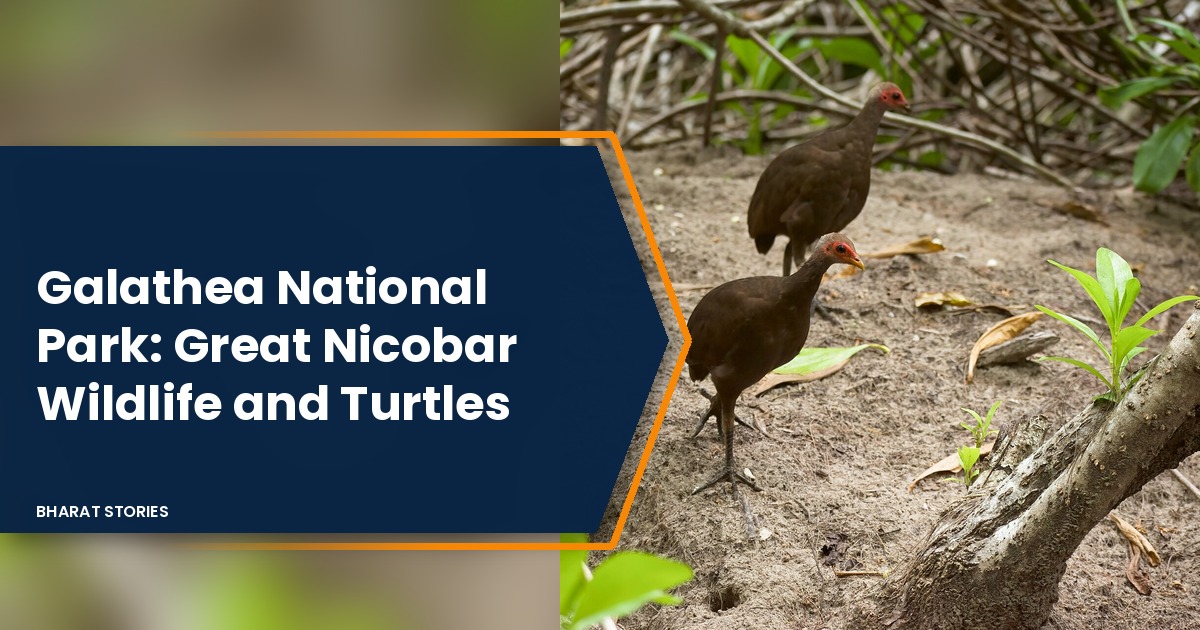
Galathea National Park: Great Nicobar Wildlife and Turtles
Galathea National Park covers the rainforest and coast of southern Great Nicobar, the island closest to the southern tip of India. It shelters some of the country’s rarest wildlife, from the mound building Nicobar megapode to giant leatherback turtles, and it now sits at the centre of a national debate over the Great Nicobar development project.
Table of Contents
Where is Galathea National Park?
Galathea National Park is on Great Nicobar Island in the Nicobar district of the Andaman and Nicobar Islands, in the Bay of Bengal near the Andaman Sea. It occupies the southern part of the island, close to Indira Point, the southernmost point of Indian territory.
The park takes its name from the Galathea River and Galathea Bay on the island’s southeast coast. It is often described as India’s southernmost national park, and it lies far closer to Sumatra in Indonesia than to the Indian mainland.
How big is it and when was it declared?
The park covers about 110 sq km and was notified in 1992. The Andaman and Nicobar Department of Environment and Forests lists it among the island territory’s protected areas.
Galathea and the larger Campbell Bay National Park, also notified in 1992, form the core zones of the Great Nicobar Biosphere Reserve. A forest buffer roughly 12 km wide separates the two parks. The biosphere reserve was added to UNESCO’s World Network of Biosphere Reserves in 2013.
| Fact | Detail |
|---|---|
| Location | Southern Great Nicobar Island, Nicobar district |
| Area | About 110 sq km |
| Declared | 1992 |
| Part of | Great Nicobar Biosphere Reserve (UNESCO network since 2013) |
| Habitat | Tropical evergreen rainforest, rivers, mangroves, sandy beaches |
| Signature species | Nicobar megapode, leatherback turtle, Nicobar tree shrew |
What wildlife lives in Galathea National Park?
The park protects tropical evergreen forest and a coastline used by nesting sea turtles, with many species found nowhere else in India. Isolation over a very long time has produced high endemism among birds, mammals and reptiles.
Birds
- Nicobar megapode: a ground bird that builds large mounds of soil and leaf litter to incubate its eggs, using heat from decomposition rather than sitting on them.
- Nicobar pigeon: a striking iridescent pigeon of the islands.
- Edible nest swiftlet: famous for nests made of hardened saliva.
- Nicobar serpent eagle and other island raptors.
Mammals
- Nicobar tree shrew: an endangered small mammal found only in the Nicobars.
- Nicobar long tailed macaque: a local form of the crab eating macaque (it is a monkey, not a bird).
- Wild pig, fruit bats and palm civets.
The Nicobars are separated from the Andamans by the Ten Degree Channel, and their wildlife shows stronger links with Southeast Asia than with mainland India. That is why many island species have Malayan or Indonesian relatives rather than Indian ones.
Reptiles
Saltwater crocodiles live in the rivers and creeks, along with reticulated pythons, water monitor lizards and the Malayan box turtle. On the beaches, leatherback, olive ridley, green and hawksbill turtles have all been recorded.
Why is Galathea Bay important for leatherback turtles?
Galathea Bay is one of the most important leatherback turtle nesting beaches in the Indian Ocean. Leatherbacks are the largest living turtles and can travel thousands of kilometres between feeding and nesting grounds.
Forest Department records obtained through a Right to Information request and published by Scroll show 889 leatherback nests and 108 olive ridley nests relocated to protected hatcheries at Galathea Bay in the 2025 to 2026 season. That is the highest leatherback count since monitoring began about four decades ago, ahead of 649 nests in 2022. The real number on the beach is likely higher, because not every nest is found and moved.
What is the Great Nicobar project and how does it affect the park area?
The Great Nicobar project is a large government plan for a transshipment port, an airport, a power plant and a new township on the island. The port is planned at Galathea Bay, the same stretch of coast used by nesting leatherbacks.
- Scroll reports the overall project at about Rs 92,000 crore, with roughly 130 sq km of mostly evergreen forest involved, and the port component at about Rs 50,000 crore.
- Planned breakwaters would narrow the mouth of Galathea Bay from about 3,000 metres to 300 metres.
- The standing committee of the National Board for Wildlife denotified the 11.44 sq km Galathea Bay Wildlife Sanctuary in January 2021 to make way for the port.
- In February 2026 the National Green Tribunal dismissed challenges to the project, holding that no part of the site falls under the strictest coastal protection category.
- Coral reefs at the site are disputed: Frontline reports that the Zoological Survey of India has documented reefs in the bay and planned coral translocation, while official coastal maps show none.
The government presents the project as strategic and economic, giving India its own transshipment hub near a major shipping lane. Conservation scientists and some former officials warn about the loss of forest, the turtle beach, coral and the lands of the Shompen, a particularly vulnerable tribal group. The project’s progress and legal challenges are worth following if you care about the future of the park and its surroundings.
Who lives on Great Nicobar?
The interior forests are home to the Shompen, a small hunter gatherer community, while Nicobarese people traditionally lived along parts of the coast. Settlers from mainland India were brought to the island from the late 1960s and live mainly along the east coast near Campbell Bay.
The 2004 Indian Ocean tsunami hit Great Nicobar hard. Coastal villages were destroyed, and parts of the southern coast near Indira Point subsided permanently.
Can tourists visit Galathea National Park?
Ordinary tourism is very limited. Most of Great Nicobar is a tribal reserve protected under the Andaman and Nicobar Islands Protection of Aboriginal Tribes Regulation of 1956, and foreign nationals generally cannot visit the Nicobar group without special permission.
For Indian citizens with a valid reason to travel, such as research, official work or approved visits, the Forest Department’s entry permit page explains that entry to national parks and sanctuaries needs a permit from the Chief Wildlife Warden or the local forest officer, along with a daily fee. Separate permission from the district administration is usually needed to travel to the island itself. Rules change, so confirm with the Andaman and Nicobar administration before planning.
How do people reach Great Nicobar?
Campbell Bay, the main settlement, is reached by government ships from Port Blair, a voyage that takes well over a day, and by limited helicopter services. There is no regular tourist infrastructure inside the park.
What is the climate like?
Great Nicobar is warm and humid all year, with heavy rain brought by both the southwest and northeast monsoons. The driest spell usually falls between January and April, which is also the main turtle nesting season. Older descriptions claiming that summer temperatures reach only 22 degrees Celsius are not accurate for this tropical island, where daytime temperatures are usually higher.
Frequently Asked Questions
Which national park is the southernmost in India?
Galathea National Park on Great Nicobar Island is generally described as India’s southernmost national park, close to Indira Point.
Why can’t we visit the Nicobar Islands freely?
Most of the Nicobars are tribal reserves protected by law to safeguard indigenous communities and fragile ecosystems, so entry needs special permits.
Is Galathea part of a biosphere reserve?
Yes. Galathea and Campbell Bay National Parks are the core zones of the Great Nicobar Biosphere Reserve, recognised by UNESCO in 2013.
What is a megapode?
A megapode is a ground bird that incubates its eggs in a mound of warm, decaying vegetation. The Nicobar megapode is found only in the Nicobar Islands.
Learn more
Galathea National Park is remote, protected and rarely seen by visitors, yet its beaches and forests matter far beyond the island. For wider context on the island chain, read our guide to the history, geography and economy of Andaman and Nicobar, or browse our list of national parks of India.