

Bandipur National Park: Wildlife, Safaris and Travel Tips
Drive south from Mysuru towards Ooty and, about an hour and a half out of the city, the farmland gives way to dry forest. Signboards warn of elephants crossing, speed breakers appear every few hundred metres, and sooner or later a herd of spotted deer will be standing at the roadside, unbothered by the traffic. You have reached Bandipur, one of the oldest and best protected tiger reserves in India. Bandipur sits alongside Nagarhole, Kudremukh and Anshi in our state-wise guide to the country’s national parks.
Bandipur lies in Karnataka, mostly in Chamarajanagar district with a part in Mysuru district, at the point where the state meets Tamil Nadu and Kerala. It is famous for elephants, has a strong tiger population and is part of the much larger Nilgiri Biosphere Reserve. Here is what to know about its history, wildlife, seasons and the practical side of a visit.
Table of Contents
Bandipur at a Glance
| Item | Detail |
|---|---|
| State | Karnataka; Chamarajanagar and Mysuru districts |
| Tiger reserve area | About 912 sq km |
| Project Tiger | One of the first reserves, included in 1973 |
| Neighbours | Nagarhole (Karnataka), Mudumalai (Tamil Nadu), Wayanad (Kerala) |
| Known for | Asian elephants, tigers, gaur, dholes and dry deciduous forest |
| Safari base | Forest department reception at Melukamanahalli, on the highway |
| Nearest city | Mysuru, around 80 km |
| Night traffic | NH 766 and NH 181 through the park are closed from 9 pm to 6 am |
From Royal Reserve to Tiger Reserve
The forests around Bandipur were a hunting preserve of the Wodeyar rulers of Mysore. In 1931 the Maharaja set aside about 90 sq km as the Venugopala Wildlife Park, one of the earliest protected areas in the region. The area grew over the following decades, and when Project Tiger began in 1973 Bandipur was among the first nine reserves chosen. Additions since then have taken the reserve to roughly 912 sq km.
What makes Bandipur special is less its own size than its position. To the north west it joins Nagarhole across the Kabini river. To the south it meets Mudumalai in Tamil Nadu, divided by the deep Moyar gorge, and to the south west it touches the Wayanad sanctuary in Kerala. Together these protected areas form one of the largest continuous forest blocks in South India, and they hold some of the largest numbers of wild tigers and Asian elephants anywhere in the world.
Landscape and Habitat
Most of Bandipur is dry deciduous forest, with teak, rosewood, sandalwood, Indian laurel and bamboo, opening into scrub towards the east where rainfall is lower. In the wetter western parts, moist deciduous forest takes over. Small seasonal streams and man made water holes dot the reserve, and the Kabini reservoir on the northern edge draws animals during the dry months.
The highest point is Himavad Gopalaswamy Betta, a hill of about 1,450 metres with a temple on top. Mist often hangs on the summit, which explains the word himavad in its name. The temple is open to pilgrims under forest department rules, and private vehicles are not allowed up the final stretch.
Wildlife of Bandipur
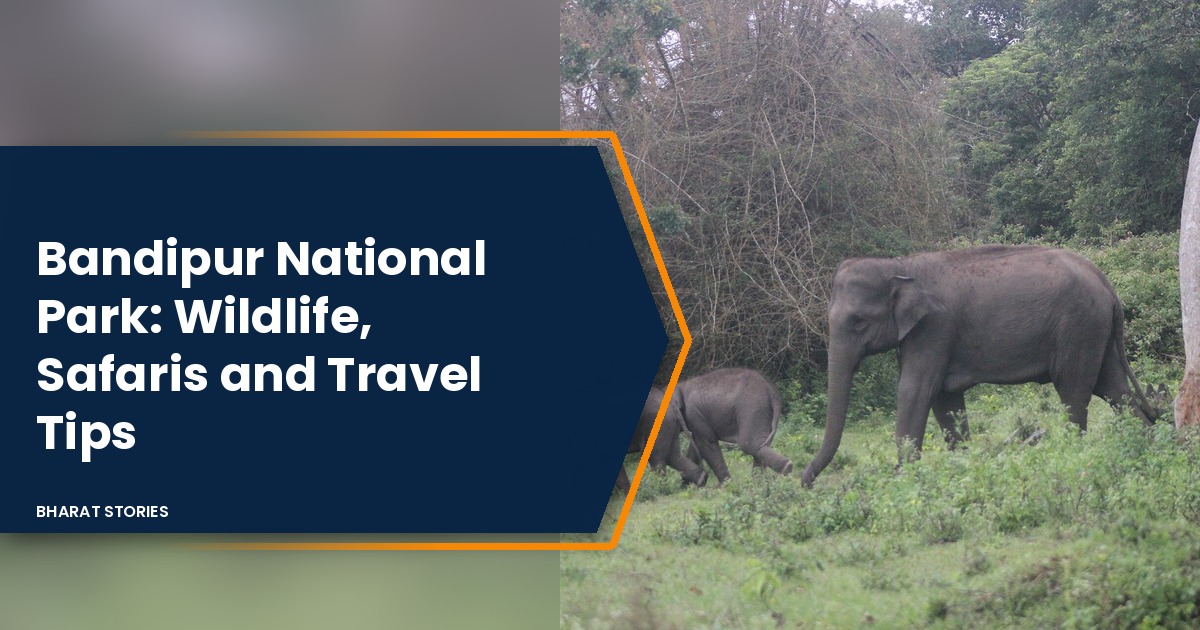
Elephants are the animal most visitors see, often in family groups grazing on bamboo or crossing the highway. Gaur, the massive wild cattle of Indian forests, are common, as are spotted deer, sambar, barking deer, four horned antelope and wild pigs. Grey langurs and bonnet macaques are everywhere.
Tigers are present in good numbers, and Karnataka had the second largest tiger population of any state in the 2022 national estimate. A sighting is still a matter of luck. Leopards turn up fairly often, sometimes resting in trees, and Bandipur is one of the better places in India to see dholes, the Asiatic wild dogs that hunt in packs along the forest roads. Sloth bears, striped hyenas, jackals and the occasional mugger crocodile along the rivers add to the list.
Birds and smaller life
Over 200 species of birds have been recorded. Changeable hawk eagles, crested serpent eagles, Indian peafowl, grey junglefowl, Malabar larks and several kinds of bee eaters are typical sights. Butterflies are abundant after the monsoon, and monitor lizards often sun themselves on rocks beside the road.
Safaris and Visitor Rules
Unlike some parks where private jeeps enter the core, Bandipur runs safaris through the Karnataka Forest Department. Visitors buy tickets at the reception centre at Melukamanahalli, close to the highway, and board forest department buses or jeeps for a drive of about an hour and a half. Morning and afternoon slots are offered, and the numbers are limited, so arrive early on weekends and holidays.
Some lodges near the reserve are authorised to run their own nature activities, and the state run Jungle Lodges and Resorts has a property close to the reception. Self driving inside the safari area is not allowed. You can drive the public highways that cut through the reserve during the day, but stopping, getting out of the car, feeding animals or honking near wildlife is prohibited and fined.
The night closure of the two national highways is one of the most talked about conservation measures in South India. Since 2009, traffic on NH 766 towards Kerala and NH 181 towards Ooty has been stopped between 9 pm and 6 am, after years of animals being killed by fast moving vehicles. Plan long road trips around these hours.
When to Visit
Bandipur stays open through most of the year, though the forest department can suspend safaris during severe drought, fire risk or heavy rain.
- October to February: green forest, cool mornings and comfortable afternoons. A good time for birds and general wildlife.
- March to May: the forest dries out, leaves fall and animals gather near water. Visibility improves, but it gets hot and fire danger rises.
- June to September: the monsoon brings fresh grass and fewer visitors. Sightings can be harder in thick growth, but the forest is at its most beautiful.
Getting There
Mysuru is the natural base for most travellers, around 80 km away on the Ooty road. Bengaluru is roughly 220 to 230 km and about five hours by road. Mysuru has a railway station with good links to Bengaluru and Chennai, and a small airport with limited flights. Kempegowda International Airport in Bengaluru is the main air gateway.
Ooty is about 80 km south, down the hairpin bends past Masinagudi, so many people combine the two. If you want to compare Western Ghats forests in the same state, our guide to Anshi National Park covers the wetter forests of Uttara Kannada. For the urban edge of Karnataka’s wildlife, see Bannerghatta National Park near Bengaluru.
Tips for a Better Visit
Book stays early for long weekends, when Bengaluru and Kerala traffic fills every lodge on the route. Carry water, a cap and binoculars, and keep your phone on silent during safaris. Muted clothes help you blend in. If you are driving through, stay within the posted speed and never stop to photograph elephants on the highway; a startled herd can charge a car.
Forest fires have damaged parts of Bandipur in dry years, most notably in 2019. Never throw a cigarette or match out of a vehicle in this landscape. Up to date rules, fees and safari times are posted by the Karnataka Forest Department.
Frequently Asked Questions
Is Bandipur better than Nagarhole?
They share the same wildlife and are effectively one landscape. Bandipur is drier and easier to reach from Mysuru, while Nagarhole has denser forest and the Kabini backwaters. Many people visit both.
Can I drive my own car on a safari in Bandipur?
No. Safaris run in forest department vehicles from the Melukamanahalli reception. Private cars may only use the public highways during open hours.
What are the chances of seeing a tiger?
Fair but never certain. Elephants, deer, gaur and langurs are seen on almost every drive; tigers and leopards on some.
Why is the highway closed at night?
To reduce roadkill. The ban on night traffic through the reserve has been in place since 2009 and has been upheld by the courts.
Is Bandipur suitable for a day trip from Bengaluru?
It is possible but tiring. An overnight stay near the reserve or in Mysuru allows an evening and a morning safari without a dawn start from the city.