

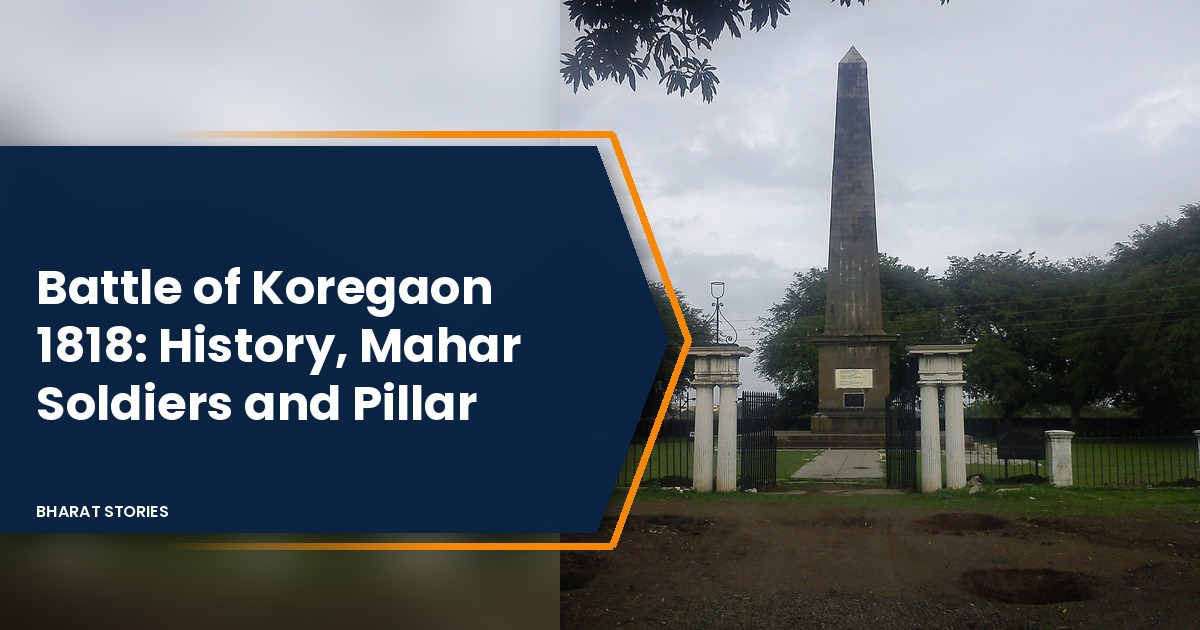

The Battle of Koregaon was fought on 1 January 1818 at Koregaon Bhima, a village on the Bhima river near Pune, between a small East India Company force and the army of Peshwa Baji Rao II. It lasted about twelve hours, ended without a clear winner on the day, and later became one of the most remembered events of the Third Anglo Maratha War. Today the battle is known mostly because of the Mahar soldiers who fought in it and the victory pillar that stands at the site.
Table of Contents
What was the Battle of Koregaon?
It was a clash on 1 January 1818 in which about 834 Company troops held the village of Koregaon against repeated attacks by a much larger Peshwa army, until the Peshwa’s men withdrew at night. The Wikipedia article on the Battle of Koregaon describes a Peshwa force of about 28,000 men on its way to attack Pune, of which around 2,000 were sent into the fight. The Company side was led by Captain Francis Staunton.
The battle was part of the Third Anglo Maratha War of 1817 and 1818. That war ended Peshwa rule and left the Company in control of most of western, central and southern India. Our post on the Maratha Empire covers the rise of the Peshwas, and Koregaon sits near the very end of that story.
Why was the Battle of Koregaon fought?
The battle happened because the Peshwa, after losing Pune to the British, was trying to march back and retake it, and a Company relief force ran straight into his army on the way.
- On 13 June 1817 the Company forced Baji Rao II to sign the Treaty of Pune, which made him give up large territories and ended his claim to lead the other Maratha chiefs.
- The Peshwa then turned on the British. He burnt the British Residency at Pune but was defeated at the Battle of Khadki on 5 November 1817.
- He fled while General Smith chased him, and Pune was placed under Colonel Charles Barton Burr.
- Late in December the Peshwa doubled back towards Pune. Burr asked for help from the Company troops stationed at Shirur, and that relief column met the Peshwa’s army at Koregaon.
The Wikipedia article on the Third Anglo Maratha War explains how the Bhosale of Nagpur and Holkar of Indore also rose against the Company and were defeated within months.
What happened on 1 January 1818 at Koregaon?
A Company detachment that had marched all night from Shirur reached Koregaon on the morning of 1 January 1818, found the Peshwa’s army across the river and defended the village until about 9 pm, when the attackers left. One of the earliest detailed accounts is the Poona District Gazetteer of 1885, which The Indian Express summarised in its explainer. In order, the day went like this:
- At 8 pm on 31 December 1817, the second battalion of the first regiment of Bombay Native Infantry, about 500 rank and file, left Shirur with about 300 irregular horse and two six pounder guns worked by 24 Madras artillerymen.
- After a march of roughly 25 miles, they reached the Bhima river near Koregaon at about 10 in the morning and saw a huge Maratha cavalry force on the other side. The Gazetteer places the village 16 miles northeast of Pune.
- Staunton occupied the walled village and placed his two guns to cover the river and the Shirur road.
- The Peshwa sent three infantry parties of Arab, Gosain and Maratha soldiers across the river from different points, backed by two guns and rocket fire.
- By noon the Arab soldiers had taken a temple at the edge of the village and captured one of the Company guns. Lieutenant Chisholm was killed. Some gunners, cut off from food and water, talked of surrender, but Staunton refused.
- Lieutenant Pattinson led a counter attack and took the gun back.
- As night fell the attacks eased. By about 9 pm the firing stopped and the Peshwa’s troops left, reportedly fearing a larger British force under General Smith that was on its way.
The Peshwa did not attack again, and on the night of 2 January Staunton marched back to Shirur with most of his wounded.
Who fought on each side at Koregaon?
A small Company force of Indian sepoys with British officers faced the army of Peshwa Baji Rao II and his commanders, including Bapu Gokhale, Appa Desai and Trimbakji Dengle.
- East India Company: the 2nd Battalion, 1st Regiment Bombay Native Infantry, auxiliary horse and a small Madras artillery detachment, under Captain Francis Staunton. The Hindu puts the total at 834 troops and 12 officers.
- Peshwa’s army: about 20,000 cavalry and 8,000 infantry in all, according to Wikipedia, with around 2,000 men committed to the attack and reinforced through the day.
Of the 834 Company troops, 275 were killed, wounded or missing. British estimates put the Peshwa’s losses at 500 to 600 killed or wounded.
Who won the Battle of Koregaon?
Neither side won a decisive victory on the day, but the Company claimed it as a triumph and the battle is usually counted as a Company win because the Peshwa lost the war soon after. The village did not fall, which is the basis of the British claim. On the other hand, Mountstuart Elphinstone, who visited the site two days later, described it in his journal as a small victory for the Peshwa, according to the Wikipedia article.
The Indian Express explainer notes that the outcome is still contested, with some Maratha histories saying the Peshwa’s army came out on top. Either way, the Company celebrated the defence. Staunton’s battalion was made Grenadiers, and Staunton received a sword and 500 guineas from the Company’s Court of Directors.
How many Mahar soldiers fought at Koregaon?
About 500 of the Company infantrymen at Koregaon are generally described as Mahars, and 22 of the 49 soldiers named on the victory pillar are identified as Mahar. The Hindu reports that the 500 infantrymen in the 834 strong force were predominantly Mahars.
The unit was mixed. A 1981 history of the Mahar Regiment by Col V Longer counts the Indian soldiers who fell as 22 Mahars, 16 Marathas, 8 Rajputs, 2 Muslims and one or two Indian Jews. The Mahar names are identified by the ending nak, which was used by that community.
Why did Mahar soldiers fight against the Peshwa?
Accounts quoted by The Hindu say relations between the Brahmin Peshwas and the Mahar community had soured badly by the time of Baji Rao II, who is said to have insulted the community and turned down its offer to serve in his army. The same report traces the strain back to the death of Peshwa Baji Rao I in 1740.
The Mahars were considered untouchable in the caste order of that time, and the later Peshwa rule is remembered for harsh treatment of such communities. At the same time, Mahars had a long military record on both sides. They served in Maratha armies from the time of Shivaji and fought alongside Peshwa forces at the Third Battle of Panipat and at Kharda in 1795. The Wikipedia history of the Mahar Regiment adds that the East India Company began recruiting Mahars around 1750 and that they made up a large share of the Bombay Army.
What is the Koregaon victory pillar?
The victory pillar is a tall stone obelisk that the East India Company put up at Koregaon in the early 1820s to honour the soldiers who died in the battle. Wikipedia dates it to 1821, while the Indian Express describes a 65 foot obelisk erected in 1822. Locally it is called the Jaystambh, Ranstambh or Vijay Stambh.
- The English inscription claims that Staunton’s force “accomplished one of the proudest triumphs of the British Army in the East.”
- The pillar carries the names of 49 Company soldiers killed in the battle.
- It appeared on the crest of the Mahar Regiment until Indian independence, and a medal for the battle was issued in 1851.
Built as a symbol of British power, the pillar has become a memorial to the Mahar soldiers, as The Hindu explains in its story on how the memorial became a symbol of Dalit pride.
Why do people gather at Bhima Koregaon every 1 January?
People gather on 1 January to honour the soldiers named on the pillar, a tradition that grew after Dr B R Ambedkar visited the site on 1 January 1927. His visit made the battle a rallying point for the Dalit community, and the Indian Express notes that he spoke again about Koregaon in a speech at Sinnar in 1941. Our profile of B R Ambedkar covers his life and work.
In 2005 the Bhima Koregaon Ranstambh Seva Sangh was formed to keep the memory alive. The Hindu reports that visitor numbers have grown from a few thousand to lakhs, including many from Uttar Pradesh, Karnataka and Gujarat. On 1 January 2018, the 200th anniversary, clashes broke out during the commemoration and led to two days of protests in Mumbai and other parts of Maharashtra.
What happened to the Peshwa after Koregaon?
Baji Rao II kept retreating, lost his main commander at Ashta in February 1818, and surrendered to the British in June 1818, which ended the office of the Peshwa as a ruling power.
- On 19 February 1818 General Smith caught the Peshwa’s army at Ashta, and Bapu Gokhale was killed there.
- On 2 June 1818 the Peshwa met Sir John Malcolm and gave up his royal claims in exchange for a pension and a home at Bithur near Kanpur.
- Most of his lands were joined to the Bombay Presidency.
- According to the Wikipedia biography of Baji Rao II, he was the 13th and last Peshwa and died at Bithur on 28 January 1851.
The fall of the Peshwa was one more step in the long British takeover described in our post on the expansion of East India Company rule in India.
Quick answers about the Battle of Koregaon
Is the Bhima Koregaon battle real?
Yes. It is recorded in Company reports and the London Gazette of 1818 and in the Poona District Gazetteer of 1885. The debate is about who won and what it means, not whether it happened.
Where is Koregaon Bhima?
Koregaon Bhima is a village on the Bhima river in Pune district, Maharashtra, about 16 miles northeast of Pune according to the 1885 Gazetteer. It is not the same place as Koregaon Park, which is a neighbourhood inside Pune city.
Who was the last Peshwa of the Maratha Empire?
Baji Rao II was the last ruling Peshwa. His adopted son Nana Saheb inherited only the title, not the power.