

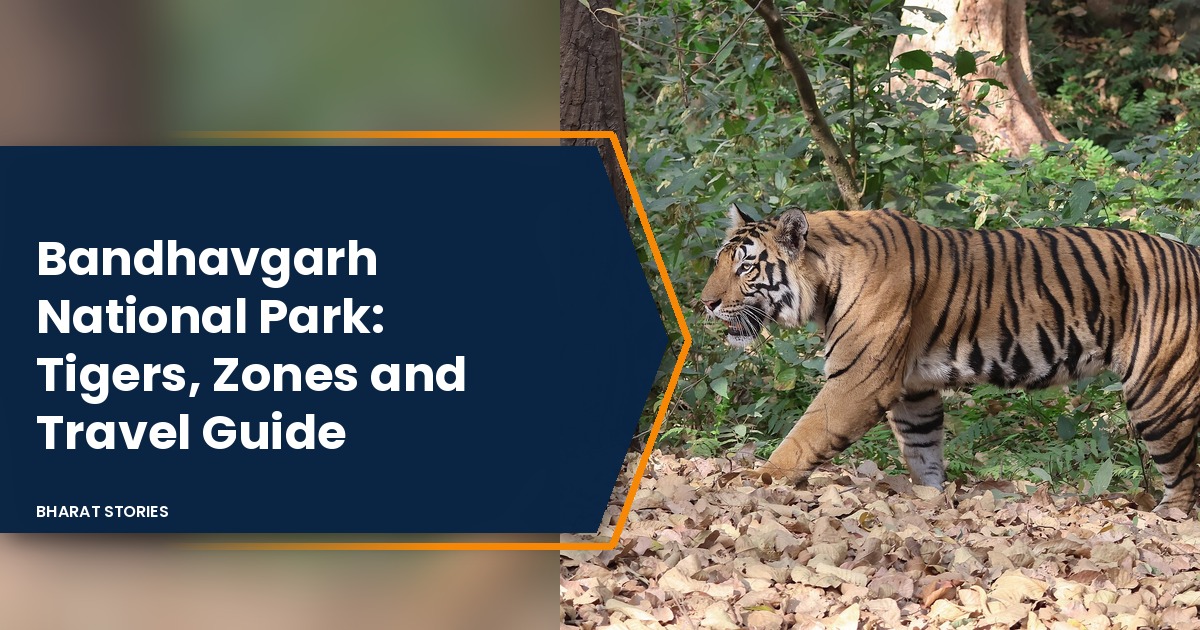
Bandhavgarh National Park: Tigers, Zones and Travel Guide
Ask a group of Indian wildlife photographers where they saw their first wild tiger and a surprising number will say Bandhavgarh. The reserve sits in Umaria district in eastern Madhya Pradesh, on the edge of the Satpura hills, and its reputation rests on a simple fact: tigers here have long lived at high density in a landscape small enough for jeeps to cover in a morning. Add a hilltop fort, ancient rock shelters and grassy valleys that glow at sunrise, and you have one of the most rewarding parks in central India.
This guide covers the essentials: how big the reserve is, how the safari zones work, which animals and birds you can realistically hope to see, when to go and how to get there. For a wider view of protected areas across the country, see our list of national parks of India.
Table of Contents
Bandhavgarh at a Glance
| Item | Detail |
|---|---|
| State and district | Madhya Pradesh; Umaria district, with part of the buffer in Katni |
| National park declared | 1968; brought under Project Tiger in 1993 |
| Tiger reserve area | About 1,537 sq km: 716.9 sq km core and 820 sq km buffer |
| Core safari zones | Tala, Magadhi and Khitauli |
| Buffer safari zones | Dhamokhar, Johila and Panpatha |
| Nearest railhead | Umaria, about 32 km from Tala village |
| Nearest airport | Jabalpur, roughly 165 to 170 km by road |
| Core zones closed | Usually 1 July to 30 September for the monsoon |
A Park Named After a Fort
The name comes from the fort that crowns the highest hill in the reserve. Bandhav means brother and garh means fort, and local tradition holds that Lord Rama gave the fort to his brother Lakshmana so he could keep watch over Lanka. Whatever the truth of the legend, the hill has been occupied for a very long time. Caves cut into the sandstone carry old inscriptions, and a large reclining figure of Vishnu, known as Shesh Shaiya, lies near a spring at the foot of the hill, with water flowing from beneath it.
For centuries the forest was a hunting ground of the rulers of Rewa. That private status kept much of it intact, and in 1968 the area became a national park. The reserve as it stands today joins Bandhavgarh National Park with the neighbouring Panpatha Wildlife Sanctuary to form the core, ringed by a much larger buffer of village land and forest. Only about a fifth of the core is open to tourists. The rest is left quiet on purpose.
Landscape and Forest
Bandhavgarh is hilly country. Steep ridges, some topped by cliffs, enclose long valleys where streams feed marshy meadows. Sal dominates the lower slopes and valley floors, while mixed forest with saja, dhaora, tendu and bamboo takes over on drier ground. Meadows such as the well photographed Chakradhara below the fort hill are where deer gather and where tigers come to hunt.
That mix of cover and open ground is why sightings here are better than in many denser forests. A tiger walking along a valley road is visible for a long way. A leopard on a rock ledge is another matter; the reserve has a healthy leopard population, but they are shy and tend to keep to the broken hill country.
Wildlife You Can Realistically Expect
Tigers are the headline, and Bandhavgarh has some of the highest tiger densities recorded anywhere in India. Madhya Pradesh as a whole had the largest tiger population of any state in the 2022 national estimate, and this reserve is one of the reasons. Still, nothing is guaranteed. Plenty of visitors do three or four drives without a sighting, and a good naturalist will tell you that a morning spent reading pugmarks and alarm calls is not wasted.
Spotted deer are everywhere, and sambar, barking deer, nilgai and wild pig are common. Gaur were brought back to the reserve in 2011 and 2012 after vanishing locally, and herds now graze in parts of the core. Sloth bears, jackals, jungle cats and the occasional pack of dholes complete the list of mammals most guests notice. Langurs and rhesus macaques are constant companions, and their alarm calls are often the first sign that a predator is moving.
A newer and more complicated arrival is the wild elephant. Herds that wandered in from Chhattisgarh around 2018 chose to stay, and they now live in and around the reserve. Their presence has brought fresh conflict with farmers on the fringe, and in late 2024 the deaths of ten elephants in a single herd, linked by officials to toxic kodo millet they had eaten, drew national attention. If your guide stops well short of a herd, that is why.
Birds
The reserve records around 250 species of birds. Crested serpent eagles and changeable hawk eagles are seen through the year, and the brightly coloured Indian pitta arrives with the summer heat. Malabar pied hornbills, Indian rollers, lesser adjutant storks and a range of woodpeckers all turn up, and the marshes near water holes attract herons and storks. Even on a slow tiger morning, a pair of binoculars keeps the drive interesting.
How the Safari Zones Work
Each core zone has its own gate and a fixed daily quota of vehicles, split between a morning and an afternoon round. Tala is the oldest and most famous zone, covering the fort hill and the meadows below it, and it is usually the first to sell out. Magadhi has wide grasslands and has produced many sightings in recent seasons. Khitauli is quieter, with good bird life and a gentler pace.
The buffer zones of Dhamokhar, Johila and Panpatha use separate gates and smaller numbers of vehicles. They are often easier to book, and they stay open for part of the monsoon when the core is shut. Tigers do use the buffer, so a buffer drive is not a consolation prize.
Permits are sold through the official Madhya Pradesh forest booking portal and released well in advance. For peak months, especially the Diwali week, Christmas and the hot summer months when animals gather at water, book as early as you can. Each permit is tied to a named vehicle with a registered guide, and you will need to show the identity document used during booking at the gate.
Best Time to Visit
The core zones open on 1 October and usually close on 30 June. Within that window, the experience changes a lot.
- October and November: fresh green forest after the rains, pleasant temperatures and fewer crowds outside the festival weeks.
- December to February: cold mornings, sometimes close to freezing in an open jeep, with misty valleys and good light. Bring a warm jacket, gloves and a cap.
- March to June: hot, dry and dusty. Grass thins out and animals stay near water, which is why many photographers prefer April and May despite the heat.
Buffer zones may run limited safaris during the monsoon. Rules change from year to year, so check the current notice before planning a rainy season trip.
How to Reach Bandhavgarh
Tala village is the hub for most visitors, with hotels and lodges along the road to the main gate. Umaria railway station, about 32 km away, sits on the Katni to Bilaspur line and is the closest railhead. Katni Junction, roughly 100 km away, has far more trains, and Jabalpur is a common choice for those combining Bandhavgarh with other parks.
Jabalpur airport is the nearest with regular flights, about three and a half to four hours by road. Khajuraho is another option, and some travellers fly into Nagpur and make a longer drive. Many itineraries pair Bandhavgarh with Kanha National Park to the south west, which takes most of a day by road, or with Pench National Park further on.
Responsible Travel
Bandhavgarh is popular, and popularity puts pressure on any park. Small choices help. Keep voices low and stay seated in the vehicle. Do not ask a driver to leave the track or follow a tiger closely, even if another jeep does. Avoid single use plastic, and carry rubbish back to your lodge.
Choose lodges that hire and train local people, buy food from nearby farms and handle waste properly. Tips should reward a guide who knows the forest, not one who breaks rules for a closer photograph. Remember that the villages around the buffer bear the real cost of living beside tigers and elephants, through lost cattle and damaged crops.
Official information on fees, rules and closures is published by the Bandhavgarh Tiger Reserve management, and it is worth checking before you book.
Frequently Asked Questions
Which is the best zone in Bandhavgarh for tiger sightings?
Tala has the strongest reputation, but Magadhi and Khitauli have produced excellent sightings in recent seasons. Tigers move between zones, so booking more than one drive matters more than picking a single zone.
How many safaris should I book?
Three to four drives over two days gives a fair chance of seeing a tiger and lets you enjoy the other wildlife without rushing.
Is Bandhavgarh open during the monsoon?
The core zones usually close from 1 July to 30 September. Some buffer areas may stay open, depending on that year’s orders.
Can children go on a safari?
Yes. Children are allowed in safari vehicles, though fees and seat rules apply. Early starts and long drives can be tiring for small children, so plan rest time.
What should I wear?
Dress in muted colours such as olive, khaki or brown. In winter add warm layers, and in summer carry a hat, sunscreen and plenty of water.