

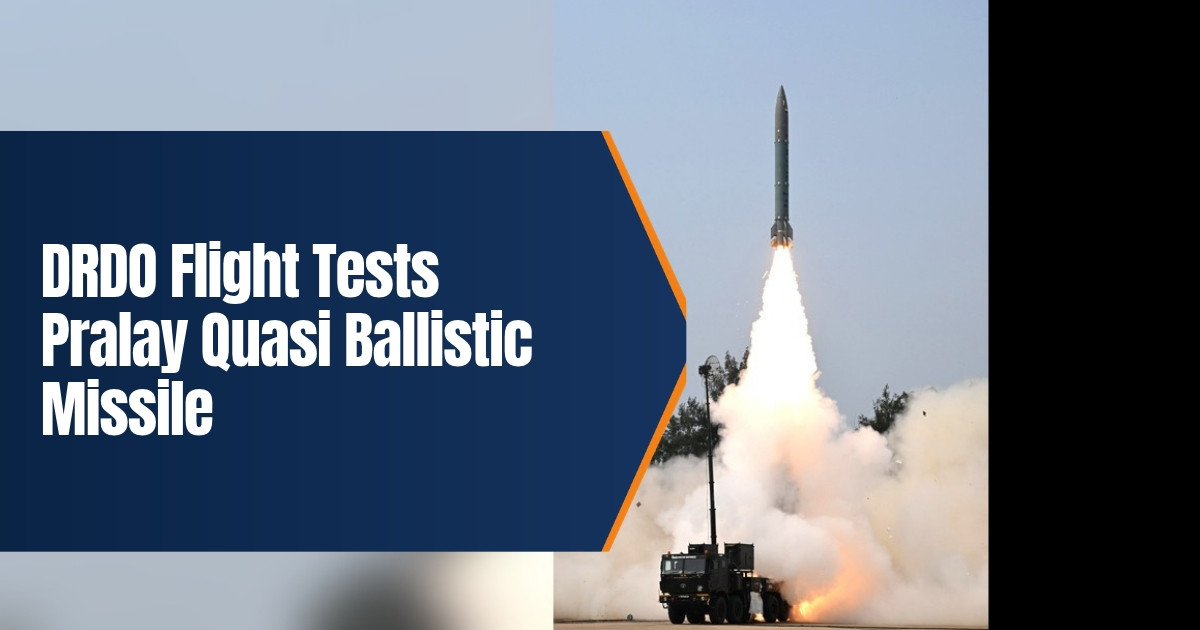

The Defence Research and Development Organisation on Thursday, 5 November 2026, successfully flight tested the indigenously developed Pralay missile, a quasi ballistic system, from Dr APJ Abdul Kalam Island off the Odisha coast. The Press Information Bureau, Ministry of Defence said the missile lifted off at around 1110 hrs and that all test objectives were fully met, as confirmed by data from range instruments deployed by the Integrated Test Range at Chandipur.
The trial was run as part of user evaluation trials. With this success, the Ministry said, induction of the system into the armed forces has become imminent.
Table of Contents
What the Pralay missile flight test confirmed
According to the Ministry release (PRID 2333276, posted at 7:47 PM on 5 November 2026), Research Centre Imarat in Hyderabad, working with other DRDO laboratories, developed the missile. Bharat Dynamics Limited, listed as one of the development cum production partners, produced the system that was fired.
Senior DRDO officials, industry representatives and personnel from the Defence Forces watched the launch as part of the user evaluation process, the release said. The Hindu reported the same details and put the launch time at around 11.10 a.m.
The Tribune, citing PIB, said the Ministry of Defence described the successful trial as bringing the system closer to induction. That wording matches the PIB line that induction has become imminent.
What Rajnath Singh and the DRDO Chairman said
Defence Minister Rajnath Singh congratulated DRDO, the Defence Forces and industry partners. He said the missile, equipped with advanced technologies, will further enhance the technological capabilities and operational preparedness of the military against emerging threats, according to the PIB release.
On X, the minister went further. The Tribune and The Hindu quoted him saying that DRDO had successfully conducted the flight test of the indigenously developed Pralay missile off the Odisha coast at 1110 hrs, that the trial was part of user evaluation trials, and that it had met all stipulated objectives as validated by range instruments. “This successful trial marks another significant milestone in strengthening India’s indigenous defence capabilities,” he said.
Defence Secretary and Secretary, Department of Defence R&D and Chairman, DRDO, Rajesh Kumar Singh also congratulated the teams linked to the flight test, the Ministry said. Readers who want more on his recent tenure can see our report on the extension given to Defence Secretary Rajesh Kumar Singh.
Why a user evaluation trial matters
User evaluation trials sit near the end of a missile programme. They are meant to show the services that the weapon meets the objectives they set before induction. Thursday’s test was framed that way by the Ministry: not as a first look at a new design, but as a step that clears the path for the forces to take the system into inventory.
The Ministry did not publish range figures, warhead details or trajectory data in the 5 November release. Bharat Stories is sticking to what that release, The Hindu and The Tribune confirmed. Claims about range or payload that appear only in older coverage of earlier Pralay tests are left out of this report.
What is clear from the official account is that the missile is described as quasi ballistic, that it is indigenous, that BDL produced the system used in the trial, and that the services and industry were present for the evaluation.
Where the launch took place
Dr APJ Abdul Kalam Island, off Odisha, is a familiar launch site for Indian strategic and tactical missile trials. The Integrated Test Range at Chandipur provides the instruments that track such flights. The PIB said those instruments confirmed that every objective of Thursday’s Pralay shot was met.
Calling the missile quasi ballistic signals that its flight path is not a simple high arc of a classic ballistic missile. Indian official statements have used that label for Pralay for years. Thursday’s release repeats it but does not expand on the flight profile beyond saying the objectives were met.
How this fits India’s indigenous defence push
Rajnath Singh cast the trial as another step in indigenous defence capability. That theme also runs through our explainer on National Technology Day on 11 May.
Pralay’s path from laboratory to production partner to user evaluation also fits the wider push to keep design and manufacture inside India. RCI Hyderabad led the development with other DRDO labs; BDL produced the system. That chain is spelled out in the Ministry release and repeated by The Hindu and The Tribune.
For the longer history of the Army’s own commemorations and fighting tradition, see our piece on National Army Day on 15 January.
The presence of the armed forces at the range also matters for what comes next. User evaluation is the services’ chance to watch the system under trial conditions before they accept it. The Ministry’s choice of words on Thursday, calling induction imminent after this shot, is stronger than a routine progress update.
Industry partnership is part of that story too. Listing Bharat Dynamics Limited as a development cum production partner puts a public sector defence firm at the centre of manufacture, not only design. The Hindu and The Tribune both repeated that production credit from the PIB note.
Featured image photo: Ministry of Defence, Government of India, GODL India, via Wikimedia Commons. It shows the flight test of the Pralay missile conducted on 5 November 2026 from Dr APJ Abdul Kalam Island off Odisha. Attribution is required under the Government Open Data Licence India.
FAQ
When was the Pralay missile flight tested?
On 5 November 2026 at around 1110 hrs from Dr APJ Abdul Kalam Island off Odisha, as part of user evaluation trials.
Is Pralay ready for induction?
The Ministry of Defence said that with this successful test, induction of the system has become imminent. No induction date was announced in the release.
Sources
- Press Information Bureau, Ministry of Defence, 5 November 2026 (PRID 2333276): launch time, ITR Chandipur data, RCI Hyderabad, BDL production partner, user evaluation, imminent induction, Rajnath Singh and Rajesh Kumar Singh statements.
- The Hindu, 5 November 2026: report of the trial, 11.10 a.m. timing, witnesses, Rajnath Singh X post.
- The Tribune, 5 November 2026: user evaluation framing; Rajnath Singh indigenous capability quote; imminent induction.