

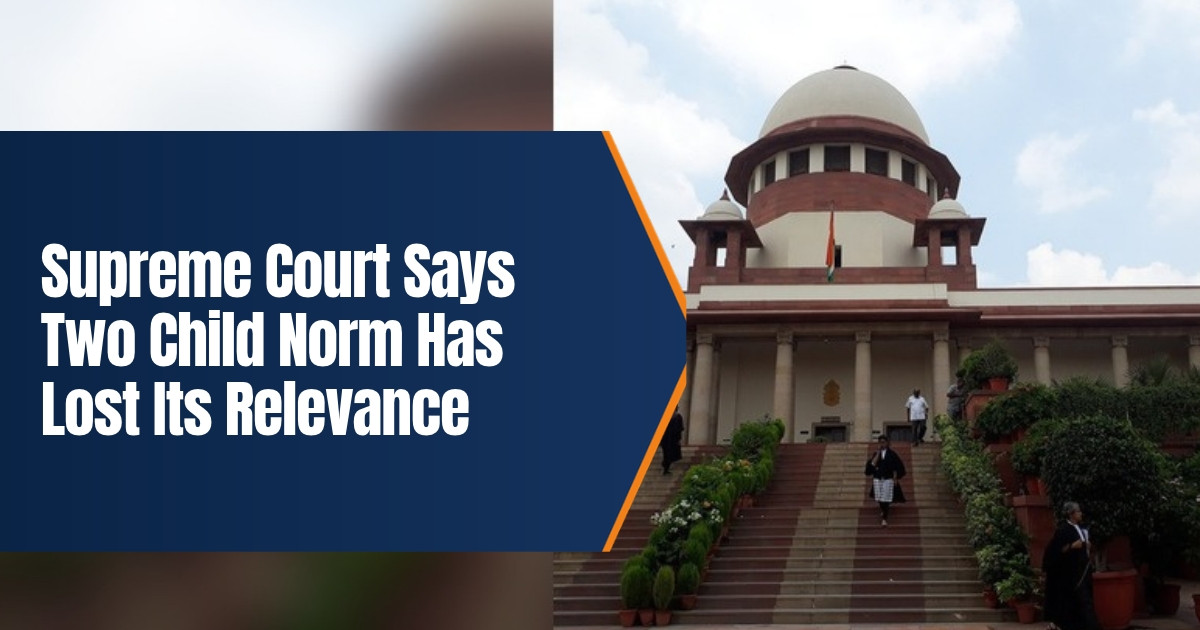

The Supreme Court has said that laws punishing people for having more than two children have lost their relevance, and has asked a larger bench to take a fresh look at the 2003 ruling that upheld the two child norm for panchayat elections. In a judgment dated 4 November 2026, a bench of Justices P.S. Narasimha and Alok Aradhe said the fear of overpopulation that justified such laws “has crumbled due to demographic changes in the past few decades”.
The court stayed the proceedings before it and directed that the matter be placed before the Chief Justice of India to set up an appropriate bench.
Table of Contents
The sarpanch behind the two child norm case
The appeal was filed by Mangala Bhimrao Ingle, whose election as sarpanch of Kakoda Gram Panchayat in Maharashtra was set aside because she had more than two children. She was disqualified under Section 14(1)(j 1) of the Maharashtra Village Panchayats Act, 1959, a provision that came into force in September 2000, the Indian Express reported. The Bombay High Court upheld her disqualification in August 2025, according to the same report.
BusinessLine reported that the authorities found she had given birth to a third child in 2014, yet contested and won the panchayat election in 2022. When it issued notice, the Supreme Court had stayed the High Court order, and that interim protection will continue until the appeal is disposed of, the judgment says.
What the numbers show
Much of the judgment rests on official population data. The bench noted that when the court decided Javed v. State of Haryana in 2003, India’s total fertility rate, or TFR, was 3.02. The latest Sample Registration System report, for 2024, puts it at 1.9. A TFR of 2.1 is the replacement level, the rate at which one generation fully replaces itself, so India is now below it. The Hindu rounded the earlier figure to 3.
The court went further back too. Between 1971 and 2024, the crude birth rate fell from 36.9 to 18.3 births per 1,000 people, while the TFR fell from 5.2 to 1.9, it said, citing SRS estimates. BusinessLine reported that the judgment also pointed to an ageing country: the share of people aged 60 and above rose from about 8.3% in 2014 to 9.7% in 2024 and is projected to be close to 15% by 2036.
India’s population is not shrinking yet, but an older population with fewer working age people is coming, the bench said. “If we fail to take note of such demographic changes, India will face serious consequences,” the judgment says.
Why the bench wants Javed revisited
In Javed, a three judge bench upheld a Haryana law that barred people with more than two children from panchayat posts. It treated a “population explosion” as a barrier to progress and, BusinessLine noted, cited China’s population control drive as an example. The new judgment observes that China has since given up its strict limits, and that the Haryana provision examined in Javed was itself later repealed by the state.
The bench was blunt about the reasoning in that ruling. Letting such laws stand, it said, “excludes an entire class of citizens from political representation on grounds bearing little rational connection to their capacity to hold public office”. It added that the rule “compels an unconscionable choice between bearing children and democratic participation, impinging on the right to reproductive autonomy under Article 21.”
The judges also made a broader point about courts. “Failure to use power to adapt to change is in its own way an abuse of power,” they wrote. Even if the law was valid when it was made, they said, the policy behind it and the reasons once given to defend it have now collapsed.
The impact on women
Javed had brushed aside the concern by saying men and women would be equally disqualified. The bench disagreed, saying that does not match social reality and that women are hit harder.
It cited a 2009 study sponsored by the Ministry of Panchayati Raj in Rajasthan, Madhya Pradesh and Gujarat, which found that such a rule, applied in a patriarchal setting, had weakened the position of women rather than empowering them. Because decisions on having children are often made by husbands, the court said, a woman may lose her seat over a choice she had little say in. It also noted documented cases of forced abortions, desertion of pregnant wives and denial of paternity by people trying to avoid disqualification.
Where the rule still applies
The idea goes back to the K. Karunakaran Committee, which had suggested barring people with more than two children from every election “from the Panchayat to the Parliament”. A constitutional amendment bill on these lines was introduced in the Rajya Sabha in 1992, but the parties never reached agreement and no central law followed, the judgment records. Several states, however, applied it to local bodies.
According to a compilation by amicus curiae Rukhmini Bobde, cited by the Indian Express, seven states have repealed the provision and 15 never had it. Assam, Goa, Gujarat, Maharashtra, Odisha and Uttarakhand are among those that still do. That state list comes from the amicus note as reported, and Bharat Stories has not checked each state law separately.
What happens next
This is not yet the end of the two child norm. The bench has not struck down the Maharashtra provision; it has referred the question to a larger bench, and the 2003 ruling stays binding until that bench decides.
For more on India’s population story, see our explainer on World Population Day on 11 July and our guide to India’s population state wise. The role of village councils is covered in our piece on National Panchayati Raj Day.
Featured image photo: Pinakpani, CC BY SA 4.0, via Wikimedia Commons. It shows the main building of the Supreme Court of India in New Delhi, photographed in August 2018.
FAQ
What is the two child norm?
It is a rule in some states that disqualifies people with more than two children from contesting or holding posts in panchayats and other local bodies.
Has the Supreme Court struck down the two child norm?
No. It said such laws have lost their relevance and referred the 2003 Javed ruling, which upheld them, to a larger bench.
Sources
- Supreme Court of India, judgment in Mangala Bhimrao Ingle’s appeal, 4 November 2026: TFR figures, crude birth rate, quotes, Javed reference, 2009 study, Karunakaran Committee, interim order, amicus.
- The Hindu, 4 November 2026: report on the judgment, bench and quotes.
- The Indian Express, 4 November 2026: appellant, Section 14(1)(j 1), September 2000, Bombay High Court, amicus compilation of states.
- BusinessLine, 4 November 2026: third child in 2014, 2022 election, ageing data, China reference.