


The Union Cabinet has approved a two year Agniveer extension that changes the shape of the Agnipath scheme just weeks before the first batch was due to leave. Agniveers who are not picked for regular service after four years will now be offered a second two year engagement, and after that, every willing Agniveer who meets the selection criteria will be offered enrolment as a regular soldier, the Ministry of Defence said on Wednesday, 4 November 2026.
The decision was announced at the Cabinet briefing in New Delhi by Chief of Defence Staff General N.S. Raja Subramani and Union Minister Ashwini Vaishnaw. The Agnipath scheme itself stays; what changes is the fate of the 75% who would have gone home after four years.
Table of Contents
What the Agniveer extension changes
When Agnipath was launched in June 2022, recruits aged 17.5 to 21 joined for four years. Only a quarter were to be kept on in the regular cadre on merit, and the rest were to return to civilian life with a lump sum. That 25% merit route stays as it is, the Defence Ministry said.
The remaining 75% will now be offered another two years of service if they want it. At the end of that second period, all of them will be offered enrolment as regular soldiers, provided they are willing and clear the selection criteria. The ministry said this creates a pathway for the absorption of all Agniveers into the defence forces.
CNBC TV18 reported that the CDS listed physical fitness and adaptability among the selection requirements. Those who join the regular cadre will do so at the rank of sepoy, according to the Hindustan Times.
One nuance is worth noting. The Defence Ministry release says all Agniveers “will be offered enrollment” after the second period, subject to conditions. The Hindu described them as becoming “eligible for consideration” for enrolment.
Pay, Seva Nidhi and seniority
The ministry said the second engagement period will carry higher pay, a bigger Seva Nidhi package and seniority benefits. The CDS gave the numbers at the briefing. An Agniveer in the extended period will get ₹43,500 a month in the first year and ₹47,500 in the second, he said, as reported by the Hindustan Times. Under the original scheme, monthly pay ran from ₹30,000 in the first year to ₹40,000 in the fourth.
On the savings side, CNBC TV18 reported that the government will contribute 70% of the amount the Agniveer puts into the Seva Nidhi fund during the extra two years. By the end of the extension, the Seva Nidhi corpus will stand at ₹10.92 lakh, the CDS said, according to that report.
There is a trade off. The Hindustan Times reported that those who become regular soldiers in their sixth year will have lower seniority than those selected at the end of year four.
Why the forces asked for the change
The ministry said the extra period was recommended by the three services after what it called a deliberate and elaborate evaluation. Its release credited Agnipath with wider recruitment across districts, a more transparent selection process, high fitness and morale, and more branches opened to women.
General Subramani said the character of warfare has changed. “You require a mix of youth, technology, and maturity,” he said, adding that the four year scheme plus the two year option would give the forces both a youthful, motivated force and a mature one that can handle technology, the Hindustan Times reported.
Agniveers not picked in the first round are “not bad” and now get a chance to serve longer, he said, calling it a “win win situation both for the Agniveers as well as the organisation”. He did not rule out further changes, saying the arrangement would be kept under review.
Defence Minister Rajnath Singh thanked Prime Minister Narendra Modi on X and described the extra years as a two year “Second Tour of Duty”, according to The Hindu and the Hindustan Times.
Who is affected first
The timing matters. According to the Hindustan Times, about 18,300 Agniveers were due to be discharged between mid November and 31 December. That is three fourths of the roughly 24,400 recruits taken into the Army, Navy and Air Force in the first round. The paper put the total number of Agniveers now serving across the three services at about 300,000.
The Hindustan Times quoted Jeetu Bhadoriya of Bhind in Madhya Pradesh, whose son is an Agniveer, calling it a proud moment for the family.
What happens to job quotas
Here the reports differ in scope, and readers should note it. The Hindustan Times reported the CDS as saying that job quotas announced for Agniveers by the Central Armed Police Forces, state governments, defence public sector companies and other bodies will be scrapped, since Agniveers can now opt for full term service.
CNBC TV18 reported his answer more narrowly. It said that on reservation in paramilitary forces, the CDS explained that the quota had been announced when 75% were expected to leave, and that there would be no reservation “in this arrangement”. The Defence Ministry release does not mention quotas at all. Bharat Stories could not confirm whether state level quotas, such as those some states announced for former Agniveers, will be formally withdrawn.
A scheme that was always contested
Agnipath replaced a system in which soldiers served for about 20 years and retired with a pension, health care and canteen benefits. It drew protests in 2022 over the short tenure and lack of pension. The Hindustan Times noted that Agniveers saw combat during Operation Sindoor last year, and said their performance helped ease doubts about the scheme.
For the history behind the Army’s own annual day, see our piece on National Army Day on 15 January. Our story on Kargil Vijay Diwas recalls the soldiers of 1999, and you can also read about the recent extension given to Defence Secretary Rajesh Kumar Singh.
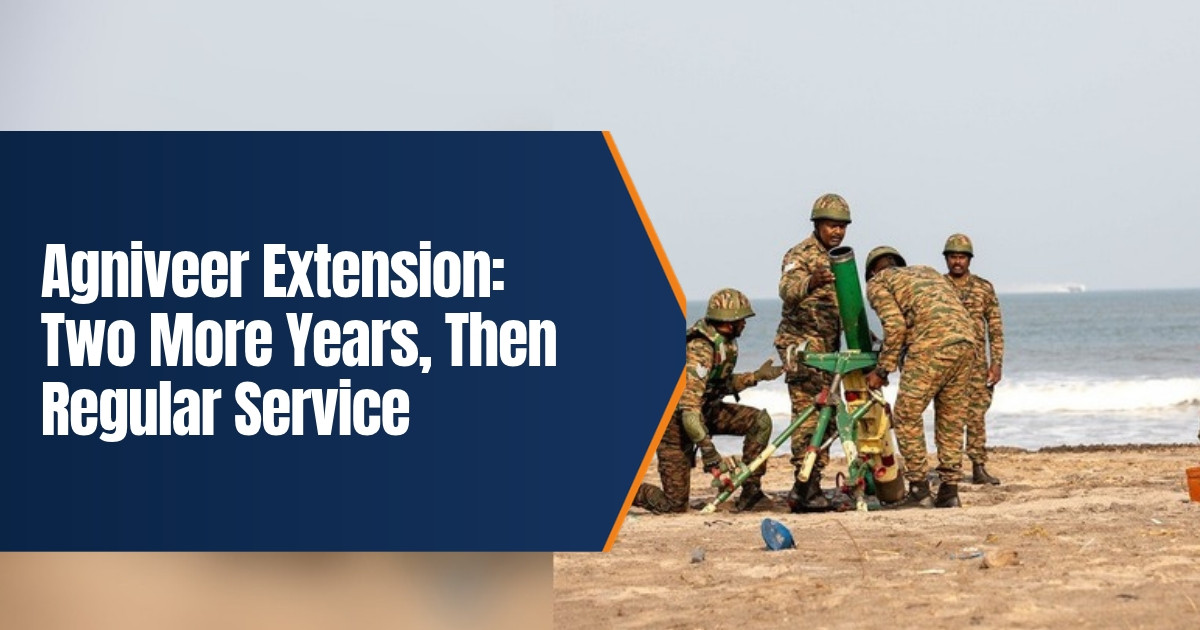
Featured image photo: U.S. Army National Guard photo by 1st Sgt. James Tomlinson, public domain, via Wikimedia Commons. It shows Indian Army soldiers of the 4/8 Gurkha Rifles simulating mortar fire on Kakinada Beach, Andhra Pradesh, during Exercise Tiger Triumph in April 2025. The soldiers pictured are not identified as Agniveers.
FAQ
What is the new Agniveer extension?
Agniveers not selected for regular service after four years can now serve two more years. After that, all willing Agniveers who meet the selection criteria will be offered regular enrolment.
Is the Agnipath scheme ending?
No. The Defence Ministry said the scheme will continue, with the 25% merit selection after four years unchanged.
Sources
- Press Information Bureau, Ministry of Defence, 4 November 2026: Cabinet decision, 25% merit route, second two year engagement for 75%, enrolment of all willing Agniveers, listed achievements, higher pay and Seva Nidhi.
- Hindustan Times, 4 November 2026: CDS quotes, monthly pay figures, sepoy rank, seniority, 18,300 due for discharge, 300,000 Agniveers, job quotas, family reactions.
- CNBC TV18, 4 November 2026: selection criteria, 70% government Seva Nidhi share, ₹10.92 lakh corpus, paramilitary reservation answer.
- The Hindu, 4 November 2026: briefing details, eligibility wording, Rajnath Singh post on X.