

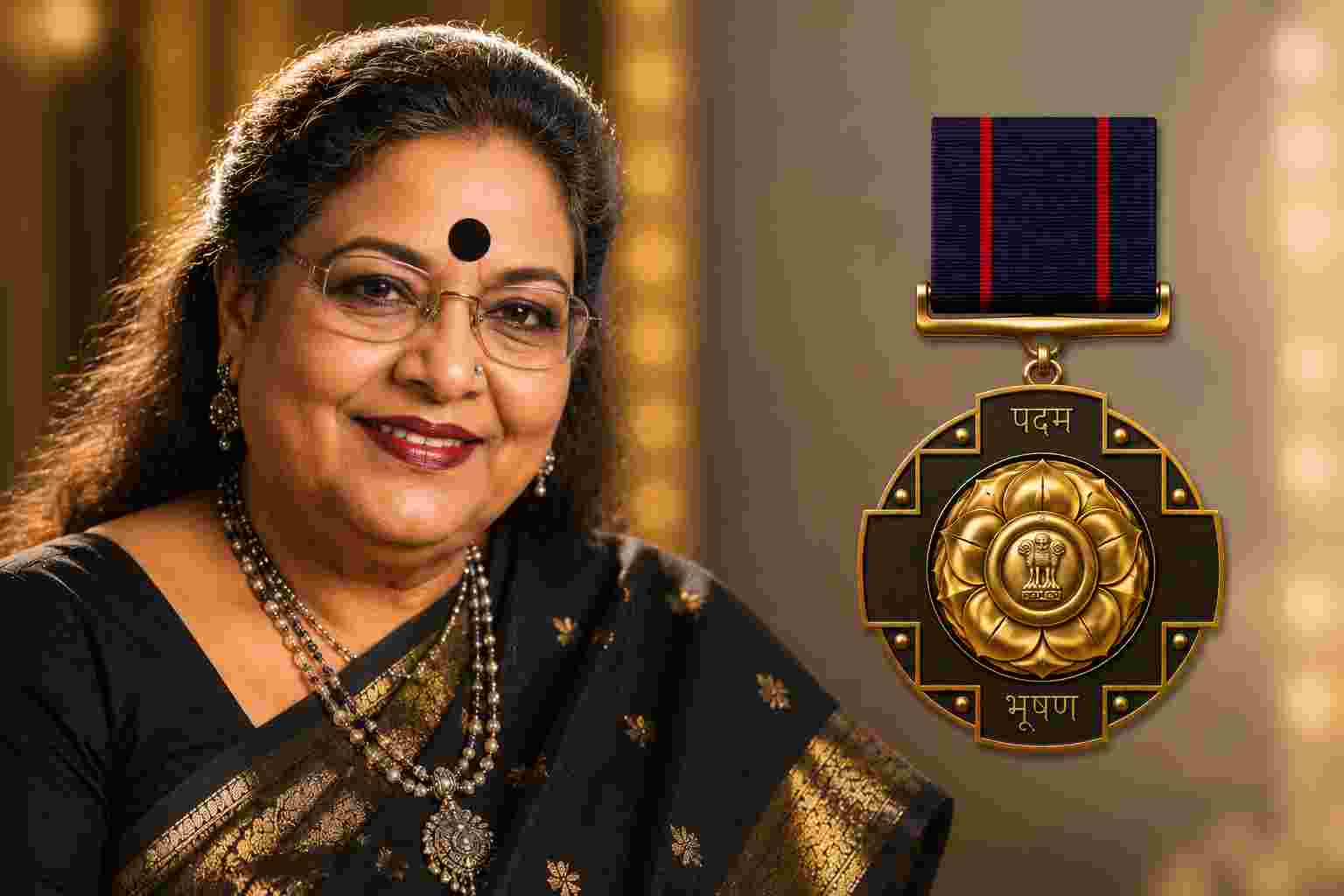
Usha Uthup Padma Bhushan
There’s a certain kind of artist who doesn’t chase trends. They just show up, do the work, and somewhere along the way, the whole country catches up to them. Usha Uthup is exactly that kind of artist. With a voice that doesn’t sound like anyone else and a career stretching across more than five decades, she stands as one of the most recognisable voices among Indian singers.
When the Government of India awarded her the Padma Bhushan in 2011, it felt less like a surprise and more like a long overdue acknowledgement. This piece looks at her life, her journey, and why the Usha Uthup Padma Bhushan honour means so much — not just to her fans, but to Indian music as a whole.
Table of Contents
Who Is Usha Uthup?
Born on November 8, 1947, in Mumbai, Usha Uthup grew up in a household where music was always present. She didn’t come from a family of classical musicians or Bollywood insiders. She found her way into singing through sheer confidence and a voice that was, quite literally, impossible to ignore.
Her voice is deep, bold, and rich in a way that stands apart from the lighter, more delicate tones considered standard for female singers in India during her early years. Rather than softening it or conforming to what was expected, she leaned into it. That decision changed the course of her career.
She started performing at clubs and restaurants in Chennai during the late 1960s, singing a mix of pop, jazz, and Western numbers at a time when that was considered an unusual path for an Indian woman. People noticed — and it didn’t take long before her name started spreading well beyond the city she was performing in.
The Making of a Music Legend
Usha Uthup’s career didn’t follow the standard Bollywood playbook. She wasn’t packaged or produced in the typical way. She built her reputation through live performance first — something that gave her a stage presence very few playback singers could match.
Her big mainstream breakthrough came with the 1971 film Hare Rama Hare Krishna, where she sang “Dum Maro Dum.” That song alone introduced her to millions of listeners who had never stepped inside a nightclub. It was raw, catchy, and completely unlike what people were used to hearing from Indian singers in Hindi cinema at the time.
What followed was a long, steady career built on remarkable range. She recorded songs in Hindi, Bengali, Tamil, Telugu, Kannada, Malayalam, and even English. She worked with composers across generations and genres. Usha Uthup performed on international stages and collaborated with artists from different countries without ever losing that unmistakably Indian quality in her voice.
Among music legends India has produced, Usha Uthup holds a special place precisely because she never belonged to just one category. She was too pop for classical circles, too Indian for Western ones, and somehow perfectly at home in all of them.
The Padma Bhushan and What It Represents
The Padma Bhushan is India’s third highest civilian honour. It is awarded for distinguished service of a high order to the nation — in fields like art, literature, education, sports, and public affairs. Being included among Padma Bhushan awardees puts a person in genuinely rare company.
For Usha Uthup, the 2011 award was recognition of a career that had never really slowed down. She wasn’t being honoured for a single hit or a single era. She was being recognised for five decades of consistent, quality work across languages, genres, and generations.
The Usha Uthup Padma Bhushan award also carried a cultural message. It acknowledged that Indian music is not one thing. There are many things — classical, folk, pop, jazz, film, devotional — and artists who cross those lines deserve to be celebrated, not just the ones who stay comfortably inside them.
Many Padma Bhushan awardees from the world of music have built their reputations within one specific tradition. Usha Uthup’s recognition was for something broader: a career that kept saying yes to music in all its forms.
What Made Her Stand Out From Other Indian Singers
When you line Usha Uthup up next to other Indian singers of her generation, a few things immediately stand out.
Her look, for one. The six-yard saree, the big bindi, the flowers in her hair — she wore traditional Indian clothing on international stages without any self-consciousness. At a time when many artists were going Western to appear cosmopolitan, she went the other direction and it worked.
Her voice, of course. But also what she did with it:
- She sang in over ten Indian languages, making her accessible to audiences across regional lines
- She brought Western pop and jazz structures into Indian popular music before it became fashionable to do so
- She performed live with the same energy at 60 as she did at 25 — stage presence that couldn’t be faked
- She collaborated with younger artists across decades, never treating newer music as beneath her
- She represented India at international festivals and events, carrying Indian music to audiences who had little exposure to it
These weren’t calculated brand moves. They were just who she was as an artist. And that consistency over such a long period is exactly what puts her among the genuine music legends India has produced.
Her Influence on the Generations That Followed
Ask younger musicians in India about Usha Uthup and most of them will mention two things: her confidence and her voice. Both in equal measure.
She showed that an Indian singer didn’t need to sound a particular way to succeed. She showed that a woman could command a stage, own a room, and perform on her own terms without shrinking to fit someone else’s idea of what female vocals should sound like.
That’s had a quiet but real effect on how younger artists see themselves. Her Usha Uthup biography isn’t just a personal story — it reads like a permission slip for every singer who felt their voice was too different, too big, or too hard to categorise.
Many Indian singers today cite her as proof that a long, credible career can be built without chasing trends or bending yourself into a shape that doesn’t fit.
A Career That Kept Going
What’s striking about Usha Uthup’s story is that it didn’t peak and fade and kept working. She recorded, performed, appeared at festivals, collaborated with new artists, and stayed relevant without chasing relevance.
She performed at venues ranging from small theatres to massive concert arenas adn appeared on television, took part in reality music shows as a judge and guest, and kept finding new listeners who had somehow only just discovered her.
Usha Uthup’s place among Indian singers is secure not because of any single moment, but because of the sheer volume of good work spread across half a century. That kind of career doesn’t happen by accident. It takes a genuine love for the craft and the discipline to keep showing up for it.
Her Usha Uthup biography stands as one of the more honest accounts in Indian music — no overnight success story, no dramatic fall and comeback, just steady, dedicated work that built something lasting.
Frequently Asked Questions
-
When did Usha Uthup receive the Padma Bhushan?
Usha Uthup was awarded the Padma Bhushan in 2011 by the Government of India. The award recognised her decades-long contribution to Indian music across multiple languages and genres.
-
What languages has Usha Uthup sung in?
She has sung in Hindi, Bengali, Tamil, Telugu, Kannada, Malayalam, English, and several other Indian languages. This range is one of the reasons she connects with audiences well beyond any one region of India.
-
How did Usha Uthup start her singing career?
She began performing at clubs and restaurants in Chennai in the late 1960s, mostly singing Western pop and jazz. Her live performances built her a strong following before she moved into Indian film music and playback singing.
-
What is Usha Uthup’s most famous song?
“Dum Maro Dum” from the 1971 film Hare Rama Hare Krishna is widely considered her most iconic number, though she has a large catalogue of well-known songs across languages and films.
-
Why is Usha Uthup considered one of the music legends India has produced?
Her career spans over five decades, covers multiple languages and genres, includes international performances, and has influenced generations of Indian singers. The Usha Uthup Padma Bhushan award reflects the government’s formal recognition of that lasting contribution to Indian music.