

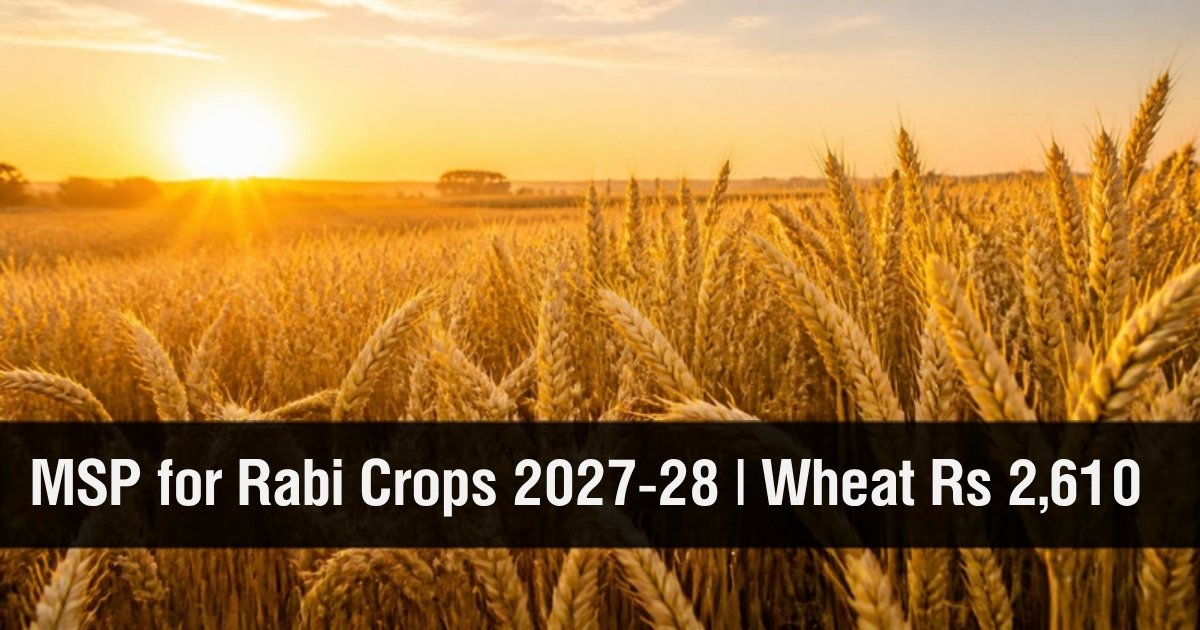

New Delhi: The Union Government has raised the Minimum Support Price (MSP) for all six rabi crops for the 2027 to 28 marketing season. The decision was taken on Wednesday, 30 September 2026, by the Cabinet Committee on Economic Affairs, chaired by Prime Minister Narendra Modi. Wheat now has an MSP of Rs 2,610 per quintal, which is Rs 25 more than the current rate.
Table of Contents
What happened
The Cabinet Committee on Economic Affairs, a top group of ministers that takes decisions on the economy, cleared new support prices for wheat, barley, gram, lentil, rapeseed and mustard, and safflower. Union Minister Ashwini Vaishnaw announced the decision at a briefing in New Delhi after the meeting.
The government said the aim is to give farmers a fair price and to push them towards a wider mix of crops. The Press Information Bureau (PIB) said the highest rise in rupee terms is for safflower, at Rs 675 per quintal. Rapeseed and mustard follow with Rs 413. Lentil gets Rs 390, barley Rs 136, gram Rs 83 and wheat Rs 25.
A quintal is 100 kg. The MSP is the minimum price at which government agencies buy a crop from farmers. It works like a floor price. If the open market pays less, a farmer can still sell to the government at the MSP.
Who is affected
The main group affected is farmers who grow rabi crops. These are winter crops. They are usually sown from October and harvested from around March and April. Wheat, gram and mustard are grown in many states, so many farm families will watch these rates closely before they sow.
Agriculture Minister Shivraj Singh Chouhan spoke about the small rise for wheat. As reported by The Indian Express, he said wheat stocks are overflowing and the country has many times the amount it needs. He added that pulses have very low productivity, and that efforts are on to encourage farmers to grow more of them.
Government buying agencies and state governments are also affected, because procurement is based on the MSP. Ordinary households are affected only indirectly. The MSP is a price for farmers. It is not the price you pay at the shop.
Key details and numbers
Here are the new rates for the 2027 to 28 marketing season, with the old rate for the 2026 to 27 season, as published by the government. All prices are in rupees per quintal.
- Wheat: Rs 2,610, up Rs 25 from Rs 2,585. The expected margin over cost is 106 per cent.
- Barley: Rs 2,286, up Rs 136 from Rs 2,150. The expected margin is 58 per cent.
- Gram: Rs 5,958, up Rs 83 from Rs 5,875. The expected margin is 59 per cent.
- Lentil (masur): Rs 7,390, up Rs 390 from Rs 7,000. The expected margin is 92 per cent.
- Rapeseed and mustard: Rs 6,613, up Rs 413 from Rs 6,200. The expected margin is 96 per cent.
- Safflower: Rs 7,215, up Rs 675 from Rs 6,540. The expected margin is 50 per cent.
The margin is the extra money over the cost of production. The government counts all paid out costs, such as hired labour, machine and bullock work, rent for leased land, seeds, fertiliser, manure, irrigation, diesel and electricity, and interest on working capital. It also adds the value of the farmer’s own family labour. The projected all India cost for wheat is Rs 1,264 per quintal, and for safflower it is Rs 4,810.
The Cabinet briefing also gave a money figure. The government expects to pay farmers about Rs 90,962 crore for around 324 lakh tonnes of these crops in the 2027 to 28 marketing season.
The Indian Express worked out the rise in percentage terms. Wheat goes up 0.97 per cent, gram 1.41 per cent, lentil 5.57 per cent, barley 6.33 per cent, rapeseed and mustard 6.66 per cent, and safflower 10.32 per cent. The newspaper also reported that the Rs 25 rise for wheat is the smallest in rupee terms since the 2010 to 11 season. Last year, the wheat MSP went up by 6.6 per cent to Rs 2,585.
What happens next
The decision is now official, and the new rates will guide government buying in the 2027 to 28 marketing season. That season starts after the winter crop is harvested next spring. Farmers sow this year’s rabi crop in the coming weeks, so the prices tell them what to expect.
State governments and buying agencies will announce local dates and arrangements closer to harvest. The sources we checked do not give start dates for buying.
Background
The Commission for Agricultural Costs and Prices, known as CACP, studies costs and recommends the MSP for these crops. It looks at the cost of production, the returns from different crops, demand and supply, domestic and global prices, and the effect on the wider economy. The Cabinet then takes the final decision.
Since the Union Budget of 2018 to 19, the government has said it will fix the MSP at a level of at least 1.5 times the all India weighted average cost of production. In other words, the margin should be at least 50 per cent. The new rates meet that test for all six crops, with safflower exactly at 50 per cent.
The government also shared figures on buying over the years. Wheat procurement from 2014 to 15 till 2025 to 26 was 3,715 lakh tonnes, against 2,254 lakh tonnes from 2004 to 05 till 2013 to 14. For all six rabi crops, buying rose to 3,921 lakh tonnes from 2,302 lakh tonnes. Money paid to wheat farmers at MSP in the recent period is Rs 7.31 lakh crore, compared with Rs 2.56 lakh crore in the earlier ten years. For the six rabi crops together, the figures are Rs 8.36 lakh crore and Rs 2.65 lakh crore.
What it means for you
If you are a farmer, note the rate for your crop and compare it with your own costs. Ask at your local mandi or agriculture office when and where buying will start in your area. Keep your land records and bank account details ready, because payment for MSP sales goes to the bank.
Farmers who want to know about other help can read our guides on PM Kisan status, benefits and registration, the UP Kisan Karj Rahat Yojana and smart agriculture methods.
If you are not a farmer, there is no direct change to your bill.
Sources
- Press Information Bureau (Government of India), Cabinet briefing for Wednesday, 30 September 2026
- Press Information Bureau, release titled Cabinet approves Minimum Support Prices (MSP) for Rabi Crops for Marketing Season 2027 to 28, 30 September 2026
- The Indian Express, report on Rabi MSP and wheat, updated 1 October 2026
- Akashvani News (All India Radio), Union Cabinet hikes MSP for Rabi crops, 1 October 2026
- DD News, Cabinet approves MSP hike for all Rabi crops for 2027 to 28 marketing season, 30 September 2026
- CNBC TV18, Cabinet approves Minimum Support Prices for Rabi crops, 30 September 2026