


Battle of Haldighati: A Historic Clash between Mughals and Rajputs
The Battle of Haldighati was a significant event in Indian history that took place on June 18, 1576. The battle was fought between the forces of Mughal Emperor Akbar, led by Raja Man Singh I of Amber, and the army of Maharana Pratap, the ruler of Mewar. The battle is known for its fierce fighting and valiant resistance put up by Maharana Pratap and his army against the Mughal Empire.
The battle lasted for several hours and resulted in the defeat of Maharana Pratap’s forces. However, the Rana himself managed to escape and continued his resistance against the Mughal Empire. The Battle of Haldighati is considered a turning point in the history of Rajputs and is remembered for the bravery and courage displayed by Maharana Pratap and his army.
Despite being outnumbered and outgunned, Maharana Pratap’s army fought with all their might, displaying remarkable courage and valor. The battle is a testament to the strength of the Rajput warriors and their unwavering commitment to their principles and values. The Battle of Haldighati remains an important event in Indian history and continues to inspire generations of Indians.
Table of Contents
Historical Background
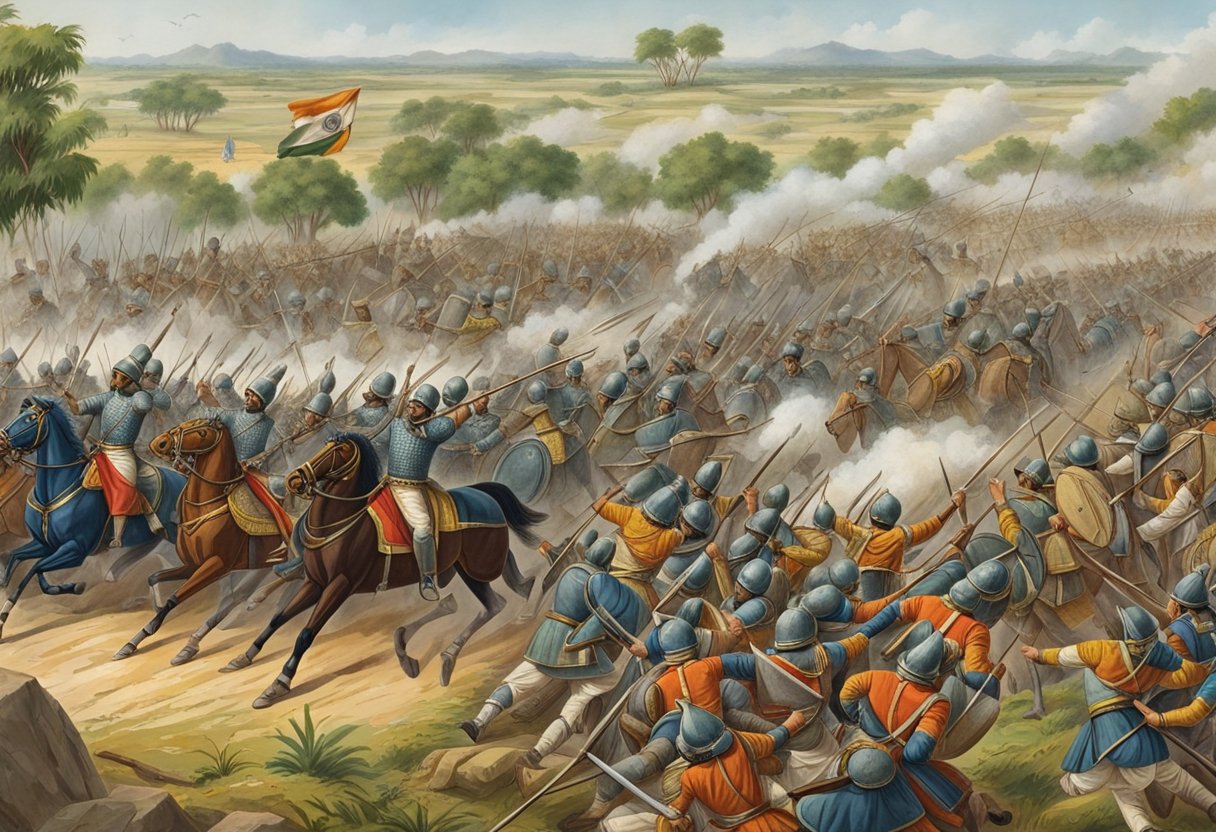
The Battle of Haldighati was fought on June 18, 1576, between the Mughal forces led by Man Singh I of Amber and the Mewar forces led by Maharana Pratap, a Rajput king. The battle is considered one of the most significant battles in Indian history, as it symbolizes bravery, valor, and adaptability.
During this period, the Mughals were expanding their empire across the Indian subcontinent, and Maharana Pratap emerged as a significant opposition force in Rajasthan. The battle took place in the Haldighati Pass, which is a narrow mountain pass located in the Aravalli Range of Rajasthan. The pass was named Haldighati because of the yellowish color of the rocks, which resembled the turmeric spice.
Maharana Pratap hoped that the narrow nature of the Haldighati Pass would help confuse the enemy’s superior numbers. He set his base at the Gogunda town near Udaipur city of Rajasthan, which is around 23 km south of the Haldighati Pass. However, the Mughals managed to locate the Mewar forces and attacked them.
The battle lasted for several hours, and both sides put up a brave fight. However, the Mughals ultimately carried the day after inflicting significant casualties on the Mewar forces, although they failed to capture Maharana Pratap, who retreated reluctantly persuaded by his fellow warriors.
The Battle of Haldighati is significant as it represents the determination and bravery of the Rajputs in defending their land against the Mughal Empire. It is also noteworthy as it marks the beginning of a long and bitter struggle between the Rajputs and the Mughals, which lasted for several decades.
Key Figures
Maharana Pratap
Maharana Pratap was the ruler of Mewar during the Battle of Haldighati. He was born in 1540 and ruled from 1572 until his death in 1597. Pratap was known for his bravery and his refusal to bow down to the Mughal Empire. He was a skilled warrior and horseman, and he led his army into battle against the Mughals despite being outnumbered. Pratap is remembered as a hero in Rajasthan and is revered by many as a symbol of resistance against foreign rule.
Akbar
Akbar was the Mughal emperor during the Battle of Haldighati. He was born in 1542 and ruled from 1556 until his death in 1605. Akbar was known for his military campaigns, his religious tolerance, and his efforts to unify the diverse regions of India under Mughal rule. He was a patron of the arts and sciences and is remembered as one of the greatest emperors in Indian history.
Man Singh I
Man Singh I was a Rajput king who served as a general in the Mughal army during the Battle of Haldighati. He was born in 1540 and was a close ally of Akbar. Man Singh was a skilled military commander and played a key role in several of Akbar’s campaigns. He was also a patron of the arts and is remembered for his contributions to Rajput culture.
During the Battle of Haldighati, Maharana Pratap led the forces of Mewar against the Mughal army led by Akbar’s general, Man Singh I. Despite being outnumbered, Pratap fought bravely and managed to escape the battlefield. The battle is remembered as a symbol of the Rajput resistance against the Mughal Empire, and it has become a part of Indian folklore.
The Battle
The Battle of Haldighati was fought on 18th June 1576 between the forces of Mewar led by Maharana Pratap and the Mughal forces led by Man Singh I of Amber. The battle took place in the Haldighati mountain pass near Gogunda, Rajasthan, India.
Strategy
Maharana Pratap’s army consisted mainly of Rajputs, Bhils, and other tribesmen. The Mughal army had a larger number of soldiers, including Rajputs who had defected from Mewar. Maharana Pratap’s strategy was to use the rugged terrain of the mountain pass to his advantage. He placed his army in a narrow valley, with steep hills on either side. This prevented the Mughal army from using their superior numbers to encircle and overwhelm the Mewar forces.
Execution
The Mughal army advanced towards the Mewar forces, but were met with a barrage of arrows and boulders. The Mughal cavalry charged towards the Mewar lines, but were met with a wall of spears. The Mughal artillery was ineffective due to the narrow valley and the steep hills on either side. The Mughal forces were unable to break through the Mewar lines and suffered heavy losses.
Despite their initial success, the Mewar forces were unable to exploit their advantage due to lack of ammunition. Maharana Pratap himself was wounded in the battle and had to retreat to a nearby hill. The Mughal forces claimed victory, but were unable to capture Maharana Pratap or his army. The battle was a stalemate, but it was a moral victory for Maharana Pratap, who had successfully defended his kingdom against a much larger and better-equipped army.
Overall, the Battle of Haldighati was a significant event in Indian history, as it symbolized the struggle of the Rajputs against the Mughal Empire. It also highlighted the importance of strategy and terrain in warfare.
Aftermath
Immediate Impact
The Battle of Haldighati was a fierce battle between the Mughal Empire and the forces of Mewar led by Maharana Pratap. Although the battle ended in defeat for the forces of Mewar, Maharana Pratap managed to escape and continued his resistance against the Mughal Empire. The immediate impact of the battle was that it strengthened the Mughal Empire’s hold over the region. However, it also left a lasting impact on the Rajput community, who saw the battle as a symbol of their resistance against foreign rule.
Long Term Consequences
The Battle of Haldighati had several long-term consequences. It marked the beginning of a long and bitter struggle between the Mughal Empire and the Rajputs. Maharana Pratap continued his resistance against the Mughal Empire for several years after the battle, and his efforts eventually paid off. The Mughal Empire was unable to completely subjugate the Rajputs, and their autonomy was preserved.
The battle also had a profound impact on the Rajput community’s sense of identity. It became a symbol of their resistance against foreign rule and their commitment to preserving their culture and traditions. The legacy of the battle continued to inspire Rajput leaders for centuries, and it remains an important part of Rajput history and culture to this day.
In conclusion, the Battle of Haldighati was a significant event in the history of India. While it may have ended in defeat for the forces of Mewar, it had a lasting impact on the Rajput community and their struggle against foreign rule.
Historical Significance
The Battle of Haldighati was a significant event in Indian history that took place on June 18, 1576. It was fought between the forces of Maharana Pratap, the sovereign of Mewar, and the Mughal Emperor Akbar’s forces, led by Man Singh I of Amber. Although the battle ended in defeat for the forces of Mewar, Maharana Pratap escaped continuing his valiant resistance against the Mughal Empire.
The battle is significant because it marked the beginning of a long-standing struggle between the Rajputs and the Mughals. It was a pivotal clash that had far-reaching consequences for the Rajput resistance against the Mughal Empire. It is said that the battle was fought over the issue of sovereignty and independence. Maharana Pratap refused to accept the Mughal rule and fought to preserve the independence of Mewar.
The Battle of Haldighati is also significant because it showcased the bravery, courage, and determination of the Rajputs. Maharana Pratap and his army fought valiantly against the Mughals, even though they were outnumbered and outgunned. The battle is a testament to the Rajput’s fierce sense of honor and loyalty to their land and people.
The battle also had a significant impact on the cultural, strategic, and political landscape of India. It inspired many Rajput leaders to continue their resistance against the Mughal Empire, and it became a symbol of their struggle for independence and sovereignty. The battle also had a lasting impact on the military tactics and strategies of the Rajputs, who learned valuable lessons from their defeat.
Overall, the Battle of Haldighati is a significant event in Indian history that has left an indelible mark on the cultural, strategic, and political landscape of India. It is a testament to the bravery, courage, and determination of the Rajputs, and it has inspired many to continue their struggle for independence and sovereignty.
Controversies and Debates
The Battle of Haldighati is a significant event in Indian history and has been the subject of many debates and controversies. Here are some of the key issues that have been discussed:
Outcome of the Battle
One of the most controversial aspects of the Battle of Haldighati is the outcome. While some historians believe that the Mughals emerged victorious, others argue that Maharana Pratap and his forces were able to hold their ground and prevent the Mughals from advancing further into Mewar. The debate centers around the fact that while the Mughals were able to capture the battlefield, they were unable to capture Maharana Pratap or his army.
Casualties
There is also a controversy surrounding the number of casualties in the Battle of Haldighati. While some sources claim that the Mughals suffered heavy losses, others argue that the number of casualties was relatively low on both sides. The lack of reliable historical records makes it difficult to determine the exact number of casualties.
Role of Maharana Pratap
Another area of debate is the role of Maharana Pratap in the battle. While some historians believe that he was a brave and skilled warrior who fought valiantly against the Mughals, others argue that he was not a strategic thinker and that his resistance against the Mughals was ultimately futile.
Historical Accuracy
Finally, there is a debate about the accuracy of the historical records surrounding the Battle of Haldighati. Some historians argue that the accounts of the battle have been exaggerated or distorted over time, while others believe that the records are generally accurate.
Overall, the Battle of Haldighati remains a controversial and debated topic in Indian history. While there is no clear consensus on the outcome or other aspects of the battle, it remains an important event that continues to be studied and analyzed by historians and scholars.
Frequently Asked Questions
What were the causes of the Battle of Haldighati?
The Battle of Haldighati was fought due to the ongoing conflict between the Mughal Empire and the Rajputana region. Maharana Pratap, the king of Mewar, refused to accept Akbar’s suzerainty and continued to resist Mughal rule. This led to a series of battles between the two forces, including the Battle of Haldighati.
Between which two forces was the Battle of Haldighati fought?
The Battle of Haldighati was fought between the Mughal forces led by Raja Man Singh I of Amber and the forces of Maharana Pratap, the king of Mewar.
How many times was the Battle of Haldighati fought?
The Battle of Haldighati was fought only once, on 18 June 1576.
What was the main aim of Akbar in fighting the Battle of Haldighati?
The main aim of Akbar in fighting the Battle of Haldighati was to bring the Rajputana region under his control and establish Mughal rule. He wanted to subjugate the Rajputs and consolidate his empire.
Who won the Battle of Haldighati and why?
The outcome of the Battle of Haldighati is a matter of debate among historians. While the Mughals claimed victory, Maharana Pratap managed to escape with his life and continued to resist Mughal rule. The battle was a significant event in the history of Rajputana and is remembered for the bravery and valor displayed by Maharana Pratap and his soldiers.
Did Maharana Pratap lose the Battle of Haldighati?
While Maharana Pratap and his forces were unable to defeat the Mughals, they managed to hold their ground and inflict significant damage on the enemy. Maharana Pratap himself managed to escape with his life and continued to resist Mughal rule, making him a hero and symbol of resistance for the people of Rajputana.