

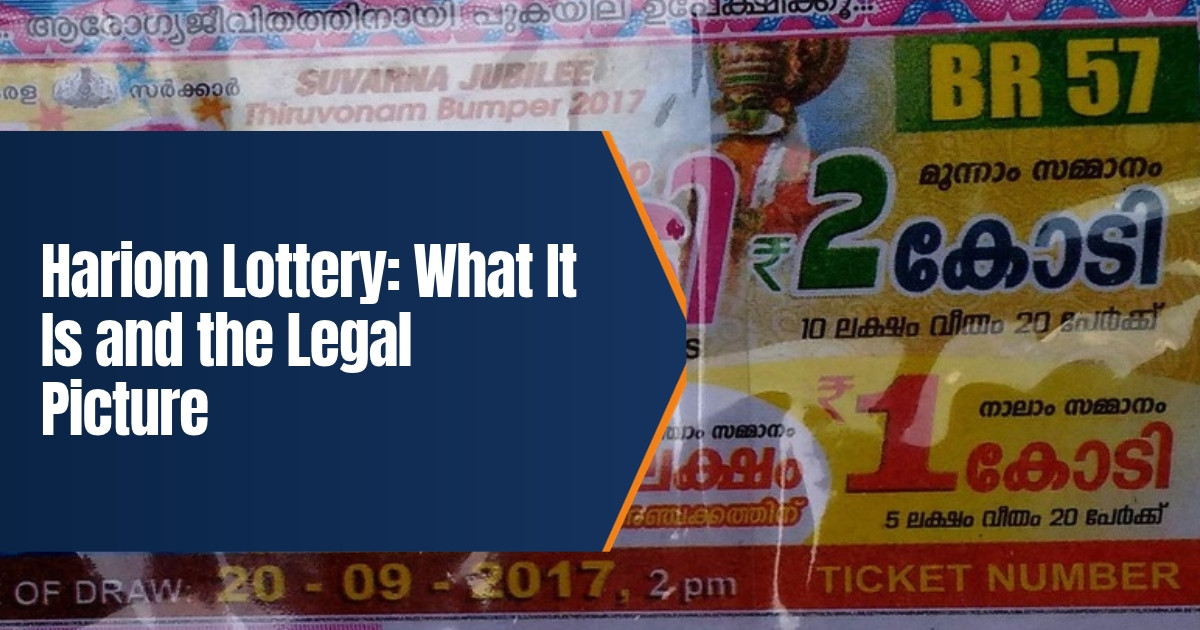
Hariom Lottery: What It Is and the Legal Picture
Someone forwards a result chart on WhatsApp. A cousin mentions a number he has been playing for weeks. A Telegram channel promises a “sure” pick for tonight. That is usually how people first hear of the Hariom Lottery, and the obvious question follows. Is it a real lottery?
Short answer: no. Below we explain what the Hariom Lottery actually is, how it differs from a state lottery, what Indian law says in 2026, and where to get help.
Note: This is general information, not legal or financial advice. Bharat Stories does not link to or recommend the Hariom Lottery or any game like it.
Table of Contents
Quick Facts
| Item | Detail |
|---|---|
| Type | Informal number game, similar to matka or satta |
| Run by | Unknown operators; no public company or licence |
| Where it spreads | Websites, Telegram and WhatsApp groups |
| Official app | None found in major app stores |
| State lottery? | No; not listed by any state lottery department |
| Legal status | Unregulated; likely illegal gambling under Indian law |
What Is the Hariom Lottery?
Despite the name, it is a betting game on numbers. You pick a number, or a set of them, and send money to an agent or an online wallet. A result is then announced at a fixed time of day. If your number comes up, you are told you have won some multiple of what you staked.
Result charts get passed around online, and some groups sell “lucky numbers” or “guaranteed” tips.
The format is the old matka or satta model, which has run in India for decades. What we could not find, after looking, is any public detail on who runs the Hariom game, how its results are drawn, or whether winners actually get paid. Nobody independent checks the draws.
How It Differs From a Legal Lottery
India permits lotteries, but narrowly. The Lotteries (Regulation) Act 1998 says only a state government can organise or promote one, and only in a state that allows them. Kerala, Punjab, West Bengal, Sikkim, Maharashtra and Goa are among the states that run their own.
A genuine state lottery leaves a paper trail. Tickets are printed or registered and carry serial numbers. Draws happen in public or under official supervision, and the state lottery department publishes the results. There are written rules for claiming a prize, tax is deducted at source, and if something goes wrong you have a government office to complain to.
The Hariom Lottery offers none of that. A name that sounds like a brand is still just a name.
The Law in India in 2026
Lotteries and gambling laws
Gambling is largely a state matter. The Public Gambling Act 1867, along with many state laws, bans running or visiting a common gaming house, and courts have treated matka style number betting as gambling. Running a private lottery without state authority breaks the 1998 Act and may also be a criminal offence under state law.
The Online Gaming Act 2025
The Promotion and Regulation of Online Gaming Act 2025 took effect on 1 May 2026, and it bans online money games, meaning any game where you pay or deposit money hoping to win money back. Offering such a game can bring up to three years in prison and a fine of up to Rs 1 crore. Advertising one can bring up to two years and Rs 50 lakh. Banks and payment services are barred from processing the payments.
The Act has been challenged in the Supreme Court. That case is still pending, so for now the ban stands.
Tax on winnings
Even legal wins are taxed hard. Section 115BB of the Income Tax Act sets a flat 30 percent rate, plus surcharge and cess, and tax is deducted at source on prizes above Rs 10,000. Money from an unregulated game comes with no proper record at all, which invites tax trouble on top of legal trouble.
Why People Play Despite the Risks
We get why it appeals. The stakes look tiny. Results arrive within hours. Stories of big wins travel through groups in minutes. The losses rarely get mentioned.
Some play out of habit, some out of money worries, some because they think they have spotted a pattern. The maths stays the same: the game is built so the operator comes out ahead, and over time players as a group lose more than they win.
Risks of Unregulated Number Games
Nobody has to pay you. An operator can refuse, go quiet or vanish, and with no supervision the results themselves could be changed without anyone knowing.
Then there is fraud. Payment links and unofficial apps are a common way to steal bank details or UPI credentials. Players and agents can also face police action.
The slower damage is debt. Chasing losses leads to borrowing, and borrowing leads to stress and arguments at home. And when any of this goes wrong, there is no regulator to call.
Common Myths About Number Games
“Old result charts show a pattern.” In a truly random draw, past results tell you nothing about the next one. In an unregulated game, the results may not be random to begin with.
“Paid experts know the fixed number.” If someone really knew tonight’s number, why would they sell it to you for a few hundred rupees? Selling tips is its own business.
“Small stakes can’t hurt.” They add up. A small amount played several times a day becomes a large loss by the end of the month.
“One big win will clear my debts.” This belief is one of the main ways gambling debt grows.
How to Check Whether a Lottery Is Real
Look for the name of a state government lottery department on the ticket, and find that department’s official website. Check the draw result there, on the department’s own site, not on a chart someone shared in a group. Remember that a real lottery never asks a winner to pay a fee before handing over a prize. And buy only from authorised sellers in states where lotteries are legal.
If any one of those checks fails, walk away.
Warning Signs of a Lottery Scam
Be suspicious of any message saying you have won a lottery you never entered. Same goes for a request to pay a “fee” or “tax” before your prize can be released, or an offer of fixed or guaranteed numbers in exchange for money.
Other red flags: payments going to a personal UPI ID or wallet rather than an official account, pressure to act fast or keep things secret, and links asking you to download an app from outside the official app stores. Never share a one time password, PIN or your screen with anyone who says they will release a prize.
Lost money already? Take screenshots of the chats and payments, and report it quickly. In India you can call the cybercrime helpline on 1930 or file a complaint at cybercrime.gov.in. Your bank can block a UPI ID or card if told in time.
Advice for Families
These games spread through friends, neighbours and office groups, so families often notice first. Frequent small UPI payments to names nobody recognises. Sudden borrowing. Someone checking the clock around result times.
If you see this, a calm conversation without blame usually goes further than anger. Agreeing on a household budget and blocking payments to unknown wallets also helps. Leaving the groups that share result charts and tips can make stopping much easier.
Gambling Harm and Where to Get Help
Spending more than you can afford, chasing losses, borrowing to play, hiding it from family? Then help is free and confidential. In India, Tele MANAS is on 14416, and the cybercrime helpline on 1930 handles fraud. In the UK, GamCare is on 0808 8020 133. In the USA, call 1 800 GAMBLER. In Australia, Gambling Help Online is on 1800 858 858.
For more reading, see our guide to online betting and casino laws and risks, our article on mental health and addiction, and our piece on mental health awareness in India.
Frequently Asked Questions
Is the Hariom Lottery a government lottery?
No. No state lottery department runs it or lists it.
Is the Hariom Lottery legal in India?
Unregulated number betting is treated as illegal gambling. Online money games have also been banned since 1 May 2026, though a challenge to that ban is pending in the Supreme Court.
Are there tips that improve the chances of winning?
No. Paid tips are a common scam, and no tip changes the result.
Is there an official Hariom Lottery app?
We found none in the major app stores. Avoid any app shared through a link.
Where can I get help?
In India, call Tele MANAS on 14416, or 1930 to report fraud.