

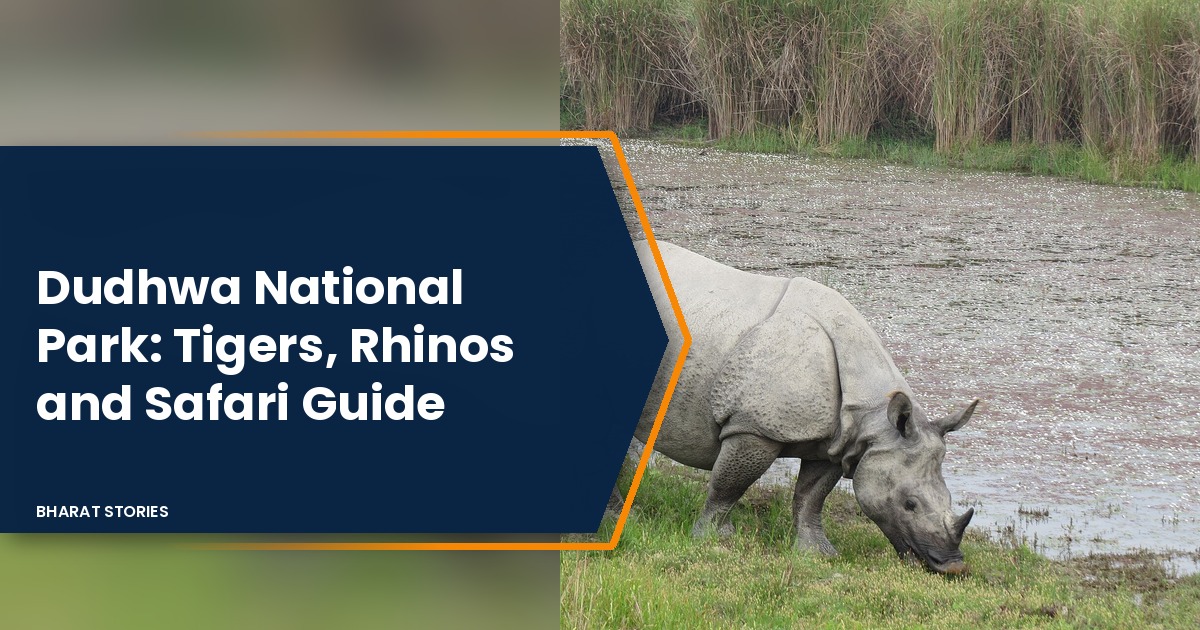
Dudhwa National Park: Tigers, Rhinos and Safari Guide
On the edge of the Nepal border in Uttar Pradesh, the plains of the Terai still look the way much of north India once did: tall sal forest, wide grasslands, slow rivers and marshes busy with deer. Dudhwa National Park protects one of the best surviving pieces of this landscape. It is home to tigers, swamp deer and leopards, and it is also the site of one of India’s longest running rhino recovery projects.
This guide covers Dudhwa’s history, its habitats and wildlife, the rhino programme as of 2026, the 2026 to 2027 tourist season and practical tips for a visit. For more protected areas across the country, see our list of national parks of India.
Table of Contents
Dudhwa National Park at a Glance
| Item | Detail |
|---|---|
| Location | Lakhimpur Kheri district, Uttar Pradesh, on the India Nepal border |
| National park declared | 1977 |
| Park area | About 490 sq km |
| Tiger reserve | Dudhwa Tiger Reserve, formed in 1987 with Kishanpur Wildlife Sanctuary; Katarniaghat Wildlife Sanctuary was added later |
| Rivers | Mohana along the northern border, Suheli to the south |
| Signature species | Tiger, swamp deer, greater one horned rhino, Bengal florican |
| Rhinos | 53 in the June 2026 census |
| Tourist season | 1 November to 15 June |
History of the Park
The forests around Dudhwa were managed for timber for much of the twentieth century. Their protection owes a great deal to Billy Arjan Singh, a farmer turned conservationist who settled at Tiger Haven on the edge of the forest and campaigned for decades to save its tigers and swamp deer. Parts of the forest were protected as a sanctuary first, and in 1977 the area was declared Dudhwa National Park, covering roughly 490 sq km.
In 1987 the park and the nearby Kishanpur Wildlife Sanctuary were brought together as Dudhwa Tiger Reserve under Project Tiger. Katarniaghat Wildlife Sanctuary in Bahraich district later joined the reserve, creating a larger protected landscape along the border. The three areas are separated by farmland and towns, so forest corridors and cooperation with Nepal’s protected areas across the border are important for animals that move long distances.
The 2026 to 2027 season is being marked locally as Dudhwa’s golden jubilee season, fifty years after the national park was created.
Habitats: Sal, Grass and Wetland
Dudhwa lies on the alluvial plain between the Mohana and the Suheli. Its forests are dominated by sal, mixed with trees such as asna, haldu, jamun, shisham and silk cotton. Between the forest blocks lie open grasslands, some tall and dense enough to hide an elephant, and a network of streams, pools and marshes known locally as tals.
These grasslands are the heart of Dudhwa’s value. Across most of north India, similar Terai grasslands have been converted to sugarcane and wheat. Here they survive, and they are kept open by careful management, including controlled burning, so that grazing animals and grassland birds have room to live.
Wildlife of Dudhwa
Tigers and Other Predators
Tigers are found across the reserve, but the dense grass and forest make sightings less predictable than in drier parks of central India. In the national tiger estimate of 2022, Uttar Pradesh as a whole recorded 205 tigers, and the Dudhwa landscape holds a significant share of them. Leopards, fishing cats, jungle cats, sloth bears and jackals also live here. On the opening day of the 2026 season, visitors to Kishanpur reported several tiger sightings.
Swamp Deer
Dudhwa is one of the most important places in the world for the northern swamp deer, or barasingha, named for the many tines on a stag’s antlers. Herds gather on wet grasslands and around lakes such as Jhadi Tal in Kishanpur. Sambar, chital, hog deer and barking deer complete the deer family here.
Birds
Several hundred bird species have been recorded across the reserve, more than 350 by most counts. The endangered Bengal florican, a bustard of tall grasslands, is one of the most sought after. Swamp francolin, great slaty woodpecker, several species of hornbill, and many raptors and waterbirds are also present, and winter brings large numbers of migratory ducks.
Katarniaghat’s River Life
In Katarniaghat, the Girwa river is home to gharials, mugger crocodiles and Gangetic river dolphins. Boat trips here offer a different view of the reserve from the jeep tracks of Dudhwa.
The Return of the Rhino
Greater one horned rhinos once lived across the Terai but had vanished from Uttar Pradesh for more than a century. In April 1984 the forest department brought five rhinos from Assam to a fenced area of about 27 sq km in the Sonaripur range of Dudhwa. Four females from Nepal followed in 1985. Despite early losses, the group began to breed.
As the population grew, inbreeding and fights between males became concerns. A second rehabilitation area of about 14 sq km was created in the Belrayan range in 2018. Then, starting in November 2024, the forest department, working with WWF India and wildlife veterinarians, began releasing radio collared adults from the enclosures into open grassland inside the reserve. Two were freed in November 2024, two in March 2025 and four more in March 2026.
The fourth rhino census, held from 25 to 27 June 2026, counted 53 rhinos: 17 adult males, 25 adult females and 11 calves more than a year old. According to the field director, 11 of them now range freely. The count was a net gain of five, even though three rhinos had died, including a female killed by tigers in March 2026 and two calves killed by a dominant bull. Uttar Pradesh is now one of only three Indian states, along with Assam and West Bengal, with a wild population of this species.
Officials said in November 2026 that two more rhinos would be released this season, and that a proposal to reintroduce wild water buffalo to Dudhwa is being processed.
The Tharu Community
Many villages around Dudhwa belong to the Tharu, an indigenous community of the Terai. Their crafts, including baskets and decorative items woven from grass, and their distinctive food and festivals are part of the region’s identity. Some ecotourism programmes include visits to Tharu villages and handicraft centres, which help local families earn from the park.
Planning a Visit
Season and Booking
The 2026 to 2027 season opened on 1 November 2026 and runs until 15 June 2027. Officials kept entry fees, safari vehicle charges, guide fees, elephant ride and camera charges unchanged from last year. Safaris, entry and forest rest houses can be booked through the Uttar Pradesh government’s integrated wildlife ecotourism portal, which was relaunched in 2026. Early in the season, waterlogged tracks can force safaris to be cancelled at short notice, so keep your plans flexible.
Ways to Explore
Open jeep safaris run in the morning and afternoon. Elephant rides are offered on some routes and are a good way to see rhinos in tall grass. Kishanpur has its own safari routes around Jhadi Tal, and Katarniaghat is known for boat trips on the Girwa. New rules in 2026 restrict the use of mobile phones for reels and videos on safari, so check the current instructions when you book.
Best Time to Go
November to February is cool and green, with winter birds. March to June is hot, but animals gather near water and the thinning grass improves visibility. The park closes for the monsoon from mid June.
Getting There
Palia Kalan, about 10 km away, is the nearest town and has a railway station. Lucknow, about 230 km by road, is the nearest major airport. Lakhimpur and Shahjahanpur are other road and rail links. Forest rest houses and private lodges near Palia offer accommodation.
Responsible Travel
Stay inside your vehicle, keep to the routes, do not feed or call to animals and carry your waste back out. The park is a working habitat for endangered species, and the grassland birds in particular are sensitive to disturbance during the breeding season.
Frequently Asked Questions
Where is Dudhwa National Park?
It is in Lakhimpur Kheri district of Uttar Pradesh, close to the Nepal border, with Palia Kalan as the nearest town.
How many rhinos live in Dudhwa?
The census of June 2026 found 53 greater one horned rhinos, of which 11 roam freely outside the fenced rehabilitation areas.
When is Dudhwa open for tourists?
The park is open from 1 November to 15 June. It is closed through the monsoon.
Which areas make up Dudhwa Tiger Reserve?
Dudhwa National Park, Kishanpur Wildlife Sanctuary and Katarniaghat Wildlife Sanctuary, along with their surrounding buffer forests.
Can I see tigers in Dudhwa?
Yes, but sightings depend on luck because the cover is thick. Kishanpur has produced some of the more regular tiger sightings in recent seasons.
How do I book a Dudhwa safari?
Use the official Uttar Pradesh wildlife ecotourism portal, which handles safaris, entry tickets and forest accommodation for parks across the state.