

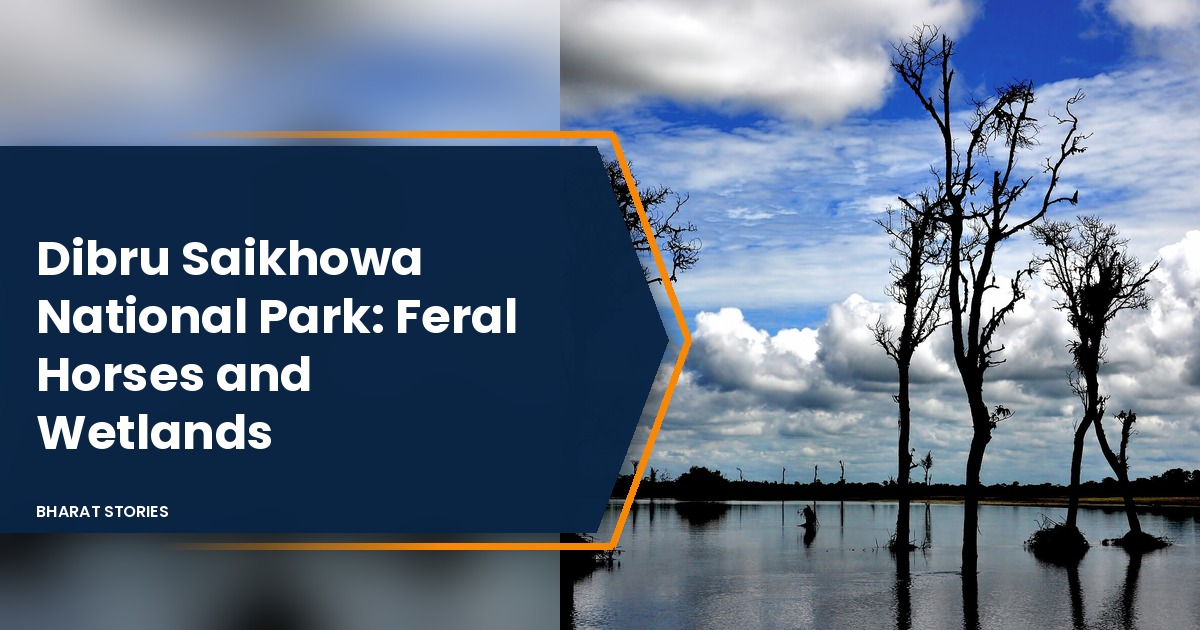
Dibru Saikhowa National Park: Feral Horses and Wetlands
In the far east of Assam, not far from where the Siang, the Dibang and the Lohit join to form the Brahmaputra, the great river spreads into a maze of channels, sandbars, swamps and tall grass. Inside this shifting landscape lies Dibru Saikhowa National Park, one of the wildest and least crowded protected areas in the Northeast. It is known for two unusual residents: the rare white winged wood duck and a herd of feral horses that roam its grasslands. Assam has several more, and you can find them all in the full list of Indian national parks, arranged state by state.
This guide explains where the park is, how it came to be protected, what lives there, the pressures it faces in 2026 and how to plan a visit. For other parks in the state, see our guide to Kaziranga National Park.
Table of Contents
Dibru Saikhowa National Park at a Glance
| Item | Detail |
|---|---|
| Location | Tinsukia and Dibrugarh districts, Assam |
| Biosphere reserve | Designated in July 1997, about 765 sq km |
| National park | Declared in 1999, a core of about 340 sq km |
| Boundaries | Brahmaputra and Lohit to the north, Dibru river to the south |
| Elevation | Around 110 to 126 m above sea level |
| Best known for | White winged wood duck, feral horses, river dolphins, birds |
| Nearest town | Tinsukia, roughly 12 km to the south |
| Best season | November to April |
Location and Landscape
According to the Tinsukia district administration, the biosphere reserve covers about 765 sq km, made up of a core of roughly 340 sq km and a buffer of about 425 sq km. The core is the national park. It sits on the flat floodplain of the upper Brahmaputra at an average height of about 118 m, so almost all of it goes under water at some point during the monsoon.
That annual flood shapes everything here. The vegetation is a mosaic of semi evergreen forest, moist deciduous forest, cane and bamboo brakes, wet grassland and a type of swamp forest dominated by willows of the genus Salix, which is rare elsewhere in India. Old river channels become seasonal lakes, locally called beels, and sandbars, called chaporis, appear and vanish from one year to the next. Parts of the park are steadily being eaten away by river erosion, a natural process that has nonetheless reduced the land available to wildlife and to the people who live on its edges.
How the Park Was Protected
The area was first notified as reserved forest during the colonial era and later became a wildlife sanctuary. Conservationists pushed for stronger protection in the 1980s and 1990s, largely because the forests here held one of the last secure populations of the white winged wood duck. In 1997 the government designated the Dibru Saikhowa Biosphere Reserve, and in 1999 the core was upgraded to a national park.
Not everyone welcomed the change. Several forest villages, including Laika and Dodhia, where Mising families have lived for generations, ended up inside or on the edge of the park. Restrictions on farming and grazing, combined with floods and erosion, have made life hard there. Recent academic work published in 2026 records that many villagers now want an orderly relocation rather than an uncertain life inside a park that is shrinking under them. Any visitor should understand that this is a lived landscape, not an empty wilderness.
Wildlife of Dibru Saikhowa
The White Winged Wood Duck
The white winged wood duck is a large, shy duck that lives in forested wetlands and roosts in trees. It is endangered, and Assam is one of its last strongholds. The Assam Tourism page on the park notes that the reserve was primarily meant for the conservation of this species. Seeing one takes patience and a good local guide, and sightings are never guaranteed.
The Feral Horses
The park’s most photographed animals are its free roaming horses. They are not truly wild in the scientific sense. They are commonly said to descend from horses left behind by the army around the time of the Second World War, and over the decades they adapted to swimming channels, grazing on sandbars and surviving floods. In an affidavit filed before the National Green Tribunal in May 2025, the Chief Wildlife Warden of Assam estimated that about 175 to 250 feral horses live in the core and buffer areas, with Lanka, Tapu and Laika Chapori among the places they favour. The same report said no poaching had been recorded, but that floods, siltation and erosion were shrinking their habitat, and suggested a scientific study of the herd.
Mammals, Reptiles and Fish
The rivers around the park are one of the better places in Assam to see the Gangetic river dolphin, which surfaces briefly to breathe. Wild water buffalo graze on the chaporis, and the forests hold elephants, hoolock gibbons, capped langurs, slow loris, leopards and several small cats. Tigers have been recorded in the past, but they are rarely seen. The wetlands are rich in fish because the Brahmaputra restocks them every flood season, and that in turn supports otters, turtles and fishing birds.
Birds
Birdwatchers come for the grassland and wetland species. Dibru Saikhowa is one of the few places where you can look for the black breasted parrotbill, the marsh babbler and the swamp francolin and Jerdon’s babbler. In winter, ducks, geese, waders and raptors arrive in large numbers, which is why the cooler months are the main season. The nearby Maguri Motapung beel, just outside the park, is another favourite spot for birders.
New Discoveries
Smaller life here is still being described. In September 2026, researchers from the Zoological Survey of India named a new species of tiny parasitic wasp, Oxyserphus narendrani, from specimens collected in the park. It was the first record of its genus in India, a reminder of how much remains to be documented in these wetlands.
Pressures on the Park in 2026
Dibru Saikhowa sits in the heart of Assam’s oil belt, and that creates lasting tension. In May 2020 a gas well at Baghjan, just outside the park, blew out and later caught fire. The blowout burned for months before it was capped, killed firefighters, displaced families and damaged the wetlands around Maguri Motapung beel. It is still cited whenever new drilling is discussed.
The biggest current issue is a proposal by Oil India to extract hydrocarbons from beneath the park using extended reach drilling. The company plans to drill from sites outside the boundary and then turn the well horizontally under the forest. The environment ministry rejected forest clearance for the project in August 2024, and Oil India has challenged that decision. On 3 November 2026 the Supreme Court sought responses from the Centre and the Assam government, with a further hearing listed after 17 November. The court’s 2023 ruling against mining inside and near national parks is central to the dispute.
Days later, on 10 November 2026, local groups reported crude oil leaking into the Dibru river from a pipeline near the park and warned of protests. The extent of any pollution had not been established at the time of reporting. Add annual erosion, cattle grazing in the buffer and the needs of forest villagers, and it is clear that the park’s future depends on careful decisions over the next few years.
Planning a Visit
When to Go
The park is best visited between November and April, when water levels fall, the channels are navigable and migratory birds are present. During the monsoon most of the area floods and access is limited. Mornings are cool and misty in December and January, so carry a warm layer.
Getting There
Tinsukia is the nearest railhead, and Dibrugarh airport is roughly 50 km away. The usual entry point for boat trips is Guijan ghat on the southern side, a short drive from Tinsukia. From there, country boats run along the Dibru and the main channels. Some visitors also enter from the Saikhowa side near Doomdooma.
What to Expect
This is not a park with jeep tracks and fixed safari zones. Most exploration is by boat, with short walks on sandbars and in selected forest patches when the forest department allows it. Hire a registered local guide, wear muted colours, keep noise down near wildlife and never try to approach the horses or buffalo. Basic eco camps and homestays operate near Guijan, and Tinsukia has more conventional hotels.
Combining Your Trip
Dibru Saikhowa fits well with other sites in Upper Assam. The Dehing Patkai rainforests, the oil town of Digboi with its museum, the Stilwell Road and Namphake village of the Tai Phake people are all within reach. If you are travelling on to western Assam, read our guide to Manas National Park.
Frequently Asked Questions
Where is Dibru Saikhowa National Park?
It lies in Tinsukia and Dibrugarh districts in eastern Assam, on the southern bank of the Brahmaputra, a short drive north of Tinsukia town.
How big is the park?
The national park core is about 340 sq km. The wider biosphere reserve, including its buffer, is about 765 sq km.
Why are there horses in the park?
The horses are feral, meaning their ancestors were domestic. They are widely believed to come from army horses abandoned in the 1940s. Assam’s wildlife wing put the herd at around 175 to 250 animals in 2025.
What is the best time to visit?
November to April. Water levels are lower, boat routes are open and winter migrants are present.
Can I see river dolphins there?
Yes, Gangetic river dolphins are seen fairly often in the channels around the park, though they surface only for a moment and are easy to miss.
Is drilling allowed inside the park?
No drilling is permitted inside it. A proposal to reach oil beneath the park from outside its boundary was refused forest clearance in 2024 and is being contested in the Supreme Court in November 2026.