

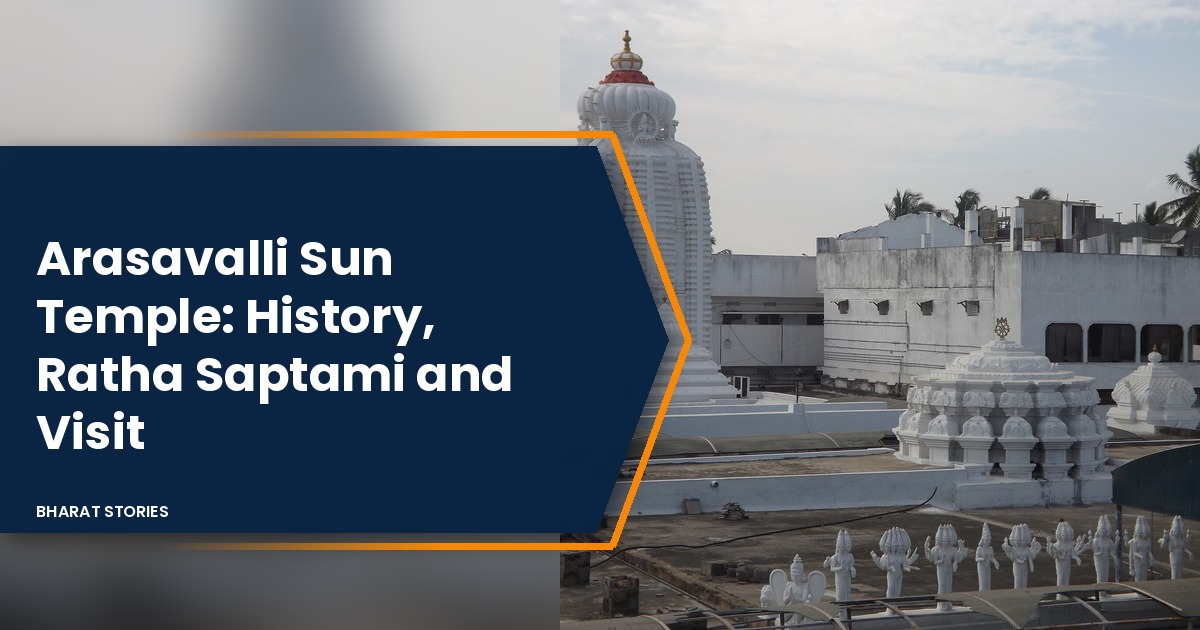
Arasavalli Sun Temple: History, Ratha Saptami and Visit
A short ride east of Srikakulam town in north coastal Andhra Pradesh stands one of the few temples in India where the Sun God is worshipped every day of the year. The Arasavalli Sri Suryanarayana Swamy temple draws huge crowds on Sundays and on Ratha Saptami, and it is famous for a moment, twice a year, when the rising sun shines through the gateways and falls on the feet of the deity.
This guide explains the temple’s history and legends, its Kalinga style architecture, the Ratha Saptami festival, the sun ray phenomenon and practical tips for a visit. If you are interested in other sun temples, read our article on Konark.
Table of Contents
Arasavalli Temple at a Glance
| Item | Detail |
|---|---|
| Full name | Sri Suryanarayana Swamy Temple, Arasavalli |
| Location | Arasavalli, about 1 km east of Srikakulam town, Andhra Pradesh |
| Deity | Surya, worshipped as Suryanarayana Swamy |
| Builder | Attributed to Devendra Varma, an Eastern Ganga ruler of Kalinga, 7th century CE |
| Rebuilt | Reconstructed in 1778 CE by Elamanchili Pullaji Panthulu |
| Style | Kalinga style, related to the temples of Odisha |
| Main festival | Ratha Saptami, declared a state festival in December 2024 |
| Sun rays on the idol | Early March and the start of October, for a few minutes after sunrise |
History of the Temple
Stone inscriptions in the temple are the main evidence for its age. According to the temple’s own history page, archaeologists read them as showing that Devendra Varma, a ruler of the Kalinga kingdom, built the temple and installed the image of the Sun God in the later half of the 7th century. Later inscriptions record gifts of land by his successors, made before the 11th century, to fund perpetual lamps and a school for students of the Vedas and Shastras.
The region was then part of the realm of the Eastern Gangas, the dynasty whose later kings also built the great Sun Temple at Konark in Odisha. Over the following centuries the Arasavalli temple suffered from neglect and decay. The structure visitors see today largely dates from 1778, when it was reconstructed by Elamanchili Pullaji Panthulu, a local benefactor, with further work in later years. Today the temple is managed by the Andhra Pradesh Endowments Department.
The village was once known as Harshavalli, often explained as the abode of joy. Over time the name changed to Arasavalli, also written Arasavilli.
Legends of Arasavalli
Two stories are told about the temple’s origin. According to the Padma Purana, a Hindu sacred text, the sage Kashyapa installed the image of Surya here for the welfare of humanity. For this reason Surya is said to belong to the Kashyapa gotra.
The temple’s local legend, the sthala purana, gives Indra a starring role. The king of the gods is said to have tried to force his way into a nearby Shiva shrine and been thrown back by Nandi, the guardian bull. Humbled, Indra prayed to the Sun, who appeared before him. Indra then installed the image of Surya here and dug the sacred tank, known as Indra Pushkarini, with his thunderbolt. Pilgrims still bathe in this tank before darshan.
Architecture and the Deity
The temple is built in the Kalinga style, with a curving tower over the sanctum of the kind called rekha deula in Odisha. Smaller shrines and mandapas stand around the main temple within the compound. Much of the stonework has been plastered and painted white in recent decades, so it looks newer than its long history suggests.
The presiding image shows Surya standing, holding lotus flowers, with his consorts Usha and Chhaya. He is traditionally pictured riding a chariot drawn by seven horses with Aruna as charioteer. Hindu tradition links the seven horses with the seven days of the week, and many teachers also connect them with the colours of sunlight. Through most of the year the image is covered with ornaments and decorations. Only on Ratha Saptami do devotees see the deity in its original, unadorned form, called nijarupa darshan.
When the Sun Touches the Deity
The temple is aligned so that, on a few mornings each year, the first rays of the sun pass through the five entrance gateways and reach the feet of the idol in the sanctum. Temple priests and news reports place this around 8 to 10 March and again around 1 to 3 October. The light rests on the image for only a few minutes, and cloud can hide it completely, so devotees often wait for several mornings. Some guides give September instead of October, so it is wise to check the dates announced by the temple each year.
In 2015 the endowments department said it planned to clear structures between the temple tank and the sanctum so the rays would fall more freely. The event is one of the busiest times at the temple after Ratha Saptami.
Ratha Saptami at Arasavalli
Ratha Saptami falls on the seventh day of the bright half of the month of Magha, usually in late January or February. It is celebrated as Surya Jayanti, the birthday of the Sun God, and as the symbolic turning of his chariot towards the north, marking the change of season. The Srikakulam district administration describes it as the most important festival of the temple.
In December 2024 the Andhra Pradesh government declared Ratha Saptami a state festival. In 2026 it fell on 25 January. Rituals began after midnight with a milk abhishekam, and devotees bathed in the Indra Pushkarini at dawn with arka leaves on their heads, a custom associated with prayers for health. Officials expected more than 2.6 lakh visitors. The district laid on special queues, CCTV monitoring, a mass Surya Namaskar event and a cultural procession through Srikakulam, along with helicopter and hot air balloon rides for the first time. Reports the next day also pointed to crowding and poor coordination at the temple, so visitors on the festival day should expect long waits and plan carefully.
A Note on Beliefs
Many devotees believe that worship at Arasavalli helps relieve eye and skin ailments, and the Sun is honoured across Indian traditions as a giver of health. These are matters of faith. Anyone with an eye or skin problem should still see a qualified doctor, and visitors standing for hours in the sun on festival days should drink water and protect their skin.
Planning a Visit
Timings and Dress
The temple is open daily from early morning to the night, with a break in the afternoon. Sundays are the busiest days of the week. Darshan and seva timings change on festival days, so check the official temple website before you go. Modest traditional clothing is expected, and footwear must be left outside.
Getting There
Arasavalli is about 1 km from the centre of Srikakulam. The nearest railway station on the main Howrah to Chennai line is Srikakulam Road at Amadalavalasa, roughly 13 km away. Visakhapatnam airport is about 110 km by road. Autos and local buses connect the town to the temple.
Nearby Places
Srikakulam district has several other important sites. The Srikurmam temple, dedicated to Vishnu in his tortoise form, is about 13 km away. Mukhalingam, with early Eastern Ganga temples, and the beaches at Kalingapatnam and Baruva can be visited on day trips. The Incredible India page on Srikakulam lists more attractions in the district.
Best Time to Visit
The cooler months from October to March are the most comfortable. If you want to see the sun rays on the deity, aim for early March or early October and arrive before sunrise.
Frequently Asked Questions
Where is Arasavalli temple located?
It is in Arasavalli village, about 1 km east of Srikakulam town in the north coastal part of Andhra Pradesh.
Who built the Arasavalli Sun temple?
Inscriptions credit Devendra Varma, a Kalinga king of the Eastern Ganga line, in the 7th century. The present structure is mostly the result of reconstruction in 1778.
When do the sun rays fall on the deity?
For a few minutes after sunrise on some days in early March and again in early October, if the sky is clear.
What is nijarupa darshan?
It is the sight of the deity without its usual coverings and ornaments. At Arasavalli this is offered only on Ratha Saptami.
Is Ratha Saptami a public festival in Andhra Pradesh?
Yes. The state government declared it a state festival in December 2024, with the main celebrations held at Arasavalli.
Is Arasavalli the only sun temple in India?
No. Konark in Odisha and Modhera in Gujarat are other famous sun temples, but Arasavalli is one of the few where Surya is still worshipped daily with regular rituals.