

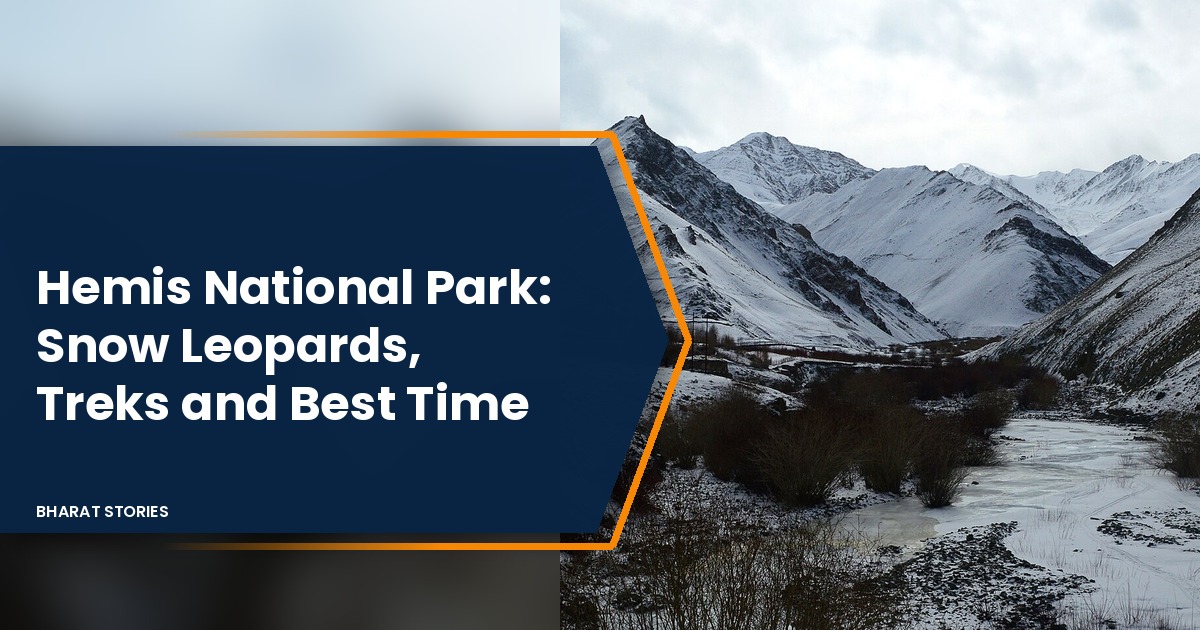
Hemis National Park: Snow Leopards, Treks and Best Time
Snow leopards are among the hardest big cats on earth to see, yet every winter photographers and naturalists travel to one valley in Ladakh with a real chance of watching one. That valley, Rumbak, lies inside Hemis National Park, India’s largest national park and its only one north of the main Himalayan range. In summer the same park becomes a trekking playground of high passes, Buddhist villages and wide desert mountain views.
This guide covers where Hemis is, its size and history, the wildlife, snow leopard season, the main treks, homestays and how to plan a trip from Leh.
Table of Contents
Where is Hemis National Park?
Hemis National Park is in Leh district of Ladakh, about 50 km from Leh town, bounded to the north by the Indus river and covering the Rumbak and Markha valleys and parts of the Zanskar range.
The park lies in the rain shadow of the Himalayas, so it is a cold desert: dry, rocky and sparsely vegetated, with rivers lined by willow and poplar. Villages such as Rumbak, Yurutse, Skiu and Markha sit within the park, and the famous Hemis monastery stands near its eastern edge, giving the park its name.
Hemis monastery is about 400 years old and is the setting for the two day Hemis Tsechu festival, usually held in June or July, when monks perform masked cham dances in the courtyard. Many travellers time a summer trek to finish with the festival, so book stays in Leh early if your dates overlap.
How big is Hemis National Park and when was it set up?
Hemis was created in 1981 with about 600 sq km in the Rumbak and Markha catchments, enlarged in 1988 to about 3,350 sq km and again in 1990 to about 4,400 sq km, making it the largest national park in India.
These stages are summarised on Wikipedia’s Hemis National Park page. Some official lists still quote the older 3,350 sq km figure, which is why you will see both numbers. The Department of Wildlife Protection of the Ladakh administration manages the park.
| Fact | Details |
|---|---|
| Location | Leh district, Ladakh |
| Established | 1981, enlarged 1988 and 1990 |
| Area | About 4,400 sq km (older figure 3,350 sq km) |
| Altitude | Roughly 3,300 to over 6,000 metres |
| Famous for | Snow leopard, bharal, Ladakh urial, Markha valley trek |
| Recorded species | 16 mammals and 73 birds |
Why is Hemis National Park famous for snow leopards?
Hemis is one of the best places in the world to see wild snow leopards, because its valleys hold good numbers of the cat’s prey and the animals move down closer to villages in late winter.
India’s first national Snow Leopard Population Assessment, carried out between 2019 and 2023 and released in January 2024, estimated 718 snow leopards in the country. Ladakh had the largest share, about 477. Within Ladakh, the Rumbak catchment of Hemis is the best known area for sightings, and some estimates have put the park’s own population as high as about 200 animals.
Seeing one still takes patience. Spotters scan slopes with telescopes from dawn, and many visitors wait several days. Good guides and trackers from Rumbak and nearby villages are what make the difference.
What other animals live in Hemis?
The park holds bharal (blue sheep), argali, the Ladakh urial or shapu, Asiatic ibex, Tibetan wolf, Eurasian brown bear, red fox, Himalayan marmot, mountain weasel and woolly hare.
- Bharal: the most common wild sheep and the snow leopard’s main prey, often seen on cliffs above Rumbak.
- Shapu (Ladakh urial): Hemis is the only protected area in India known for this wild sheep.
- Argali: the great Tibetan sheep, rare and found at higher, open slopes.
- Tibetan wolf and red fox: wide ranging predators that sometimes cross paths with trekkers.
- Himalayan marmot: burrowing rodents easily seen in summer meadows.
Birds of Hemis
Raptors are a highlight: the golden eagle, lammergeier (bearded vulture) and Himalayan griffon soar over the valleys. Other birds include the Himalayan snowcock, chukar partridge, red billed chough, brown and robin accentors, streaked rosefinch, fire fronted serin and several snowfinches.
When is the best time to visit Hemis National Park?
February and March are best for snow leopard trips, while mid June to mid October is the season for trekking and general sightseeing.
| Months | Best for | Conditions |
|---|---|---|
| December to March | Snow leopard tracking, winter wildlife | Severe cold, often minus 15 to minus 25 C at night |
| April to mid June | Quieter visits, early birds | Snow on passes, cold nights |
| Mid June to mid October | Markha valley and other treks, Hemis festival | Warm days, cold nights, strong sun |
| Late October to November | Fewer visitors | Very cold; many homestays close |
Which treks pass through Hemis National Park?
The Markha valley trek is the most popular, crossing the Ganda La and Kongmaru La passes; the Spituk to Stok trek over Ganda La and shorter walks around Rumbak are other options.
The Markha valley trek usually takes six to eight days with nights in village homestays or camps. The Ganda La pass, at about 4,980 metres, lies between Rumbak and Skiu, and Kongmaru La is the higher pass on the eastern side before the descent towards Hemis. The park also includes climbing peaks such as Stok Kangri (6,153 m) and Kang Yatse (6,496 m). Climbing rules and permissions for these peaks have changed in recent years, so check the current status with registered Leh operators.
What are homestays in Hemis and why do they matter?
Homestays let visitors sleep and eat in Ladakhi village homes inside the park, giving families income from wildlife and reducing anger when snow leopards kill livestock.
More than 1,600 people live inside the park, mostly herders keeping sheep and goats. Snow leopards sometimes raid livestock pens, which used to lead to revenge killings. Since 2000, homestays started with the Snow Leopard Conservancy India Trust, predator proof corrals and nature guide training have helped turn the cat into an asset rather than a pest. When you stay in a homestay, you are directly supporting that model.
What should you know before visiting Hemis?
Acclimatise in Leh for at least two days, book through registered operators or local homestays, pay park fees, and follow rules against littering, drones and disturbing wildlife.
- Altitude sickness is a real risk. Rest in Leh before going higher, drink water and descend if symptoms worsen.
- Carry warm layers in every season and a down jacket in winter.
- Do not use playback or bait to attract animals.
- Keep a respectful distance from any snow leopard; do not approach kills or block its path.
- Carry cash. ATMs and card payments are limited outside Leh.
The Incredible India page on Hemis has an official overview for travellers.
How do you reach Hemis National Park?
Fly to Leh’s Kushok Bakula Rimpochee Airport, then drive to Zingchen or Martselang, the usual entry points for Rumbak and the Markha valley. In summer, Leh is also reachable by road from Manali and Srinagar.
- Fly to Leh and rest for two days.
- Drive about an hour to Zingchen for Rumbak, or to Chilling or Martselang for Markha valley routes.
- Walk in to Rumbak, a few hours from the road head.
- Visit Hemis monastery on the way back, south of the Indus.
Plan the rest of your trip with our Leh Ladakh travel guide, our pick of top treks in Ladakh, other high mountain parks such as Great Himalayan National Park, and our list of national parks of India.
Frequently Asked Questions
Which is the largest national park in India?
Hemis National Park in Ladakh, at about 4,400 sq km, is generally listed as the largest national park in India.
Are there snow leopards in Hemis National Park?
Yes. Hemis is one of the world’s best known places to see them, especially in the Rumbak valley in February and March.
Can tourists visit Hemis National Park?
Yes. You can trek, stay in homestays and join guided snow leopard trips. Park fees apply, and some climbing peaks need separate permission.
Is Hemis National Park in Jammu and Kashmir?
It is now in the Union Territory of Ladakh, created in 2019. Older articles place it in Jammu and Kashmir.