

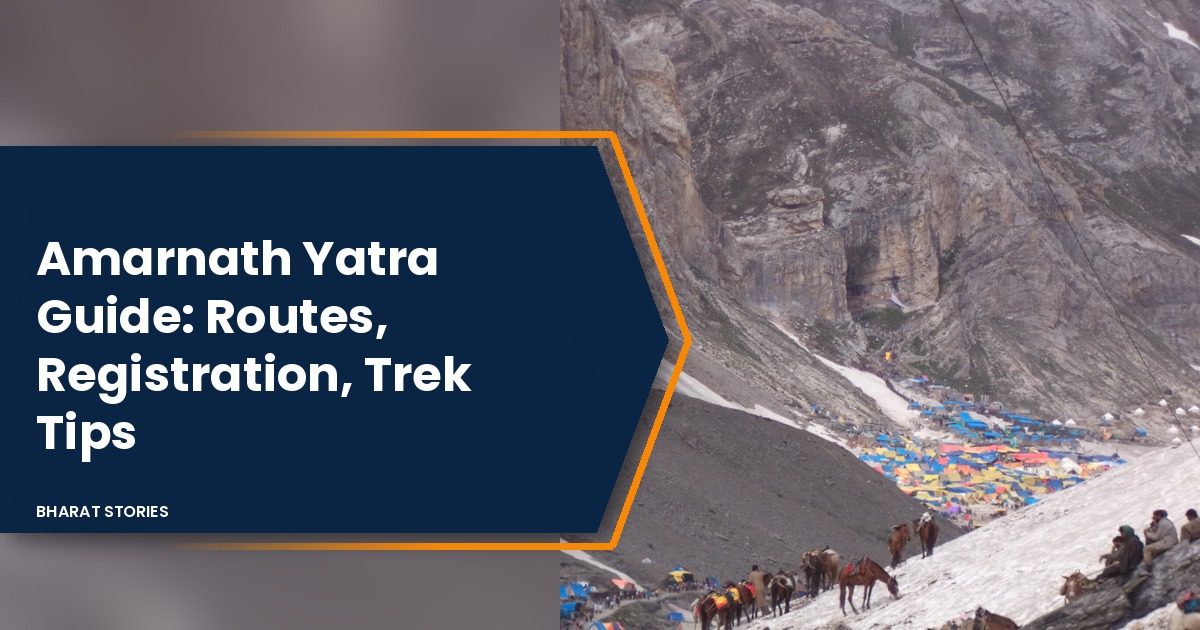
Amarnath Yatra Guide: Routes, Registration, Trek Tips
For a few weeks each summer, lakhs of pilgrims walk, ride ponies or are carried in palkis through the high valleys of Kashmir to reach a cave at 3,888 metres. Inside, a natural column of ice forms each year, worshipped as a lingam of Lord Shiva. The Amarnath Yatra is one of the toughest and most moving pilgrimages in India, and it needs real planning: registration, a medical certificate, the right route and respect for the mountains.
This guide explains the cave and its legend, the two routes, how registration works, what happened in the 2026 yatra, health precautions and a practical packing list.
Table of Contents
What is the Amarnath Yatra?
The Amarnath Yatra is the annual Hindu pilgrimage to the Amarnath cave shrine in the Pahalgam tehsil of Anantnag district, Jammu and Kashmir, held for a limited period in July and August when the ice lingam is fully formed.
The cave lies about 141 km from Srinagar on the Amarnath mountain, surrounded by glaciers and snowfields. It is closed for most of the year because of snow. The pilgrimage is organised by the Shri Amarnathji Shrine Board (SASB), chaired by the Lieutenant Governor of Jammu and Kashmir, with security and logistics handled by the administration, army, police and paramilitary forces.
What is inside the Amarnath cave?
The cave holds a natural ice stalagmite that devotees worship as a self manifested Shiva lingam, with two smaller ice formations regarded as Parvati and Ganesha.
Water dripping from the cave roof freezes on the floor and builds the lingam upward. It grows from about May as snow melts and slowly shrinks after August. The cave itself is about 40 metres high and is made of limestone and gypsum, according to Wikipedia’s page on the Amarnath Temple. Heat from crowds and warmer summers affects the size of the lingam, which is why authorities regulate activity near the cave.
What is the legend of Amarnath?
Devotees believe this is the cave where Shiva told Parvati the secret of immortality, the Amar Katha, after leaving behind his companions along the way so no one else could hear it.
The legend says Shiva left his bull Nandi at Pahalgam, the moon from his hair at Chandanwari, his serpents at Sheshnag lake, his son Ganesha at Mahagunas pass and the five elements at Panchtarni. The pilgrimage route follows these same places. Another tradition holds that the sage Bhrigu was the first to see the lingam. Kalhana’s 12th century chronicle Rajatarangini refers to the shrine as Amareshvara and to the yatra as a known event, and the cave also appears in the Ain i Akbari of the 16th century.
Which routes lead to the Amarnath cave?
There are two routes: the traditional Pahalgam route via Chandanwari, about 43 km on foot and usually three to five days one way, and the shorter, steeper Baltal route, about 14 km, which many pilgrims finish in one or two days.
| Feature | Pahalgam route | Baltal route |
|---|---|---|
| Base camp | Nunwan, Pahalgam, then Chandanwari | Baltal, near Sonamarg |
| Trek length | About 43 km from Chandanwari | About 14 km |
| Gradient | Longer but gentler | Short but very steep |
| Typical time | Three to five days one way | One to two days return |
| Main halts | Pissu Top, Sheshnag, Mahagunas Top, Panchtarni, Sangam | Domail, Barari, Sangam |
| Nearest rail | Anantnag | Srinagar |
Pahalgam route
From Pahalgam, vehicles go 16 km to Chandanwari. The trail then climbs to Pissu Top, follows the valley to Sheshnag lake for a night halt, crosses Mahagunas Top at about 14,500 feet, the highest point, and descends to Panchtarni before the final stretch via Sangam to the cave. It is scenic and gradual, and it is the route linked with the legend.
Baltal route
From Baltal the track runs through Domail and Barari to Sangam, where it meets the Pahalgam trail, and then on to the cave. It is much shorter, but the climb is steep, narrow in places and hard on the knees coming down. Ponies and palkis are available on both routes at regulated rates.
How does Amarnath Yatra registration work?
Every pilgrim must register in advance with the Shri Amarnathji Shrine Board, carry a Compulsory Health Certificate from an authorised doctor, and collect an RFID card that is scanned along the route. Registration usually opens in spring, months before the yatra.
- Watch for the Shrine Board’s official notice announcing yatra dates and registration.
- Get a Compulsory Health Certificate from a doctor or hospital authorised by your state for that year.
- Register online on the Shrine Board’s official website or at designated bank branches, choosing your route and date.
- Collect your RFID yatra card at the authorised centres in Jammu and Kashmir before you start, and keep it on you.
In recent seasons the Shrine Board has set age limits, generally allowing pilgrims between 13 and 70, and has not permitted women more than six weeks pregnant. Rules can change each year, so read the current notice carefully and use only official channels. Beware of websites and agents that charge for “VIP darshan” or guaranteed slots; there is no such facility.
What happened in the Amarnath Yatra 2026?
The 2026 yatra began on 3 July and formally concluded on 28 August on Raksha Bandhan, a 57 day season in which more than 4.8 lakh pilgrims visited the cave, according to the Shrine Board.
As reported by National Herald, movement from both base camps was suspended from 9 August after heavy rain, cloudbursts and landslides damaged the tracks, and helicopter services were not permitted that year. Forty two pilgrims died of natural causes, mostly cardiac problems and altitude related illness. The yatra closed with the arrival of the Chhari Mubarak, the holy mace of Shiva, at the cave. Dates for the 2027 yatra will be announced by the Shrine Board, usually in spring.
How fit do you need to be for the Amarnath Yatra?
You need good general fitness and should prepare for several weeks, because the trek reaches over 4,000 metres where oxygen is much lower; anyone with heart, lung or blood pressure problems should consult a doctor first. This is general guidance, not medical advice.
- Start walking 4 to 5 km daily at least a month before, and add breathing exercises such as pranayama.
- Spend a night in Pahalgam, Sonamarg or Srinagar before you start, to help your body adjust.
- Learn the warning signs of altitude sickness: severe headache, breathlessness at rest, vomiting, confusion or unusual tiredness.
- If symptoms appear, stop climbing, tell staff at the nearest medical camp and descend if advised. Do not push on.
- Drink water regularly, avoid alcohol and smoking, and eat light meals at community langars.
What should you pack for the Amarnath Yatra?
Pack warm layers, a waterproof jacket, sturdy trekking shoes, a torch, basic medicines and your ID, health certificate and RFID card in a waterproof pouch.
- Woollens, gloves, a cap and thermal innerwear; nights at Sheshnag and Panchtarni are near freezing.
- Raincoat or poncho, since weather changes fast.
- Walking stick, sunglasses and sunscreen for glare off snow.
- Prescription medicines, plus any your doctor recommends for the trip.
- A small amount of cash; mobile networks can be patchy away from base camps.
How do you reach the Amarnath base camps?
Srinagar airport is the nearest airport; Jammu is the main rail and road gateway, with Srinagar and Anantnag stations on the Kashmir rail line, and buses and taxis run to Pahalgam and Baltal during the yatra.
Most pilgrims travel in official convoys from the Jammu base camp to Pahalgam or Baltal. Plan for weather delays and keep a spare day in your schedule.
For more pilgrim and Kashmir reading, see our guides to Jammu and Kashmir, Vaishno Devi, Kedarnath and the 12 Jyotirlingas of India.
Frequently Asked Questions
How many days does the Amarnath trek take?
Via Baltal, most pilgrims complete the round trip in one to two days. Via Pahalgam and Chandanwari, it usually takes three to five days one way.
How difficult is the Baltal route?
It is short but steep, with narrow sections and a hard descent. Fit pilgrims manage it in a day; others hire ponies or palkis.
What is the oxygen level at Amarnath?
At about 3,888 metres each breath carries roughly 35 to 40 percent less oxygen than at sea level, and Mahagunas Top is higher still. That is why acclimatisation and fitness matter.
Is there VIP darshan at Amarnath?
No. All registered pilgrims follow the same process. Treat offers of paid VIP darshan as a scam.