

Dachigam National Park: Hangul, Wildlife and Visitor Guide
Less than an hour’s drive from the houseboats of Dal Lake, the hills above Srinagar rise into a deep forested valley that has been guarded for more than a century. This is Dachigam National Park, and it holds something no other place on earth can claim: the last wild population of the hangul, the Kashmir stag. For anyone interested in Himalayan wildlife, it is one of the most rewarding and most fragile parks in India.
This guide covers the park’s history and landscape, the hangul and the other animals that live here, the latest census figures, and practical advice on permits and the best time to go. For other protected areas around the country, see our list of national parks of India.
Table of Contents
Dachigam National Park at a Glance
| Item | Detail |
|---|---|
| Location | Srinagar district, Jammu and Kashmir |
| Distance from Srinagar | About 22 km from Lal Chowk |
| Area | About 141 sq km |
| Protected since | 1910, first to safeguard Srinagar’s water supply |
| National park declared | 1981 |
| Altitude | Roughly 1,700 m to over 4,200 m |
| Flagship species | Hangul or Kashmir stag; 323 counted in 2025 |
| Best time to visit | April to August, according to the district administration |
Ten Villages and a Water Supply
The name Dachigam is usually read as ten villages, a memory of the settlements that were moved when the area was protected. The original reason for protection was practical rather than ecological. In 1910 the forest above Harwan was closed to grazing and felling so that the streams flowing from it would keep Srinagar’s drinking water clean. It was later a royal hunting preserve of the Maharaja, and after independence it remained under strict protection until it was declared a national park in 1981.
That long history of guarding the catchment is a large part of why the forests are in such good shape today. Water from the park still feeds the Harwan reservoir and flows towards Dal Lake, so protecting Dachigam also protects the city below.
Lower and Upper Dachigam
The park is usually described in two parts. Lower Dachigam, closer to Srinagar and the main gate at Harwan, is a valley of mixed forest and open slopes between about 1,700 and 2,500 metres. Wild apple, pear, cherry, walnut and apricot trees grow among the oaks and willows, a reminder of the orchards that once stood here. This is where most visitors walk, and where the hangul spend the winter months.
Upper Dachigam climbs much higher, through coniferous forest and birch to alpine meadows and rocky ridges. The Marsar lake lies in this upper zone, and the Dagwan stream that runs down the length of the park begins in these heights. The upper reaches are cut off by snow for much of the year and are visited mainly by researchers and wildlife staff during summer.
The Hangul: Kashmir’s Own Red Deer
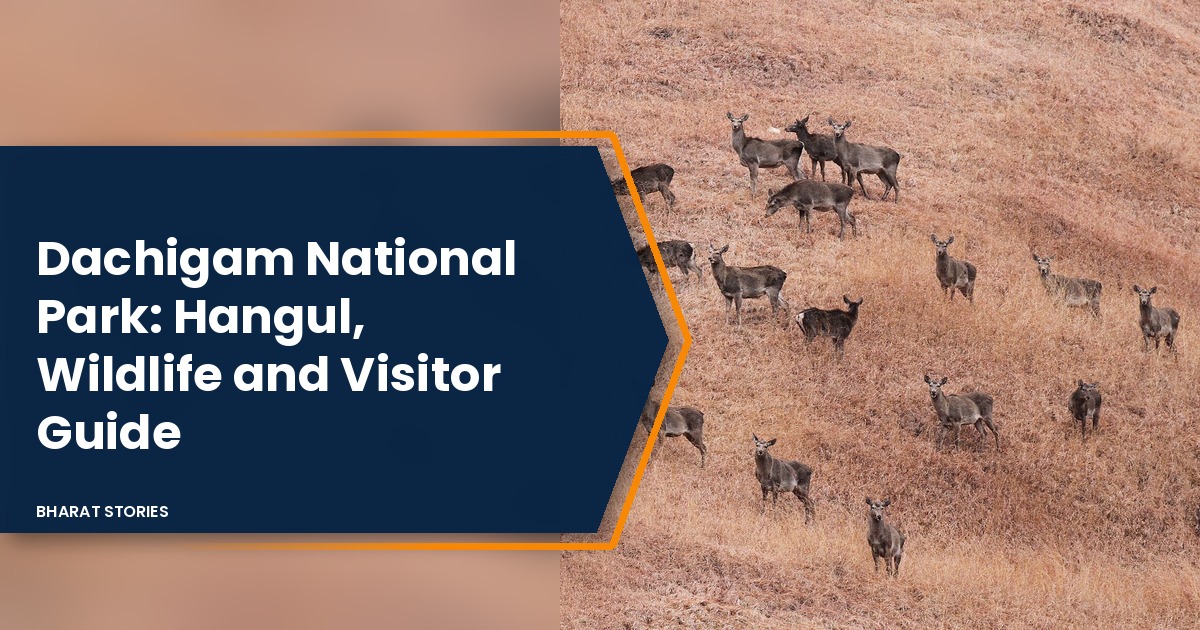
The hangul is a subspecies of red deer, related to the deer of Europe and Central Asia. Stags carry wide, branching antlers, often with five or more points on each side, and in autumn their bugling calls echo across the valley during the rut. The species is the state animal of Jammu and Kashmir, it is listed under Schedule I of the Wildlife Protection Act, and it has been assessed as critically endangered.
A century ago the hangul ranged widely across the mountains of Kashmir and into neighbouring areas. Hunting, habitat loss and disturbance pushed it back until, by the 1970s, only a small herd survived in and around Dachigam. The low point came in the early 2000s, when census teams counted only around 127 animals in 2008.
Since then numbers have been climbing slowly. The Department of Wildlife Protection carries out a census every two years. In March 2025, around 400 staff surveyed Dachigam and its surroundings and counted 323 hangul, up from 289 in 2023, 261 in 2021, 237 in 2019 and 214 in 2017. The 2025 figure is the highest in more than three decades.
Scientists are cautious, though. The population is still small and confined to one area, and studies have found a strongly female biased sex ratio and low numbers of fawns surviving each year, which limits how quickly the herd can grow. Predation by leopards and feral dogs, disturbance from grazing and roads at the park edge, and the risk of disease spreading through a single population are all concerns. A conservation breeding centre at Shikargah near Tral, set up to build a backup population, has been revived in recent years.
Other Wildlife of Dachigam
The hangul is the star, but it is far from alone. Dachigam has one of the highest densities of Asiatic black bears in the region, and visitors in late summer often see them feeding in fruit trees. Leopards are present throughout the lower forests. Higher up live Himalayan brown bears, long tailed marmots, Himalayan serow and the elusive musk deer. Yellow throated martens, red foxes, jackals and Himalayan grey langurs are seen across the park.
Birdwatchers can find the Himalayan monal in the higher forests, golden orioles and Himalayan woodpeckers lower down, and a range of warblers, flycatchers, buntings and birds of prey. Spring, when migrants return and the slopes fill with flowers, is especially rewarding for birds.
Visiting Dachigam
Dachigam is open through the year, but visits are regulated. You need an entry permit from the Department of Wildlife Protection, which is usually arranged through the Wildlife Warden’s office in Srinagar or at the park entrance. Check the latest rules with the Wildlife Warden’s office before you go, as access can change. Visitors normally walk or drive a short distance into lower Dachigam with a guide or forest staff. Trekking into the upper park requires special permission.
The park can be closed for short periods. Entry is usually stopped during the hangul census in spring and during the autumn rut, when the deer are most sensitive to disturbance.
When to Go
The Srinagar district administration recommends April to August, when the weather is mild and the lower valley is green. Bears are easiest to see in late summer and autumn when fruit ripens. Winter brings snow and cold, but it is also when hangul gather in the lower valley, so early winter mornings can be good for seeing them, with permission and a guide.
How to Reach
The park is about 22 km by road from Lal Chowk in Srinagar, past Shalimar Bagh and Harwan. The nearest airport is Srinagar, about 40 km away, and the nearest railway station is Srinagar, about 32 km away. Taxis from the city can drop you at the gate.
Tips for Visitors
- Carry a valid identity document and your entry permit at all times.
- Stay with your guide and on marked paths, especially in bear country.
- Keep noise low and do not approach or feed any animal.
- Avoid strong scents and do not leave food scraps, which attract bears.
- Respect closures during the census and rut; they exist to protect the hangul.
Many visitors combine a trip to Dachigam with the gardens of Srinagar. In autumn, the saffron fields of Pampore are another highlight of the valley; read more in our piece on the Kashmir saffron festival.
Frequently Asked Questions
What is Dachigam National Park famous for?
It is best known as the home of the hangul, or Kashmir stag, the only red deer found in India. Dachigam holds the last surviving wild population of this subspecies.
How many hangul are there in Dachigam?
The March 2025 census counted 323 hangul in Dachigam and adjoining areas, up from 289 in 2023.
Do I need a permit to visit Dachigam?
Yes. An entry permit from the Department of Wildlife Protection is required. Check current rules with the Wildlife Warden’s office in Srinagar before visiting.
How far is Dachigam from Srinagar?
The park is about 22 km from Lal Chowk in Srinagar, roughly a 45 minute drive.
Which animals can be seen in Dachigam besides the hangul?
Asiatic black bears, leopards, yellow throated martens, Himalayan grey langurs and many birds are found in the lower park, with brown bears, marmots, serow and musk deer higher up.
When was Dachigam declared a national park?
The area has been protected since 1910 and was declared a national park in 1981.