

Darrah National Park: Mukundra Hills Tigers and Travel
South of Kota, where the Chambal river cuts a deep gorge through a pair of long, flat topped ridges, lies a forest that was once the private hunting ground of the Maharajas of Kota. Long known as Darrah, it now forms the heart of the Mukundra Hills Tiger Reserve, and after years of setbacks it has become one of the more hopeful tiger stories in Rajasthan.
This guide explains how Darrah became a sanctuary, then a national park and a tiger reserve, what the landscape and wildlife are like, how the effort to bring tigers back has gone, and how to plan a visit. For other protected areas around the country, see our list of national parks of India.
Table of Contents
Darrah National Park at a Glance
| Item | Detail |
|---|---|
| Official name | Mukundra Hills National Park, widely known as Darrah |
| State and districts | Rajasthan; mainly Kota, with Chittorgarh and Jhalawar forests in the wider reserve |
| Darrah sanctuary declared | 1955 |
| National park notified | January 2012 |
| Tiger reserve | Mukundra Hills Tiger Reserve, constituted in 2013 |
| Tiger reserve area | About 760 sq km: 417 sq km core and 343 sq km buffer |
| Tigers | Seven reported in early 2026, after a series of translocations |
| Nearest city | Kota, about 50 km to the north |
From Royal Hunting Ground to Tiger Reserve
For generations the forests of Darrah were reserved for the rulers of Kota, who hunted tiger, leopard and deer in the hills. After independence the area passed to the state, and in 1955 it was declared the Darrah Wildlife Sanctuary. For decades it remained a modest sanctuary, visited mostly by people travelling between Kota and Jhalawar.
Its status changed in two big steps. In January 2012 the Rajasthan government notified Mukundra Hills National Park, built around the Darrah forests. In 2013 the National Tiger Conservation Authority approved the Mukundra Hills Tiger Reserve, which brings together the national park, the Darrah and Jawahar Sagar sanctuaries and a stretch of the National Chambal Sanctuary as its core. According to the NTCA brief note on the reserve, the core covers about 417 sq km and the buffer about 343 sq km, for a total close to 760 sq km.
The Mukundra Hills
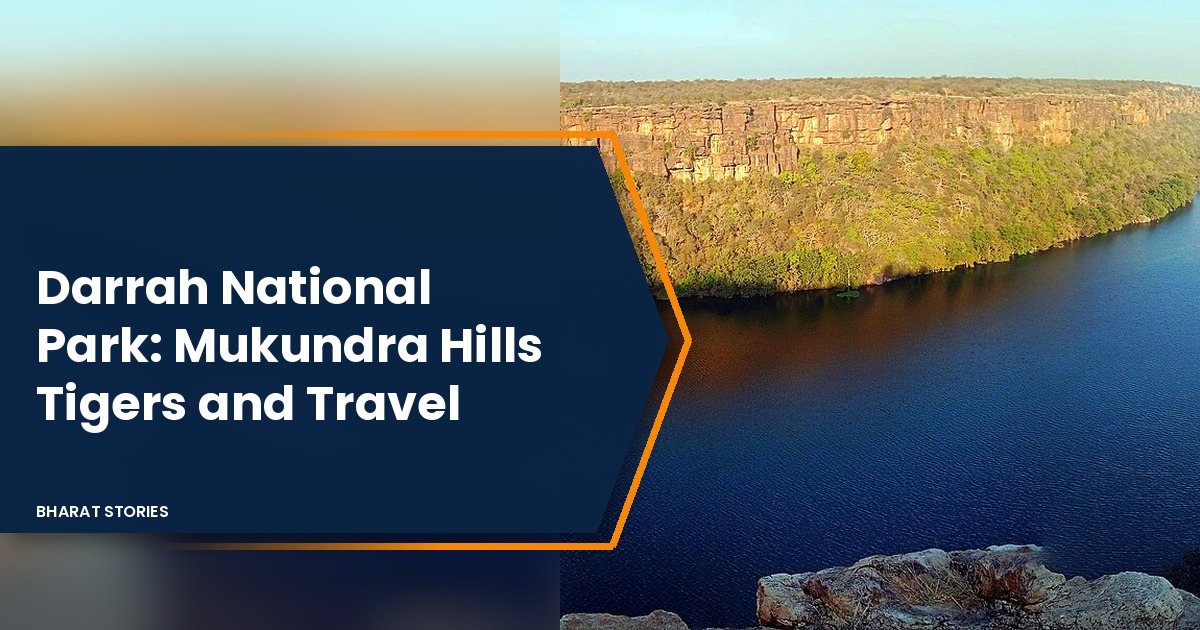
The reserve takes its name from two almost parallel hills of the Vindhyan range. Flat on top and steep at the sides, with narrow ridges in the middle, they run for nearly 80 km from the Chambal to the Kalisindh river and are only 2 to 5 km wide. Between and around them lie valleys, plateaus and river gorges.
The Chambal is the most dramatic feature. Upstream of Kota it flows through a deep gorge lined with cliffs, and the stretch inside the reserve is home to gharials, mugger crocodiles and otters. Other rivers, among them the Ahu, Amjhar and Kalisindh, keep water in the landscape for much of the year. Old rock shelters in the hills carry painted figures of animals and people, evidence that these ridges were used long before any king hunted here.
Forest and Wildlife
The forest is dry deciduous. Dhok, a hardy tree that sheds its small leaves in summer, dominates large areas, with khair, ber, tendu, salar and bel on the slopes. In summer the hills look brown and bare; after the monsoon they turn green within weeks.
Leopards are the most widespread large predators, and sloth bears live in the rocky hills. Nilgai, chital, sambar, chinkara and wild pig form the prey base, though officials have long said prey numbers need to grow, which is why plans to bring in more chital have been discussed. Striped hyenas, jackals, jungle cats, Indian porcupines and pangolins are also recorded. Birdlife includes painted partridges, grey hornbills, Alexandrine parakeets, many raptors and waterbirds along the rivers.
One correction is worth making. Older accounts sometimes list the cheetah among the animals of Darrah. The Asiatic cheetah was declared extinct in India in 1952, and the cheetahs brought to India since 2022 have been released elsewhere, not in Mukundra.
Bringing Back the Tiger
Tigers from Ranthambore have occasionally wandered into the Mukundra landscape for years, using fragmented corridors along the Chambal. When the tiger reserve was created, the plan was to turn it into a satellite home for Ranthambore’s growing population. The first attempts, between 2018 and 2020, ended badly. Several of the tigers moved there died or disappeared, and by the early 2020s the reserve was almost empty again.
The more recent effort has gone better. A tiger cub orphaned in Ranthambore was raised with minimal human contact at the Abheda rescue centre in Kota and released into Mukundra in December 2024, and officials say the young tiger now hunts independently. In June 2025 a Ranthambore tigress that had attacked people was moved to the reserve, and forest staff report that she has settled calmly. In January 2026 a four year old male, T 2408, was brought from Ranthambore and released in the Darrah range.
At the end of February 2026 a tigress from Bandhavgarh Tiger Reserve in Madhya Pradesh arrived after a journey of nearly 20 hours and was kept in a soft release enclosure in the Jhamra valley. Officials said this took the reserve’s total to seven tigers, two males, four females and one cub, and the new tigress later set up a territory in the Rawatbhata area. Reports in November 2026 said a further tigress from Maharashtra was expected soon.
Challenges remain. A major railway line and a national highway pass through the reserve, villages still sit inside parts of it, and prey must increase for a breeding population to thrive. For the park that inspired the plan, see our guide to Ranthambore National Park.
Visiting Darrah and Mukundra
Safaris in Mukundra Hills Tiger Reserve are run by the Rajasthan Forest Department, with gypsy safaris in set areas of the reserve. Routes, timings, fees and booking methods have changed several times as the tiger programme has developed, so check current details with the forest department office in Kota before you travel. As in other tiger reserves, the core usually closes for the monsoon from July to September.
The reserve is most comfortable to visit between October and March, when days are mild. Summer, from April to June, is very hot, though animals are easier to see near water. Early morning is the best time for wildlife at any season.
How to Reach
Kota is the nearest city, about 50 km north of Darrah, with good rail connections to Delhi, Mumbai and other cities. The forest lies along the road from Kota towards Jhalawar. Air connections to Kota are very limited, so most travellers fly to Jaipur or Udaipur and continue by road or rail.
Nearby Places
- Gagron Fort: a river fort near Jhalawar surrounded on three sides by water, part of the Hill Forts of Rajasthan World Heritage Site.
- Chambal river front and gardens in Kota: good for an evening walk after a day in the forest.
- Bhainsrorgarh and Rawatbhata: upstream along the Chambal, with gorges and a historic fort.
For more about the state, see our guide to Rajasthan.
Frequently Asked Questions
Is Darrah National Park the same as Mukundra Hills National Park?
Yes. Darrah is the older and more familiar name. The area was notified as Mukundra Hills National Park in 2012 and is the core of the Mukundra Hills Tiger Reserve.
Are there tigers in Darrah?
Yes. After several translocations, officials reported seven tigers in the reserve in early 2026, including a male released in the Darrah range in January 2026.
How far is Darrah from Kota?
Darrah is about 50 km from Kota, along the road towards Jhalawar.
When was Darrah declared a sanctuary?
Darrah was declared a wildlife sanctuary in 1955, after serving as a hunting ground of the Maharajas of Kota.
What is the best time to visit Darrah?
October to March has the most comfortable weather. Animals can be easier to spot near water in the hot months, and the core usually closes during the monsoon.
Which animals can be seen in Darrah?
Leopards, sloth bears, nilgai, chital, sambar, chinkara, hyenas and many birds, with gharials and crocodiles along the Chambal. Tigers are present in small numbers.