

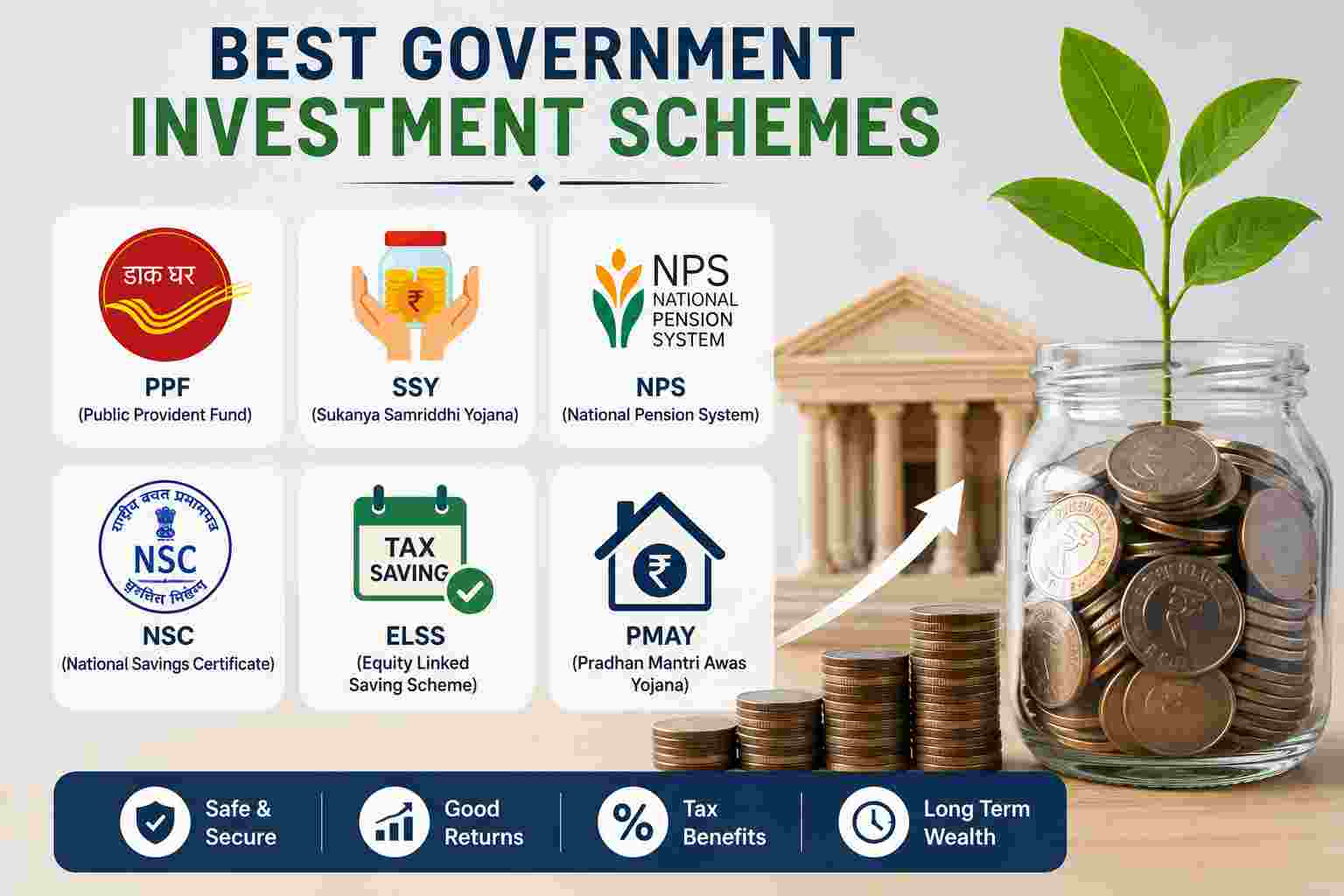
Best Government Investment Schemes
A lot of people spend years working hard and saving whatever they can — then feel completely stuck when it comes to doing something useful with that money. The stock market feels risky. Bank FD rates have been quietly shrinking for years. And the sheer number of private investment products out there makes it hard to know who to actually trust.
This is exactly why government investment schemes deserve more attention than they usually get. The government backs them. The returns are fixed and predictable. And several come with tax benefits that push the effective return even higher.
Table of Contents
Why People Have Trusted These Schemes for Generations
There is a reason your parents and grandparents put their money in post office schemes and the PPF instead of chasing the latest private sector product. These schemes have been around for decades. The Public Provident Fund has existed since 1968. Post office savings go back even further.
The core appeal is straightforward — the Government of India guarantees the principal. No private bank, mutual fund, or insurance product can offer that same weight of backing. For middle-class families, retired individuals, and anyone who simply cannot afford to lose what they have saved, that guarantee is everything.
On top of that, many small savings schemes qualify for deduction under Section 80C of the Income Tax Act, which lets you reduce your taxable income by up to Rs 1.5 lakh per year. That combination of safety and tax saving is very hard to find anywhere else.
Public Provident Fund: The One Most Financial Advisors Recommend First
If you ask most financial advisors to name one safe investment they would suggest to almost anyone, the PPF comes up immediately. It has been earning that recommendation for decades, and for good reason.
You can start with as little as Rs 500 per year and go up to Rs 1.5 lakh per year. The tenure is 15 years, with an option to extend in five-year blocks after that. The government revises the interest rate quarterly, and it consistently tends to beat most bank fixed deposit rates.
Partial withdrawals are allowed from the seventh year. Loans against the balance are available from the third year. Among all government investment schemes, PPF combines long-term wealth building with complete tax efficiency in a way very few products can match.
Sukanya Samriddhi Yojana: Designed Specifically for Your Daughter
If you have a daughter under ten years old, this scheme was made with your exact situation in mind. Open an account in her name, invest regularly, and the money grows at one of the highest interest rates offered by any small savings schemes in India today.
The account matures when she turns 21. Partial withdrawals are allowed after she turns 18 for higher education. Every rupee you invest qualifies for Section 80C deduction. The interest and the final maturity amount are both fully tax-free.
For parents who want to plan seriously for their daughter’s education or marriage without touching any market risk, Sukanya Samriddhi Yojana is one of the most thoughtfully built government investment schemes available.
Senior Citizens Savings Scheme: Built Around Regular Income After Retirement
Retirement changes what you need from your money. Growth becomes less important. Regular income becomes essential. The Senior Citizens Savings Scheme understands this.
If you are 60 or above, you can deposit up to Rs 30 lakh and receive quarterly interest directly in your account. The interest rate is among the highest offered by any government-backed safe investment plans available to individuals in India. The scheme runs for five years with an option to extend for three more.
Deposits up to Rs 1.5 lakh qualify for Section 80C deduction. For retirees who want predictable income without worrying about markets, SCSS is one of the strongest investment plans available right now.
National Savings Certificate: No Frills, No Surprises
NSC is exactly as simple as it sounds. You walk into any post office, invest a lump sum for five years, and receive the fixed maturity amount at the end. The interest compounds annually and is paid out at maturity.
There is no upper investment limit, which makes it useful if you want to park a larger amount in one shot. The full investment qualifies for Section 80C deduction. NSC certificates can also be used as collateral for loans from banks.
Among post office schemes, NSC is the one that involves the least complexity. You know what you are putting in and exactly what you will get back. For anyone who finds financial products overwhelming, that kind of clarity is genuinely reassuring.
Kisan Vikas Patra: Your Money Doubles at a Fixed Rate
Kisan Vikas Patra runs on one simple promise — your invested amount doubles over a fixed period. The maturity period shifts with the interest rate prevailing at the time of purchase.
There is no upper investment limit. You can transfer the certificate to another person if needed, and it can be pledged as collateral for a bank loan. KVP does not qualify for Section 80C deduction, but for people who want a clean, uncomplicated safe investment with guaranteed doubling of their money, it does the job without any confusion.
Post Office Monthly Income Scheme: Money in Your Account Every Month
Not everyone needs aggressive growth. Some people simply need their savings to generate a fixed monthly amount while the principal stays completely protected. That is the entire purpose of POMIS.
You invest a lump sum — up to Rs 9 lakh for an individual or Rs 15 lakh for a joint account — and monthly interest lands in your account without fail for five years. It does not offer Section 80C benefits, but for retirees or anyone living on a fixed income, the reliability of that monthly deposit is worth more than any tax deduction.
Picking the Right Scheme for Your Situation
Before you decide, think honestly about a few things:
- How long can you stay without this money? PPF runs for 15 years. NSC, SCSS, and POMIS run for 5. Match the tenure to your real life, not your ideal plan
- Do you need regular income or a lump sum later? POMIS and SCSS pay you regularly. PPF, NSC, and KVP build up and pay at maturity
- How much do tax savings matter to you? PPF, SSY, SCSS, and NSC all qualify under Section 80C. KVP and POMIS do not
- Is there a specific goal driving this? Saving for your daughter’s future, planning for retirement, or building an emergency corpus all point toward different schemes
- Is there a limit on how much you can invest? Some schemes cap the investment. NSC and KVP have no upper limit
Frequently Asked Questions
-
What makes government investment schemes safer than other options?
Government investment schemes are directly backed by the Government of India, which guarantees the principal amount. Bank deposits are insured only up to Rs 5 lakh under DICGC, and mutual funds or stocks offer no guarantee at all.
-
Which post office scheme offers the highest interest rate right now?
Among the main post office schemes, Sukanya Samriddhi Yojana and the Senior Citizens Savings Scheme typically carry the highest rates. But rates are revised every quarter by the Ministry of Finance, so what applies today may shift within months.
-
Are small savings schemes better than bank fixed deposits?
In most cases, yes. Small savings schemes offer equal or higher interest rates than bank FDs at comparable tenures, come with a sovereign guarantee rather than limited deposit insurance, and several of them offer better tax treatment.
-
Can NRIs invest in these government investment schemes?
Most government investment schemes including PPF, SSY, and SCSS are available only to resident Indians. NRIs who had active PPF accounts before becoming non-resident may be allowed to continue them until maturity in certain cases.
-
How do I figure out which investment plan is right for me?
Be honest about three things first — how long you can leave the money untouched, whether you need regular income or a lump sum at the end, and how much tax saving matters to you. Long-term tax-free growth points you toward PPF. Planning for a daughter points to SSY. Regular retirement income points to POMIS or SCSS.