

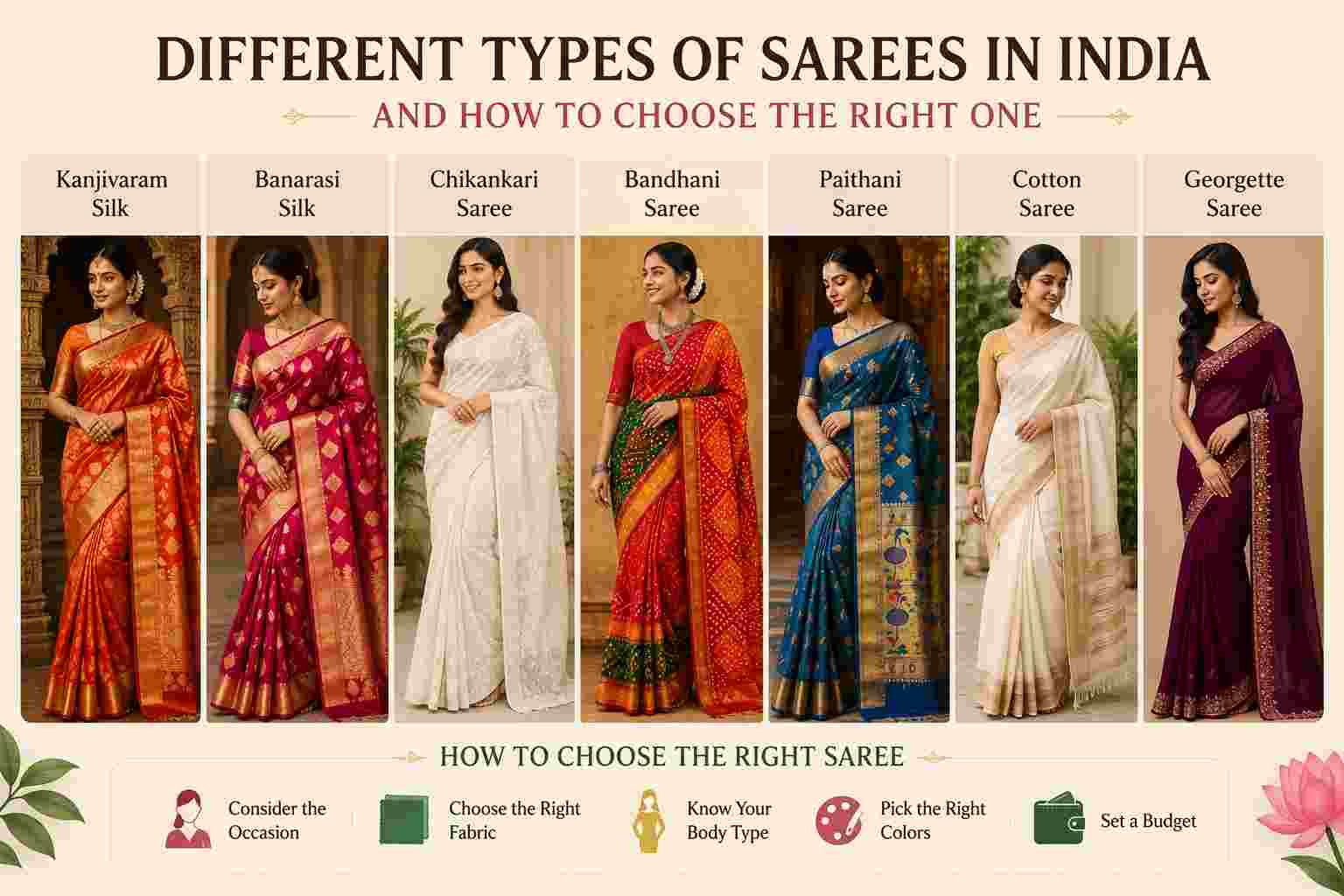
Different Types of Sarees in India and How to Choose the Right One
Walk into any woman’s wardrobe in India and there’s almost always a saree tucked somewhere — folded carefully, wrapped in plastic, or hanging near the back. Sometimes it was worn to a cousin’s wedding three years ago. Sometimes it belonged to her mother.
Sarees carry weight — not just literal weight, though some certainly have that — but emotional weight too. They connect generations. They show up at every important moment. And once you know which ones are actually worth owning and why, building a collection that makes sense becomes much less overwhelming.
Table of Contents
Why Sarees Still Matter in a Fast-Moving Fashion World
A lot of people assume sarees for women are reserved for weddings and temples. That’s only part of the picture. Indian sarees are genuinely one of the most flexible garments around. Change the drape, change the blouse, change the fabric — and the same saree belongs in a completely different setting.
A Chanderi in muted tones works in a corporate meeting. The same Chanderi in brighter colours works for a festive lunch. That adaptability is what keeps sarees relevant even as everything else around them changes.
There’s also the question of longevity. Traditional sarees don’t go out of style. A woman who inherits a Kanjeevaram from her grandmother is holding something more valuable than she started with — not just financially, but in terms of craft and history.
Types of Sarees Worth Owning
Banarasi Silk
The Banarasi is the one most people picture when they think of Indian sarees at their richest. Woven in Varanasi with pure silk and real zari — gold or silver thread worked directly into the fabric — these are heavy, opulent, and built for occasions that deserve that level of presence.
The patterns draw from Mughal-era aesthetics: paisleys, florals, jali work. A good Banarasi lasts a lifetime and then some. This is one of the best sarees to invest in if you want a piece that outlasts trends entirely.
Kanjeevaram Silk
Kanjeevaram sarees from Kanchipuram in Tamil Nadu are among the most recognised traditional sarees anywhere. Pure mulberry silk, dramatically contrasting borders, and patterns drawn from temple architecture and mythology. They’re built to last generations and frequently passed from mother to daughter at weddings.
Among types of sarees, Kanjeevaram carries a cultural significance that very few others match.
Chanderi
Not everything needs to be a statement piece. Chanderi sarees from Madhya Pradesh are light, sheer, and carry a kind of understated refinement that makes them perfect for formal daytime occasions and summer events.
The fabric is a silk-cotton blend, giving it a soft sheen without the weight of pure silk. Small woven motifs called butis appear across the body, and the borders are delicate without being fussy. Among sarees for women who want to look polished without feeling overdressed, Chanderi is consistently one of the best sarees to reach for.
Mysore Silk
Mysore silk is softer and more relaxed than Kanjeevaram — same silk heritage, quieter personality. The Karnataka Silk Industries Corporation produces it under government oversight, so quality is more consistent than most.
It works well for office wear and formal daytime occasions where you want the look of silk without something too embellished. Women who wear sarees regularly tend to love Mysore silk precisely because it cooperates — it drapes well, travels well, and always looks right.
Tant
Tant sarees from West Bengal are woven in cotton with a lightness that makes them feel almost effortless to wear. The texture is soft, the colours are usually cheerful, and the borders are simple but have real character.
These are the everyday sarees — the ones Bengali women have been wearing to work and the market and family gatherings for generations. If you’ve never worn a saree regularly because they feel too heavy or too formal, a Tant might genuinely change your mind. It’s among the most comfortable traditional sarees available and usually won’t cost a fortune.
Sambalpuri
Sambalpuri sarees from Odisha are made using ikat weaving — where the threads are dyed in a specific pattern before they’re woven, creating motifs with characteristic soft-edged outlines. The results look like they’re slightly out of focus in the best possible way.
The patterns are drawn from nature and culture — conch shells, fish, lotus, wheels. Each saree is made by hand and takes anywhere from a few days to several weeks depending on complexity. Among types of sarees that represent genuine craft traditions, Sambalpuri is one of the most visually distinctive.
Paithani
Paithani sarees from Aurangabad in Maharashtra are celebrations in woven form. Peacock and vine motifs fill the pallu and border, worked in silk with real gold zari. The colours are vivid — deep greens, purples, reds — and the overall effect is rich and festive.
Maharashtrian women wear Paithani for weddings and major festivals. It’s one of those traditional sarees that feels genuinely special to wear, not just to look at. Among sarees for women who want something tied to a specific cultural tradition, Paithani has few rivals.
How to Build a Wardrobe Around Sarees
Rather than buying reactively — one for a wedding here, a gift from someone there — it helps to think about what you actually need:
- A heavy celebration saree — Banarasi, Kanjeevaram, or Paithani for weddings and major occasions
- A lightweight silk saree — Chanderi or Mysore for formal daytime use
- An everyday cotton saree — Tant or a regional handloom cotton for regular wear
- A craft-specific piece — Sambalpuri, Kota Doria, or Pochampally for something distinctive
- A contemporary option — printed georgette or linen for casual and semi-formal flexibility
This covers most situations without overwhelming a wardrobe or a budget. Add from here as you find pieces that genuinely appeal to you rather than pieces that just happen to be available.
What to Watch Out For When Buying
The Indian sarees market has its share of machine-made imitations sitting alongside genuine handwoven pieces, sometimes at similar prices.
Authentic silk feels cool to the touch and has a natural sheen that shifts subtly in different light. Real zari — the metallic thread in Banarasi and Kanjeevaram sarees — feels slightly heavy. Machine-made imitations feel lighter and have a uniform, flat shine that doesn’t quite move the same way.
For high-value traditional sarees, buying from state government emporiums, certified handloom cooperatives, or weavers directly reduces the risk significantly. Look for the Handloom Mark or a GI certification tag on the label. These aren’t guarantees, but they’re meaningful signals.
Frequently Asked Questions
-
Which saree is best for someone buying their first one?
A Chanderi or a good cotton saree like Tant is the most sensible starting point. Both are light, forgiving to drape, comfortable to wear for long stretches, and reasonably priced. They’re among the best sarees for anyone who wants to ease into wearing them without a big investment upfront.
-
What are the most expensive types of sarees in India?
Authentic handwoven Banarasi silk, Kanjeevaram, and Paithani are typically the most expensive traditional sarees. Genuine handloom pieces start around ₹10,000 and can run into several lakhs for exceptional work. The price reflects the silk quality, the zari, and the weaving time.
-
How do I tell if an Indian saree is genuinely handwoven?
Handwoven sarees usually have tiny natural irregularities in the weave — slight variations that come from human hands at work. Machine-made sarees are perfectly uniform. For certification, look for the Silk Mark, Handloom Mark, or GI tag on the label. Buying through state emporiums or weaver cooperatives also helps.
-
Are sarees for women practical for regular work wear?
Yes, when you pick the right fabric. Linen, Mysore silk, and good cotton sarees for women work very well for office settings. They’re breathable, low-maintenance, and a simple blouse keeps the overall look professional without effort.
-
How many sarees does someone actually need in a wardrobe?
There’s no fixed answer, but five well-chosen best sarees cover most occasions comfortably — one festive, one lightweight silk, one everyday cotton, one craft-specific piece, and one contemporary option. After that, you’re adding because you love them, which is the best reason of all.