

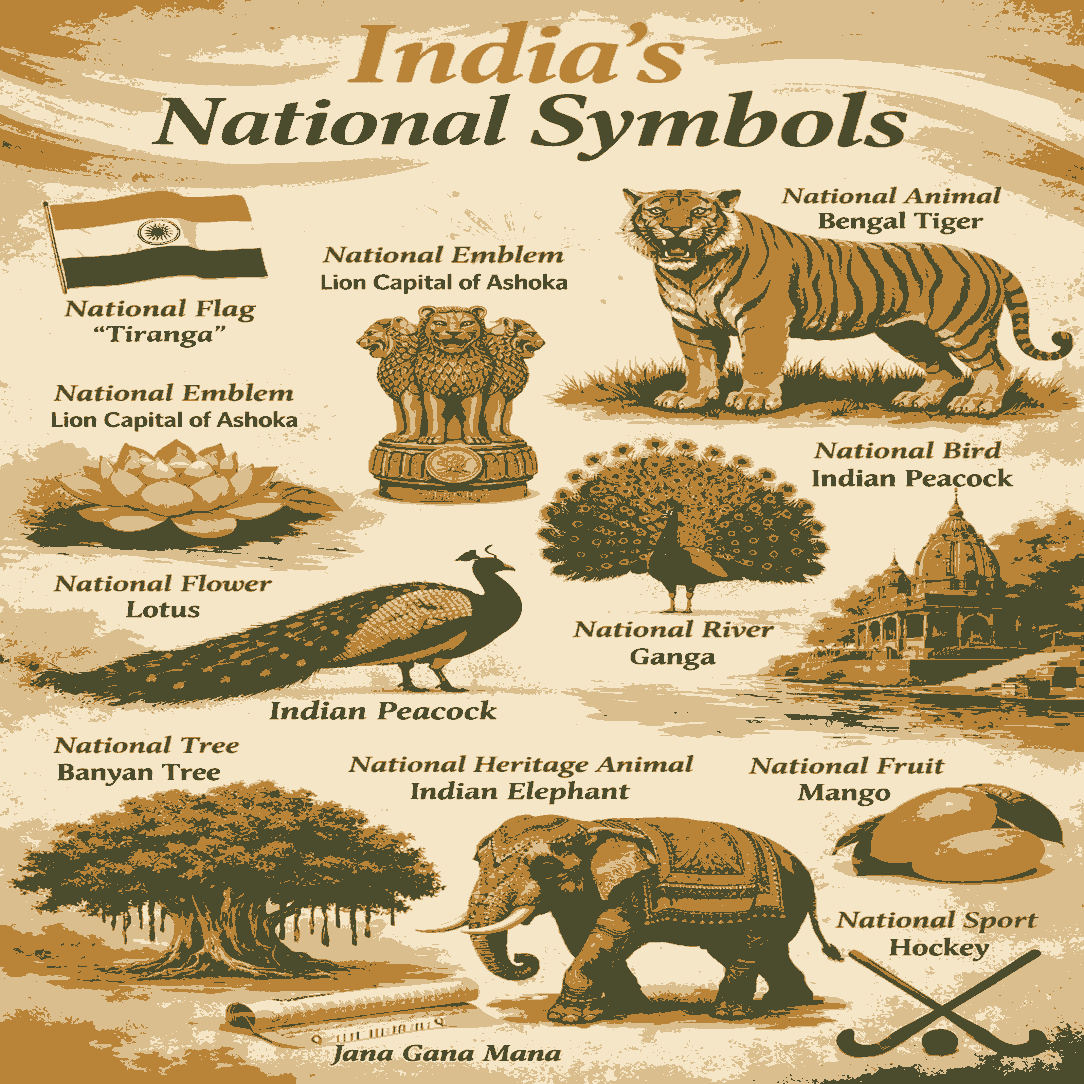

The national symbols in India are not mere signs. They mirror national values, history, and identity. The tricolour flag, the Ashoka Chakra, the national anthem, etc., behind them, there is a sacrifice that leads to a dream.
This article describes the origins of India’s national symbols, their purpose, and their current importance to students, citizens, and readers seeking to understand them. It also presents the history of the Indian national flag, the meaning of the Indian national chakra, the significance of the Indian national emblem, and the Indian national anthem history, in simple, straightforward language.
Table of Contents
Knowing the National Symbols of India List
The Indian country symbols of national interest have a lot of significant items that are used to symbolize the country in formal terms. These were symbols adopted thoughtfully during the struggle for freedom and post-independence in 1947.
The main symbols presented in the country are:
- National Flag – Tiranga
- National Capitol- Ashokan Lion-Capital.
- Jana Gana Mana -National Anthem.
- National Song – Vande Mataram
- Scientific driving – Bengal Tiger.
- Bird of the Nation: Indian Peacock.
- National Flower – Lotus
Every symbol links the citizens with the past and the Indian values, which are in the constitution. When an individual learns the list of national symbols of India, he/she starts to understand how closely culture is intertwined with history.
The Tiranga Story and History of the Indian National Flag
It is known as the Tiranga because of the three colours used in the national flag of India. The history of the Indian national flag is closely related to the freedom movement.
Prior to Independence, there were numerous proposals for the flag. Design was offered in 1921 by a freedom fighter, Pingali Venkayya, to Mahatma Gandhi. The design evolved in the form of three horizontal stripes and a spinning wheel (charkha).
The current design was promoted by the Constituent Assembly on 22 July 1947. The Ashoka Chakra was the replacement of the charkha.
What the Colours Represent
- Saffron – be brave and sacrifice.
- White – Peace and truth
- Green – Faith and prosperity
The Ashoka Chakra is placed in the centre of the white band in navy blue. The knowledge of the Indian national flag history makes individuals understand the need to give due respect and honour to the national flag.
The Wheel of Law Ashoka Chakra meaning.
Ashoka chakra does not only owe its meaning to its visual appeal. It is a 24-spoke wheel, an image of the Lion Capital of Ashoka, Sarnath.
It represents:
- Law (Dharma)
- Motion and progress
- Justice and righteousness
It is believed that the 24 spokes represent 24 vices, including courage, patience, and honesty. The sense of the Ashoka Chakra serves as a reminder to the citizens that India still believes in legal practices and ethical power.
It is located in the centre of the flag, and it demonstrates that the country should be directed by the truth. A country is stagnant when it is not moving. The wheel depicts incessant improvement.
India Sign Emblem – Responsible Power
The State Emblem of India was adopted on 26 January 1950, on the day India became a Republic. Its design is derived from the Lion Capital of Ashoka.
The logo presents four Asiatic lions in a back-to-back form. Those that may be seen at the front are only three. Under the lions, there is a circular base with a bull, a horse, and an Ashoka Chakra.
Below the previously mentioned words is a writ in Devanagari script written down as Satyameva Jayate. It translates into Truth Alone Triumphs.
Connotation of India: The meaning of India in popular culture.
The emblem of India significance are apparent in:
- Indian currency notes
- Passports
- Government documents
- Court seals
The Indian symbolism is found in its message. It is a symbol of power, brotherhood, and fact. It is a reminder to the officials of the society that power has to be exercised responsibly.
History of the Indian National Anthem – The Song of Oneness
The national anthem of India is called Jana Gana Mana. The Indian national anthem history dates back to 1911, when Rabindranath Tagore composed the song and wrote it in Bengali.
It initially became part of the Calcutta Congress of the Indian National Congress in 1911. It became the anthem of the country on 24 January 1950.
The song glorifies the soul of India and its oneness in terms of regions and cultures.
Why It Matters
The history of the Indian national anthem states that the music contributed to the freedom movement. When sung, it produces the feeling of respect and belonging.
Within the full version, it takes approximately 52 seconds to sing. As a sign of honour, citizens are supposed to rise as a sign of presence at attention.
What do national symbols mean to citizens
Formal marks are not the only national symbols. They shape identity.
For citizens, they:
- Build a sense of pride
- Remember that people have a common history.
- Promote unity in diversity
- Expressionistic of constitutional values.
When students get to hear about the national symbols of India, they are able to comprehend how the symbols relate to democracy and freedom.
Ashoka Chakra meaning and Indian national flag history, and the symbol of India, all of these tend towards the truth, justice, and equality.
Due Respect and Protection of the Laws
There are strict regulations in India regarding the respect of national symbols. The flag code of India clarifies the way the flag is to be hoisted. There exists legislation against disrespect of the national anthem or emblem, as well.
These laws are not about fear. They pertain to the preservation of honor. Whenever the citizens are aware of the history of the Indian national anthem and the history of the Indian national flag, they automatically respect them.
Professional Attitude to Nationality
Historians usually indicate that national symbols contribute towards establishing unity in a variety of nations, such as India. The symbols are a unifying element across numerous languages, religions, and cultures.
The symbol of India’s importance is in the fact that it is connected with Emperor Ashoka, who encouraged peace after the war. This concept of righteous conduct is also shown in the meaning of the Ashoka Chakra.
It is unanimously acknowledged that the thoughtful choice of these symbols in the course of Independence and afterwards demonstrates considerate leadership.
A Living Legacy
The national symbols within India are still inspirational even to future generations. People fly their flags proudly every Independence Day and the Republic Day. The song is played in the schools, at open events, and at sports matches.
The national symbols of India list is useful in making citizens recognize that these are not mere designs and songs. They symbolize sacrifice, hardship, and communion.
The history of the Indian national flag, all the way to the history of the Indian national anthem, is the history of strength and cohesiveness.
Conclusion
The national symbols of India capture the process of the transition of this country towards becoming a democratic republic after colonial rule. The Tiranga is about bravery and tranquility. Ashoka Chakra is a symbol that symbolizes law and progress. The symbol is the abbreviation of truth and authority. The hymn brings together voices in different regions.
Believers can learn the significance of the Ashoka chakra, the image of India, and the history of the Indian national anthem, and in this way, citizens get to be more attached to their country.
Such symbols are not merely official signs. They are triggers of things that lead India towards values.
Frequently Asked Questions (FAQs)
What are the key national symbols in India?
The national symbols comprise the national flag, the national emblem, the national anthem, the national animal, the national bird, and the national flower, which are the main symbols of the nation. They included these in the official list of national symbols of India adopted following independence.
What is the symbolism of the Ashoka Chakra of the Indian flag?
The meaning of Ashoka Chakra has to do with law, justice, and progress. The 24 spokes supply moral values like honesty, courage, patience, and discipline. Another thing depicted by the wheel is that a country must never pull back on the right track.
It is positioned in the middle of the flag to remind people that the moral duty Dharma has to do should be the driving force behind all actions.
Authors of the Indian national anthem?
Jana Gana Mana has been written and composed by Rabindranath Tagore. The history of the Indian national anthem goes back to 1911, and it was officially adopted in 1950.
So what is so significant about the national emblem?
The symbol’s significance is associated with its truth and power message. It has been borrowed from the Lion Capital of Ashoka, and signifies power with responsibility and the rule of Satyameva Jayate. It is also a symbol of the moral pillar of the Indian Republic and reminds government institutions to exercise fairness and integrity. The symbol is an unending source of confidence between the citizens and the state.