

Kuno National Park: Cheetahs, Safari and How to Visit
Kuno National Park is a protected forest of about 748 square kilometres in the Sheopur district of Madhya Pradesh, and since September 2022 it has been the main home of India’s reintroduced cheetahs. Seventy years after the animal was declared extinct here, the park now holds most of a cheetah population that the Press Information Bureau put at 62 in late November 2026. It opens for jeep safaris every year from 1 October.
Below you will find where the park is, how it went from a quiet sanctuary to the centre of Project Cheetah, what else lives in its grasslands, and the practical details: safari gates, timings, booking and the best months to go.
Table of Contents
Where Is Kuno National Park?
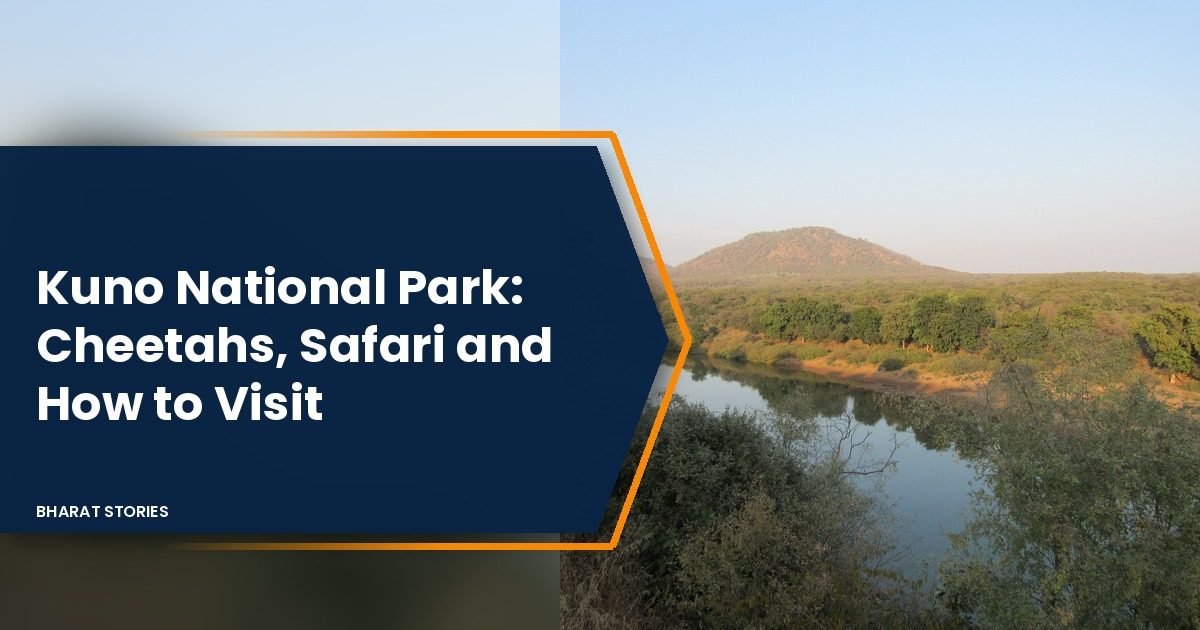
Kuno lies in northern Madhya Pradesh, mostly in Sheopur district with a smaller part in Morena, close to the Rajasthan border. The PIB feature on the cheetah programme places it in the northern part of the Vindhyachal range. The park takes its name from the Kuno River, a tributary of the Chambal that cuts through the middle of it from south to north.
The Sheopur district administration says the park is about 65 km by road from Sheopur town. Gwalior is the closest large city with an airport, and Sawai Madhopur in Rajasthan is the railhead the district lists for Sheopur. That same town is the gateway to Ranthambore, so a lot of visitors pair the two parks on one trip.
How Did Kuno Become a National Park?
It started as Kuno Wildlife Sanctuary in 1981, covering about 344.7 square kilometres, and was upgraded to a national park in 2018 when its area grew to roughly 748.8 square kilometres.
The bigger story is why. In the 1990s, wildlife scientists picked Kuno as the most suitable place for a second population of Asiatic lions, which survive in the wild only around Gir in Gujarat. To make room, 24 villages were moved out of the sanctuary between 1998 and 2003. According to PIB, that relocation involved 1,545 families and freed nearly 6,258 hectares for wildlife. Most of those families were Saharia tribal people, and the resettlement is still discussed as one of the harder chapters in the park’s past.
The lions never arrived. Gujarat resisted the move, and even a Supreme Court order of April 2013 asking for some Gir lions to be shifted to Madhya Pradesh was not carried out. If you want the background on those lions, our guide to Gir National Park and its Asiatic lions covers it. Kuno, meanwhile, became the first choice for a very different big cat.
What Is Project Cheetah at Kuno?
Project Cheetah is the Government of India’s plan to bring cheetahs back to the country, and Kuno was its first release site. The cheetah was declared extinct in India in 1952; the last three wild animals on record were shot in 1947 in what is now Koriya district of Chhattisgarh. Hunting, coursing with captive cheetahs and the loss of grassland prey all played a part in its disappearance.
The project is run by the Ministry of Environment, Forest and Climate Change through the National Tiger Conservation Authority, with the Wildlife Institute of India and the Madhya Pradesh Forest Department. Its founding document is the Action Plan for Introduction of Cheetah in India, released in January 2022. Because India’s own Asiatic cheetah now survives only in Iran, the animals came from southern Africa.
| Date | What happened |
|---|---|
| 17 September 2022 | Eight cheetahs from Namibia released into enclosures at Kuno by the Prime Minister |
| February 2023 | Twelve cheetahs arrive from South Africa, completing a founder group of 20 |
| April 2025 | Two males, Prabash and Paavak, moved to Gandhi Sagar Wildlife Sanctuary, the second site |
| November 2025 | Mukhi, the first cheetah born in India under the project, gives birth to five cubs |
| 28 February 2026 | Nine cheetahs from Botswana, six females and three males, reach Kuno |
| October 2026 | Two cheetahs from Kuno released in Veerangana Durgavati Tiger Reserve, a third site in Madhya Pradesh |
New arrivals spend time in large fenced enclosures, which the project calls Closed Natural Areas, before they are let out into open forest. That soft release gives each animal a chance to get used to the terrain, the prey and the heat.
How Many Cheetahs Are There in Kuno Now?
As of late November 2026, India had 62 cheetahs, and a little over 50 of them live in Kuno. The total comes from a PIB release of 20 November 2026 and the follow up feature, which counted 43 animals born in India, close to 70 per cent of the population.
Two recent litters pushed the number up. On 5 October 2026, KJP21, a 32 month old female born in India, had five cubs fathered by a male from Botswana. Then on 20 November, KOMG 3, a female brought from Botswana, gave birth to four cubs out in the open forest rather than inside an enclosure. Only the second birth in the wild since 2022, it was a milestone the action plan specifically looks for.
A Times of India report from 25 November 2026, quoting a Kuno newsletter, gives the park’s own count as 53, with four cheetahs at Gandhi Sagar and two at Veerangana Durgavati. The same report says Kuno has recorded 58 cubs in 14 litters, of which 40 survived, and that officials think the park could approach 80 animals by the end of 2027.
Has Project Cheetah been a success?
It is too early for a clean verdict. Breeding is happening, and India born females are now having cubs of their own. But several adults and many young cubs have died since 2022, and some scientists still question whether African cheetahs suit Indian forests at all. The government’s own long term target is a self sustaining group of 60 to 70 cheetahs by 2032 across about 17,000 square kilometres of the Kuno and Gandhi Sagar landscape. Cub survival beyond the first year is the measure to watch.
Which Animals Can You See in Kuno Besides Cheetahs?
Kuno has leopards, sloth bears, striped hyenas, Indian wolves, jackals and a good range of deer and antelope. PIB lists chital, sambar, nilgai, chinkara, chousingha and blackbuck as the main wild prey, and chital alone make up about three quarters of recorded cheetah kills.
- Predators: leopard, sloth bear, dhole, striped hyena, Indian wolf, golden jackal and jungle cat.
- River life: mugger crocodiles and gharials have been recorded in the Kuno River, along with softshell turtles.
- Birds: a 2007 survey counted 129 species, including several vulture species, crested serpent eagles and, in winter, cranes and harriers.
The landscape is mostly dry deciduous forest of kardhai, salai and khair, opening out into grassland. In the cold months the river valley is the prettiest part of the drive.
How Do You Book a Kuno Safari?
Safari permits are booked online through the Madhya Pradesh Forest Department booking portal, where you pick Kuno, your date, the zone or gate and a morning or afternoon slot. Permits open in advance, and popular dates around Diwali, Christmas and New Year fill up fast. Keep the ID you used while booking with you at the gate.
Kuno has three entry gates: Tiktoli, Ahera and Peepalbawdi. They are reached by different roads, so choose your stay first and then the gate nearest to it. An early morning drive from the wrong side of the park can eat up an hour.
What are the Kuno safari timings?
The park closes for the monsoon from 1 July to 30 September and reopens on 1 October. The Madhya Pradesh Forest Department’s timings for the 2026 to 2027 season, as reported by Dainik Jagran, are:
| Months | Morning safari | Afternoon safari |
|---|---|---|
| October and November | 6:00 am to 11:30 am | 3:00 pm to 6:00 pm |
| December and January | 6:20 am to 11:30 am | 3:00 pm to 6:00 pm |
| February and March | 6:10 am to 11:30 am | 3:00 pm to 6:30 pm |
| April to June | 5:30 am to 11:00 am | 3:30 pm to 7:00 pm |
Fees for the vehicle, guide and permit are shown on the booking portal at the time of booking, and they differ for Indian and foreign visitors, so check the live price there rather than relying on old figures.
Will you definitely see a cheetah?
No. More cheetahs now roam the open forest than in earlier years, which improves your odds, but they move over large areas and sightings are never promised. Treat a cheetah as a bonus and enjoy the river, the birds and the grassland on their own merit. Guides usually know which areas have been active that week.
What Is the Best Time to Visit Kuno?
October to March is the most comfortable period, with mild days and good light for photography. December and January mornings are cold in an open jeep, so carry a jacket, a cap and gloves. From April the heat builds quickly, although animals gather near water and can be easier to spot. In any season, the morning drive tends to be the better bet.
A couple of nights is enough for two or three drives. If you have more time, Madhav National Park near Shivpuri is within a few hours’ drive and has its own tigers, and Ranthambore is just across the state border.
Quick Answers About Kuno National Park
In which state is Kuno National Park?
Madhya Pradesh. It sits mainly in Sheopur district, with part of it in Morena district, near the border with Rajasthan.
Why is Kuno National Park famous?
It is the first place in India where cheetahs were released after the species went extinct in the country, and it holds the largest share of India’s cheetahs today. It was earlier prepared as a second home for Asiatic lions.
Is Kuno a tiger reserve?
No. Kuno is a national park, not a notified tiger reserve, and it is not known for resident tigers. For tigers in this region, Ranthambore and Madhav are the closer options.
Where does Kuno fit among India’s national parks?
It is one of more than a hundred national parks in the country. Our state wise list of national parks in India shows where Kuno sits alongside the others.