

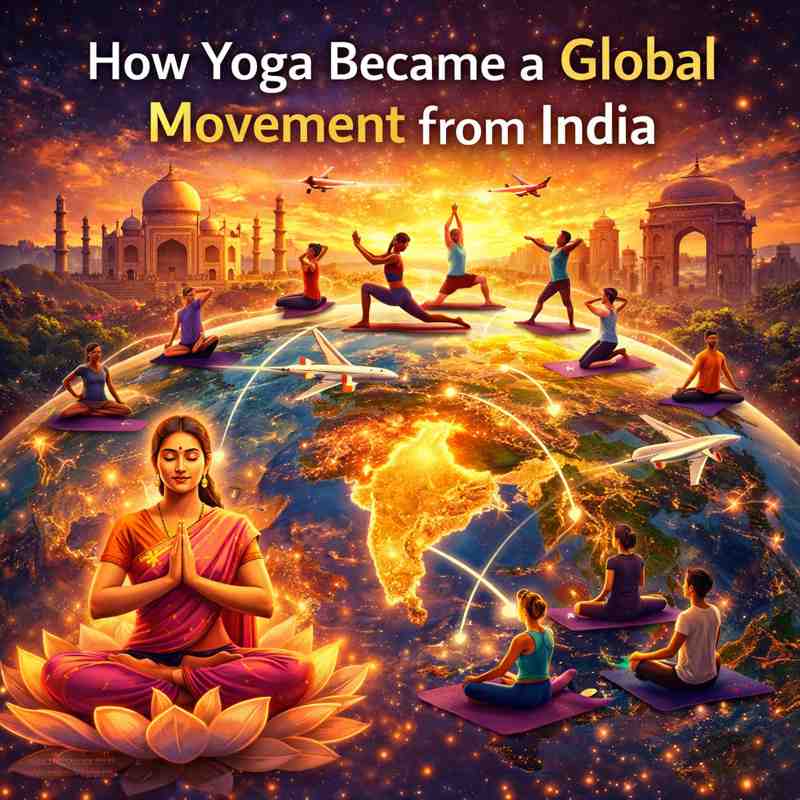

Yoga ceases to be the ashram or the spiritual realm in India. It is commonly practiced by people across continents today to be healthy, peaceful of mind, and in balance. It is important to note that the traditions of ancient India and the eternal topicality serve as the basis for yoga history India, as it was first practiced in Indian monasteries.
Since its spiritual roots, yoga has changed and transformed over the years without abandoning its values. Its popularity is not only based on fitness but also on the need to improve mental well-being. The history of yoga is closely intertwined with the yoga philosophy of India, its doctrines, and its contribution to Indian identity.
Table of Contents
The Origins of Yoga in India
The origin of yoga dates back to the Indian subcontinent more than one millennium ago. It is also said to have originated in the Indus Valley Civilization, where figures are depicted in meditative postures on seals. Gradually, it evolved into an organized system referred to in ancient literature such as the Vedas and the Upanishads.
Yoga originated in India and presents a system developed by sages and scholars to foster the union of body, mind, and spirit. Patanjali, whose compilation of the Yoga Sutras was one of the most significant contributions, made. These works were the foundation of classical yoga.
Key aspects of early yoga:
- Pay attention to self-discipline and meditation.
- Relationship between body and soul development.
- It is focused on inner peace and awareness.
- Practice as a means of freedom (moksha).
It was not the time of physical activity at this stage. It was about life and harmony.
The contributions of Yoga Philosophy in the Development of the same
The popularization of yoga is not possible without considering Indian yoga philosophy. It thrives upon principles beyond the movement of the body. Ideas such as karma, dharma, and mindfulness play a major role in yoga.
Yoga philosophy states that:
- The body and the mind are interlinked.
- Through awareness, suffering can be minimized.
- Punishment and moderation result in an improved life.
- A high price is better than success in the outside world.
Those concepts made yoga attractive to individuals of other cultures. Yoga continues to attract professionals, even in these times, not only as a means of getting in shape but also to ensure clarity of mind and stability of emotions.
Yoga is another Cultural Heritage of India
One of the important things about India is yoga. It is a sign of a country’s traditions, beliefs, and way of life. When this became evident, yoga was usually mentioned as one of the most valuable aspects of the yoga cultural heritage.
The practice of yoga went through teacher-student relationships over the centuries. The ashrams and gurukuls were among its most important institutions for protecting its teachings. Yoga would be used at feasts, religious gatherings, and in everyday activities.
The following are reasons why yoga is considered a part of the cultural heritage:
- It is strongly correlated with the Indian tradition.
- Thousands of years have been focused on its practice.
- It is a holistic way of life.
- It will bring peace with the environment and oneself.
Yoga, as an Indian cultural heritage, gained recognition, which helped spread it to other countries. It also developed the consciousness of its real roots.
How Yoga Spread Beyond India
It was at the end of the 19th and early 20th centuries that yoga took the world stage. Indian instructors went to other countries, and yoga was exposed to new people.
The involvement of Indian spiritual leaders in global activities was a significant milestone. They communicated the gospel of yoga as a lifestyle rather than a practice.
With the beginning of the search for alternatives to stressful lifestyles in Western countries, yoga became a popular phenomenon. Over time, studios, classes, and training centers started to emerge worldwide.
The expansion in yoga global popularity can be attributed to:
- Higher involvement in mental health.
- Increasing consciousness on holistic wellness.
- Impression of Indian teachers and gurus.
- Knowledge is aired on the media and the internet.
Yoga had to adapt to modern needs, but it has also retained its origins, which have made it popular even in other cultures and generations all over the globe.
The Role of the International Yoga Day
One of the largest milestones of the internationalization of yoga was International Yoga Day. It was on June 21, and every year it brings out the issue of yoga in day-to-day life.
The United Nations became the official data tool of this day in 2014. Millions of people around the world have been practicing yoga sessions and workshops, and taking awareness programs since then.
Impact because of International Yoga Day:
- Development of awareness about yoga in the world market.
- Indicated the encouragement to people to start practicing yoga.
- Stressed the significance of wellness.
- Empowered the cultural affiliation of India to the world.
The International Yoga Day celebration has helped popularize yoga as a universal practice.
Modern Yoga: A Blend of Tradition and Lifestyle
Numerous forms of yoga are practiced today. Even though traditional yoga is concerned with spiritual development, present-day yoga tends to involve physical fitness.
There are various styles that you will get, like:
- Hatha Yoga
- Vinyasa Yoga
- Power Yoga
- Ashtanga Yoga
Such diversity makes yoga accessible to people of all ages and fitness levels. It has also spread due to an increase in online classes and mobile applications.
Nevertheless, the meaning of yoga philosophy in India has not changed. Many educators still emphasize the importance of consciousness and health.
The reason Yoga is still increasing worldwide
The continuous increase in yoga global popularity is not just a trend. It is indicative of a broader shift in human attitudes towards health and well-being.
Contemporary life is usually followed by stress, work overload, and electronic overload. Yoga provides an easy way to deal with these problems.
Justification of the further expansion of yoga:
- Induce relaxation and easing of tension.
- Makes one more flexible and physically healthy.
- Encourages mindful living
- Requires minimal equipment
- Can be practiced anywhere
Yoga is something people are resorting to as a potential, natural means of enhancing their living standards.
Relationship between Yoga and Wellness
Yoga is perceived as an all-around exercise. It promotes physical and psychological well-being.
Regular practice can:
- Enhance better posture and power.
- Support better sleep
- Give more attention and concentration.
- Help manage emotions
The teachings from yoga history India reveal that yoga was, and will always be, intended to bring about balance. In the contemporary world, this concept is relevant to the current wellness requirements.
Difficulties in Preservation of Authenticity
The spread of yoga worldwide raises concerns about its originality. There are types of forms that are solely concerned with physical exercise and do not care about the deeper side.
This has sparked debate over the need to maintain the original meaning of yoga. According to experts, the yoga philosophy of India needs to be understood so that its authenticity is not lost.
Key challenges:
- Commercialization of yoga
- Ignorance regarding its causes.
- The misunderstanding of practices.
There is an attempt to inform people about the traditional background of yoga and its cultural meaning.
The Future of Yoga as a Global Movement
The future of yoga is bright. With increased mental health awareness and a growing emphasis on holistic lifestyles, yoga will continue to feature prominently in people’s lives. The valuation of the cultural heritage associated with yoga and the ongoing commitment to International Yoga Day will serve as significant catalysts for this process.
The origins and values of yoga are also to be respected as more and more people venture into this field. Such harmonization between modernity and tradition will determine the future of yoga.
Conclusion
The cause of yoga spreading from India to the world is a narrative of the tradition, adaptation, and relevance. It originated in the history of yoga in India and has become an international movement promoting a lifestyle of health and well-being.
It is not merely a practice due to its relation to the yoga philosophy of India and its place in the yoga cultural heritage. It is the lifestyle that keeps individuals of diverse cultures motivated.
Through events such as International Yoga Day, yoga is expected to continue developing as it reminds people of its real purpose: to balance, be mindful, and be at peace, and to enjoy physical and psychological stability in everyday life.
Frequently Asked Questions (FAQs)
What is the origin of yoga in India?
Yoga can be traced back several thousand years to ancient India. It is closely connected with spiritual and philosophical traditions, as mentioned in texts such as the Vedas and the Yoga Sutras.
What is the significance of the International Yoga Day?
International Yoga Day is held to raise awareness of Yoga’s significance and encourage people around the world to embrace it in their lives.
Why had yoga become so popular all around the world?
Yoga became very popular among Indian teachers, and the need to relax under stress became widely recognized worldwide. This has further boosted the popularity of yoga worldwide.
Is yoga merely concerned with physical exercise?
Yoga is not only a physical exercise. It is based in India and comprises mental practices, mindfulness, and spiritual practices.