

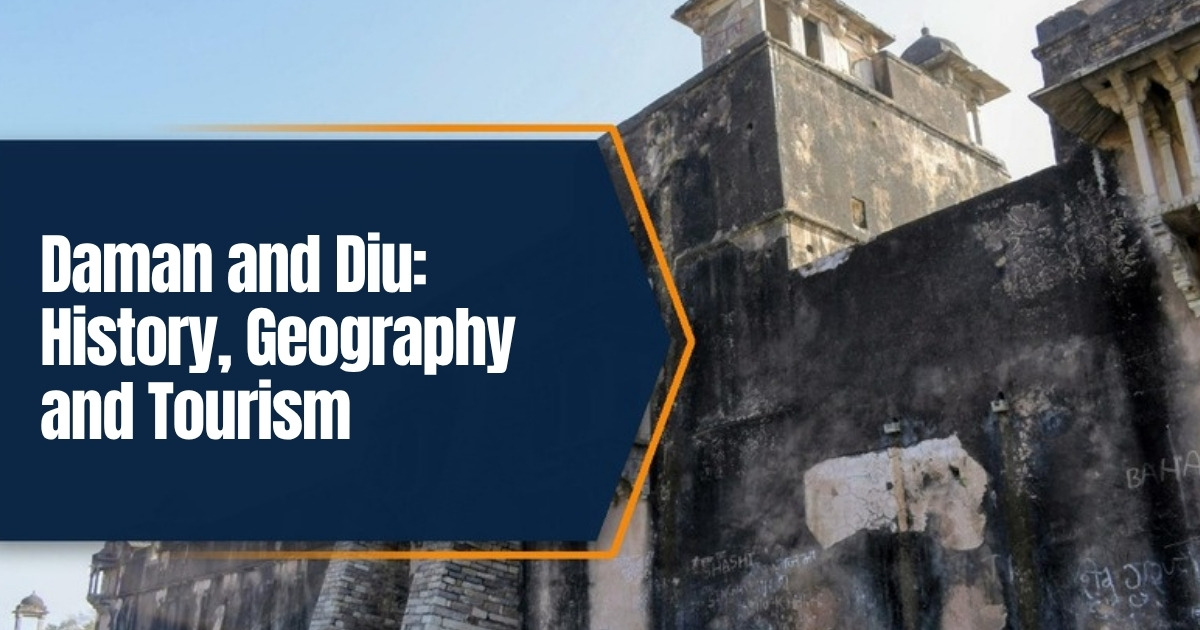
Daman and Diu: History, Geography and Tourism
Daman and Diu are two small coastal areas on India’s west coast, about 650 km apart by road but long linked by a shared history. Both were Portuguese colonies for more than 400 years, and both became part of India in 1961. Today Daman and Diu form part of a larger union territory together with Dadra and Nagar Haveli. This guide covers their history, geography, people and the main places to visit, with facts updated for 2026.
Table of Contents
Daman and Diu at a Glance
- Status: Two districts of the union territory of Dadra and Nagar Haveli and Daman and Diu, formed on 26 January 2020.
- Capital of the union territory: Daman.
- Area: About 112 square km for Daman and Diu together.
- Main language: Gujarati, with Hindi and English widely used.
- Known for: Portuguese forts and churches, beaches, seafood and a relaxed coastal pace.
History of Daman and Diu
Before the Portuguese
Diu was an important port on the Arabian Sea trade routes and was ruled over the centuries by local dynasties, including the Chavda and Vaghela rulers, before it came under the Sultanate of Gujarat. Daman sat on the coast south of Gujarat and was also linked to the Gujarat sultans. The sea made both places valuable for trade in textiles, spices and horses.
Portuguese rule
The Portuguese wanted a firm base on the Gujarat coast to control sea trade. In 1509 they fought a major sea battle near Diu against a combined fleet that included the Sultan of Gujarat and the Mamluks of Egypt. Several attempts to take Diu failed until 1535, when Sultan Bahadur Shah of Gujarat, worried about an attack by the Mughal emperor Humayun, signed an alliance with the Portuguese. That deal allowed them to build a fort on the island.
The alliance soon broke down. Bahadur Shah was killed in 1537, and Gujarat forces backed by the Ottoman navy besieged the fort in 1538 and again in 1546. The Portuguese held on both times and rebuilt the fortress, which still stands. Daman was taken by the Portuguese in 1559. For the next four centuries both towns were part of Portuguese India, governed from Goa.
Joining India
After India became independent in 1947, Portugal refused to give up its territories on the subcontinent. In December 1961 the Indian armed forces moved into Goa, Daman and Diu in an action known as Operation Vijay, and the territories became part of India on 19 December 1961. Portugal formally accepted Indian rule in 1974, after its own revolution.
From 1961 to 1987, Goa, Daman and Diu were run as one union territory. When Goa became a state on 30 May 1987, Daman and Diu became a separate union territory.
The 2020 merger
Daman and Diu and the nearby territory of Dadra and Nagar Haveli already shared one administrator. In December 2019 Parliament passed a law to merge them, and the new union territory of Dadra and Nagar Haveli and Daman and Diu came into being on 26 January 2020, with Daman as its capital. You can read more about the other half of the territory in our guide to Dadra and Nagar Haveli.
Geography
Daman lies on the mainland coast where the Daman Ganga river meets the Arabian Sea, close to Vapi in Gujarat and not far from the Maharashtra border. The river divides the town into two parts: Nani Daman to the north and Moti Daman to the south.
Diu is an island off the southern tip of the Saurashtra peninsula, across the Gulf of Khambhat from Daman. It is joined to the Gujarat mainland by a bridge. The island has limestone cliffs, sandy bays and a warm, dry climate. Both areas are surrounded on land by Gujarat, which shapes their food, language and economy.
The climate is tropical. Summers from March to June are hot and humid, the monsoon brings heavy rain from June to September, and winter from November to February is pleasant and the best time to visit.
People and Culture
According to the 2011 census, Daman district had about 1.9 lakh people, while Diu town had about 24,000. Literacy was high at 87 percent, well above the national average at the time. Most people speak Gujarati, and many also use Hindi and English. A small community still speaks a Portuguese based creole in Diu.
Hinduism is the main religion, with Muslim and Catholic Christian communities as well. Portuguese influence shows in the churches, old houses, music and some local dishes, while festivals such as Navratri, Diwali, Christmas and Nariyal Purnima, the fishing community’s festival, are widely celebrated.
Economy
Fishing has long been central to life in both towns. Daman also became an industrial hub after 1961 because of tax benefits, and the union territory now has more than 7,000 industrial units, many in pharmaceuticals, plastics and textiles. Tourism is the other big earner, helped by the beaches and by liquor laws that differ from those in neighbouring Gujarat, where alcohol is banned.
The government says more than 450 infrastructure projects worth over Rs 13,000 crore have been carried out in the union territory in the last decade, including roads, schools, a medical college and new hospitals.
Places to Visit in Daman
- Moti Daman Fort: A large Portuguese fort with walls, gates and old government buildings inside.
- Church of Bom Jesus, Moti Daman: A 17th century church with a carved wooden altar.
- Nani Daman Fort (St. Jerome Fort): A smaller fort near the river with a striking gateway.
- Jain temple: An 18th century white marble temple near Nani Daman Fort with old murals.
- Devka and Jampore beaches: Popular spots for sunsets, food stalls and walks.
- Daman seafront and night market: Newer promenades and markets developed in recent years.
Places to Visit in Diu
- Diu Fort: The 16th century fortress at the east end of the island, facing the sea. It was voted one of the Seven Wonders of Portuguese Origin in the World.
- St. Paul’s Church: Completed in 1610 and still in use, known for its white Baroque front.
- Naida Caves: A maze of rock passages and openings near the fort, popular with photographers.
- Nagoa and Ghoghla beaches: Calm, curved beaches with water sports.
- Gangeshwar Temple: A seaside shrine where waves wash over Shiva lingams set in the rocks.
- Panikota Fort: A small fort on a rock in the sea, also called Fortim do Mar.
How to Reach Daman and Diu
Daman: The nearest major railway station is Vapi, about 12 km away, on the Mumbai Ahmedabad line. Daman gained its own civil airport in 2026. NAMO Airport, which shares the Indian Coast Guard air station, was inaugurated on 5 June 2026, and the first direct Daman to Delhi flight, run by Alliance Air, took off on 16 July 2026. Officials say the trip to Delhi now takes about two and a half hours instead of eight to ten hours via Surat or Mumbai.
Diu: Diu Airport has regular flights to Mumbai and other Gujarat cities. Passenger numbers have grown from about 19,000 in 2013 to more than one lakh a year. By road, Diu is reached through Una in Gujarat, and the nearest railway station is at Delwada.
Tourism Today
Tourism has grown fast in recent years. The Vice President said in September 2026 that yearly visitor numbers across the union territory rose from about 6 lakh in 2021 to nearly 50 lakh in 2025. New seafronts, restored heritage sites and better air links are expected to bring more visitors. Diu has also drawn attention for clean energy; in 2018 it was reported to be the first Indian city to run fully on renewable power during the day.
Plan at least two days for Diu and one or two for Daman. Travelling between them by road takes a full day, so many visitors pick one on each trip or fly between Mumbai and Diu.
Local food is a big draw. Try fresh fish curry, prawns, crab and Portuguese style bread and sweets found in older family kitchens.
Daman and Diu are good weekend trips from Mumbai, Surat and other Gujarat cities, and both are easy to explore on foot or by scooter.
Carry sun protection and water, as the sun is strong on the beaches and fort walls even in winter.
What We Changed From the Old Post
The old post was hard to read and contained garbled phrases and outdated facts. It also described Daman and Diu as a separate union territory. We rewrote it in plain English, corrected the history, added the 2020 merger, updated population and tourism figures, and added 2026 travel news such as the new Daman airport and the Delhi flight.
Frequently Asked Questions
Is Daman and Diu a state?
No. Since 2020 Daman and Diu are part of the union territory of Dadra and Nagar Haveli and Daman and Diu.
What is the capital of Daman and Diu?
Daman is the capital of the merged union territory.
When did Daman and Diu become part of India?
On 19 December 1961, after more than 400 years of Portuguese rule.
What is the best time to visit?
November to February, when the weather is cool and dry.
Photo: Real96kmaratha, CC BY-SA 4.0, via Wikimedia Commons (cropped)