

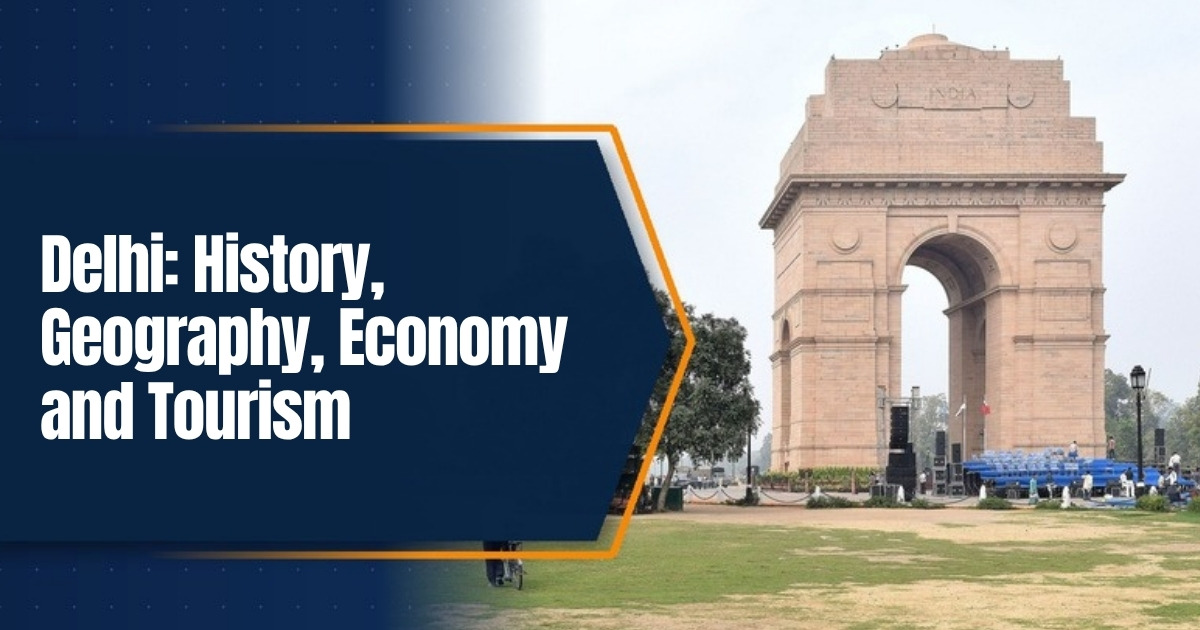
Delhi: History, Geography, Economy and Tourism
Delhi is India’s capital region and one of the largest cities in the world. Officially called the National Capital Territory of Delhi, it contains New Delhi, the seat of the Indian government, along with the old walled city, hundreds of villages that have become neighbourhoods and new suburbs that keep spreading outward. This guide explains Delhi’s history, geography, people, economy and main sights in plain language, with facts updated for 2026.
Table of Contents
Delhi at a Glance
- Status: National Capital Territory with its own elected Assembly and Chief Minister.
- Area: About 1,484 square km.
- Population: About 2.3 crore, according to provisional 2026 census figures.
- River: Yamuna.
- Neighbours: Haryana on three sides and Uttar Pradesh to the east.
- Languages: Hindi, Punjabi, Urdu and English are widely spoken.
History of Delhi
Ancient roots
Delhi is often called a city of seven cities, because rulers built new capitals here again and again. Legend links the area to Indraprastha, the city of the Pandavas in the Mahabharata, which is said to have stood near today’s Purana Qila. Archaeologists have found pottery and remains from early periods at the site, though no full ancient city has been uncovered.
Rajput kings and the Delhi Sultanate
Around the 11th and 12th centuries, the Tomar and Chauhan Rajput rulers held the region. After Prithviraj Chauhan was defeated in 1192, the area came under Muhammad of Ghor. When he died in 1206, his general Qutb ud din Aibak founded the Delhi Sultanate. The Qutub Minar, started by Aibak and completed under Iltutmish, dates from this time. Later dynasties, including the Khaljis, Tughlaqs, Sayyids and Lodis, built forts and cities such as Siri and Tughlaqabad.
The Mughal period
Babur won the Battle of Panipat in 1526 and founded the Mughal Empire. Humayun’s Tomb, built in the 1560s, inspired later Mughal tombs, including the Taj Mahal. Shah Jahan moved his capital here and built Shahjahanabad from 1638, with the Red Fort and the Jama Masjid at its heart. This walled city is today’s Old Delhi, with Chandni Chowk as its main street.
British rule and independence
After the revolt of 1857, the British took full control of Delhi. In December 1911 they announced that the capital of British India would move from Calcutta to Delhi. Architects Edwin Lutyens and Herbert Baker designed New Delhi, which was inaugurated on 13 February 1931 with wide avenues, Rashtrapati Bhavan and the buildings of government. In 1947 Delhi became the capital of independent India and took in a huge number of refugees after Partition, which reshaped the city.
Becoming the National Capital Territory
Delhi was a union territory after independence. A constitutional amendment in 1991 created the National Capital Territory of Delhi with its own Legislative Assembly of 70 seats. Police, public order and land remain with the central government, which has led to long running disputes over powers between the elected government and the Lieutenant Governor. Since February 2025 the Chief Minister has been Rekha Gupta of the BJP.
Geography
Delhi sits on the plains of north India, at about 200 to 300 metres above sea level. Two natural features shape it. The Yamuna river flows from north to south on the eastern side, with wide flood plains that can flood during heavy monsoons. The Delhi Ridge, the last northern tip of the ancient Aravalli hills, runs through the south and west, and its forests are often called the city’s green lungs.
The climate is extreme. Summers from April to June can pass 45 degrees Celsius, with hot dry winds called loo. The monsoon arrives around late June. Winters from December to February are cold and foggy. Air pollution is a serious problem in late autumn and winter, when smoke from crop burning in nearby states, vehicle exhaust, dust and still air combine to create thick smog.
People and Population
The first phase of the census, carried out between April and September 2026, counted about 2.3 crore people in Delhi, about 37 percent more than the 1.7 crore recorded in 2011. The number of households grew faster, to about 55 lakh, showing that families are getting smaller. These are provisional figures; final numbers will come after the main count in February 2027.
Delhi is now divided into 13 districts. North East Delhi is the most populous and New Delhi the least. People from every part of India live here, which shows in the city’s food, festivals and languages.
Economy
Delhi is one of India’s richest regions per person, with the second highest income per head among states and union territories after Goa. Most jobs are in services: government, trade, finance, information technology, media, health care, education, hotels and tourism. Old markets such as Chandni Chowk, Karol Bagh and Sadar Bazaar are major wholesale centres, while newer business hubs have grown in nearby Gurugram and Noida.
The wider National Capital Region, which takes in parts of Haryana, Uttar Pradesh and Rajasthan, is one of the largest urban economies in Asia.
Transport
The Delhi Metro is the backbone of city travel. In 2026 its network is about 416 km long with around 303 stations, making it one of the largest metro systems in the world. Indira Gandhi International Airport is India’s busiest airport, and the Namo Bharat regional rapid rail line connects Delhi with towns in Uttar Pradesh towards Meerut. Major railway stations include New Delhi, Old Delhi, Hazrat Nizamuddin and Anand Vihar.
Education and Health Care
Delhi is a major centre for learning. The University of Delhi, founded in 1922, has dozens of colleges across the city, and Jawaharlal Nehru University, Jamia Millia Islamia and IIT Delhi are among the best known institutions in India. Students come from every state to study here. The city is also a hub for health care. The All India Institute of Medical Sciences, set up in 1956, treats patients from across the country, and Delhi has many large government and private hospitals. Mohalla clinics and dispensaries serve local neighbourhoods.
Green Spaces and the Yamuna
For a big city, Delhi has a surprising amount of green land. The Ridge forests, the Asola Bhatti wildlife sanctuary in the south, the Yamuna Biodiversity Park and hundreds of parks give homes to birds, monkeys, nilgai and other animals. Over 500 small ponds and wetlands also survive. The Yamuna itself is badly polluted as it passes through the city because of untreated sewage and industrial waste, and cleaning it has been a long running promise of successive governments.
Places to Visit in Delhi
- Red Fort: The Mughal palace fort where the Prime Minister raises the flag on Independence Day; a UNESCO World Heritage Site.
- Qutub Minar: A 73 metre tall stone tower from the 13th century, also a World Heritage Site.
- Humayun’s Tomb: A garden tomb that set the style for later Mughal buildings; the third World Heritage Site in the city.
- India Gate and Kartavya Path: The war memorial and ceremonial avenue in the heart of New Delhi.
- Jama Masjid and Chandni Chowk: Old Delhi’s great mosque and busy market lanes known for street food.
- Lotus Temple and Akshardham: Two modern places of worship known for their architecture.
- Lodhi Garden and Hauz Khas: Green spaces with old tombs and lakes.
For a shorter list with tips, see our post on places to visit in the capital city Delhi. Many visitors also add the Taj Mahal; our guide to the Delhi to Agra road trip explains the route.
Food and Culture
Delhi is famous for its food. Old Delhi is known for parathas, kebabs, nihari and jalebis, while Punjabi dishes such as butter chicken and chole bhature became popular after Partition. The city hosts major festivals, from Diwali and Eid to the Republic Day parade, and has many museums, galleries and theatres.
Best Time to Visit
October to March is the most pleasant period, though smog can be heavy in November and December. Check the air quality index before outdoor sightseeing, especially if you have breathing problems.
Sunday markets, heritage walks run by local groups and evening light shows at some monuments are easy ways to see a different side of the city.
Delhi has hundreds of protected monuments, and many smaller tombs and step wells sit quietly inside parks and neighbourhoods.
Using the Metro is often the quickest way to move around, especially during peak traffic hours.
What We Changed From the Old Post
We rewrote the old post in plain English, removed unsourced claims and replaced 2011 era numbers with provisional 2026 census figures. We also added current facts on the Delhi government, Metro network, districts and air quality, and expanded the history and travel sections.
Frequently Asked Questions
Is Delhi a state?
Not fully. It is the National Capital Territory, with its own Assembly and Chief Minister, while the central government controls police and land.
What is the difference between Delhi and New Delhi?
New Delhi is a district within Delhi that holds the main government buildings. Delhi is the wider territory.
What is Delhi’s population?
About 2.3 crore, according to provisional census figures released in 2026.
When is the best time to visit Delhi?
October to March, while keeping an eye on air quality in early winter.
Photo: Nikhilb239, CC BY-SA 4.0, via Wikimedia Commons (cropped)