

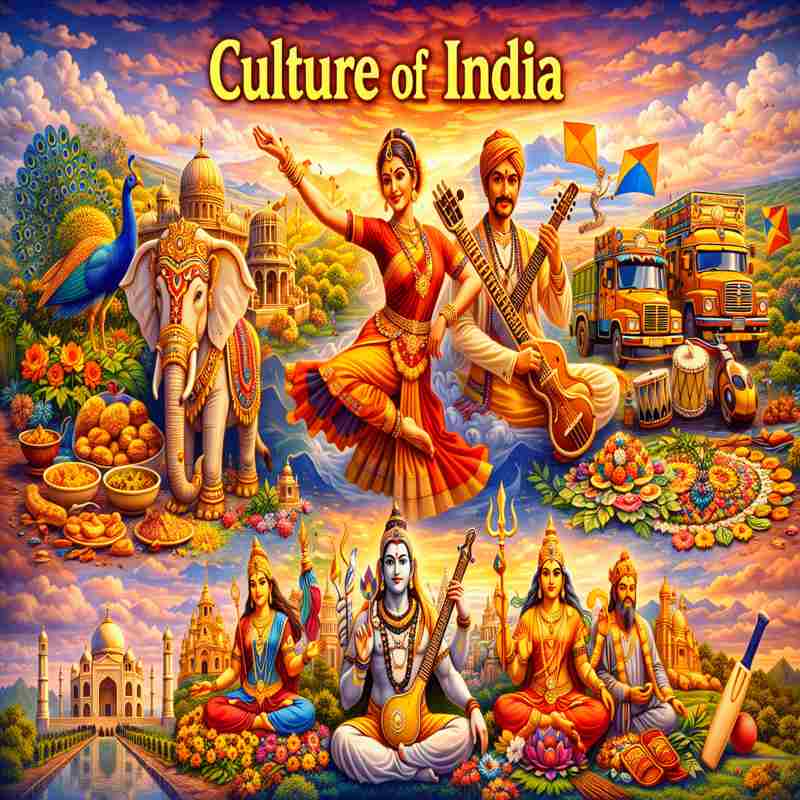
Culture of India
India has a rich history and strong traditions, and its way of life is a product of old values intertwined with modern ideas. When a person speaks about Indian culture and tradition, they refer to the overall Indian customs and lifestyle that developed over several millennia under the influence of certain beliefs and daily routines. India is a combination of the familiar and the new, as food and festivals combine with language and clothing.
The concept of Indian heritage and culture is not specific to any particular area or group of people. It is an experience that is continually evolving but has not lost its fundamental values. Closer observation reveals that all the components of India contribute something unique to its cultural identity.
Table of Contents
Learning about Indian Culture and Traditions.
Indian culture is among the oldest in the world. Its expansion has grown over the years through contributions from different civilizations, religions, and communities. Indian traditions are closely tied to family, respect, and spirituality.
Different religions also influence Indian practices and way of life. The country has faiths such as Hinduism, Islam, Sikhism, Christianity, and Buddhism, indicating a diverse culture. Religions also have their festivals, rituals, and beliefs, which have given rise to a richly colored cultural setting.
Cultural Diversity in India
India is culturally diverse, a fact among its most prominent aspects. Each state, and in many cases even each city, possesses its own language, food, mode of dress, and customs. It is this diversity that makes Indian culture so interesting.
To illustrate, the language used in Tamil Nadu is extremely different from that in Punjab. However, both regions share cultural values such as respect, community living, and the observance of festivals.
This diversity is also exhibited in food habits. Rice preparations such as idli and dosa are popular in the south, whereas wheat preparations such as roti and paratha are popular in the north. Food is a significant aspect of Indian traditions and way of life, even though the food varies, which tends to unite people.
Clothing is another example. Conventional garments such as sarees, salwar kameez, and dhotis differ in style and composition across regions. These differences are very popular during festivals and weddings and therefore form a significant aspect of Indian heritage and culture.
Festivals and Celebrations
The heart of Indian culture and traditions is festivals. They are not only ritualistic but also about collectivity, euphoria, and happiness shared with others. Festivals such as Diwali, Holi, Eid al-Fitr, and Christmas demonstrate how people from different faiths can celebrate their faiths while also celebrating one another’s happiness.
During these festivals, houses are adorned, special food is prepared, and families are assembled. You will find that even other religious people embrace celebrations, which corroborates the fact that cultural diversity in India is not only about unity among different people.
Indian Traditions and Way of Life.
Indian practices and ways of life are influenced by tradition and day-to-day life. Most traditions relate to life events such as birth, marriage, and death. Weddings, in their turn, are luxurious and heavily traditional Indian. They usually consist of rituals practiced over a long period.
Cultural habits are also evident in everyday life in India. Some tend to eat with their hands, take off their shoes to enter their homes or temples, or even begin the day with prayers. Such habits are not complex at all and carry cultural significance.
Family is key in Indian society. There are still joint families in many areas of the country, with more than one generation living together. Firm bonds with friends and families are sustained even in nuclear families.
Art, Music, and Dance
Indian heritage and culture are closely linked to art forms. They present the innovative face of traditions and narrate the history and faith stories. Such classical dance forms as Bharatanatyam and Kathak are not only performances but an expression of emotions and stories; likewise, Indian music, whether classical or folk, connects people to their origins.
Local culture and daily life are reflected in Madhubani paintings and Warli art, which represent traditional forms of art. Such art forms have been known to be transmitted from generation to generation, with traditions maintained.
History and Its Effects on Indian Culture.
Indian culture has been largely shaped by its history. In the past, in civilizations, medieval kingdoms, and during colonialism, they left their mark.
The ancient ages have been bringing concepts of science, religion, and philosophy. In the medieval era, there were architectural, musical, and food elements. New things, such as the English language and contemporary education, were introduced during the period of colonization.
All of that combined results in what we today refer to as Indian culture and traditions. Nothing is ever fixed; it is constantly evolving and rooted in its origins.
Contemporary India and the Changing Culture.
Modern life has changed, but India’s traditions have not weakened. The cities are getting faster, and lifestyles are changing. Cultural values have been retained as people are embracing new lifestyles.
Indicatively, classic clothes are nowadays popular during festivals, and Western clothes are popular in everyday life. On the same note, communication was transformed by modern technology, yet family values are still valued.
Young people currently juggle between the two worlds. They are also festival-oriented, conservative in their traditions, yet at the same time follow world trends. It is this equilibrium that keeps Indian heritage and culture alive in a dynamic world.
Food and Cultural Identity
Indian traditions and culture regard food as a significant aspect of their lifestyle. It does not merely concern eating but also sharing and celebrating. Diverse areas have their specialties, and most cuisines are attached to festivals and rites. For example, sweets play an essential role in celebrations, and some foods are cooked during religious events.
Spices are also significant ingredients in Indian cuisine, giving dishes a distinct flavor. Food plays a significant role in social life and is often eaten with family members.
Significance of Respect and Values.
One of the fundamental aspects of Indian culture is respect. It is observed in how individuals speak, act, and relate to others.
Special attention is paid to the senior population, and the recommendations are not disregarded. Teachers, too, are respected, and the concept of Guru rests on a firm cultural foundation.
Such teachings as honesty, kindness, and responsibility are introduced at an early age. These values influence how individuals live their lives and interact with society.
Conclusion
Indian culture and traditions are a combination of history, beliefs, and daily practices. It is a culture that embraces change and remains attached to its traditions.cultural diversity in India is unique, allowing communities to coexist while preserving their identities.
All things Indian heritage and culture, that are festivals, food, clothing, or values, all have stories to tell. It is not merely something to watch, but it can be felt in everyday life. To anyone attempting to learn about India, its culture offers a profound understanding of people’s way of life, their mindset, and how they interrelate with one another.
FAQs
What is unique about Indian culture?
Indian culture is distinctive due to its diversity. There are diverse languages, religions, and traditions, yet a sense of togetherness prevails. It is unique through this combination of differences and common values.
What are some of the typical traditions of India?
Some common traditions are respecting elders, celebrating festivals, engaging in religious practices, and building bonds within the family. These are traditions that are there to stay.
What is the impact of cultural diversity in India on day-to-day life?
Food, clothing, language, and festivals vary across cultures. It enables individuals to maintain diverse cultures while residing in the same country.
What is the significance of festivals in the Indian culture?
People are drawn into festivals, and festivals express religious and cultural beliefs. They are a time of celebration, sharing, and building relationships.
Is the Indian culture evolving?
Yes, there is a change in Indian culture, and people embrace modern lifestyles. Nevertheless, the old values and practices continue to play a significant role in life.