

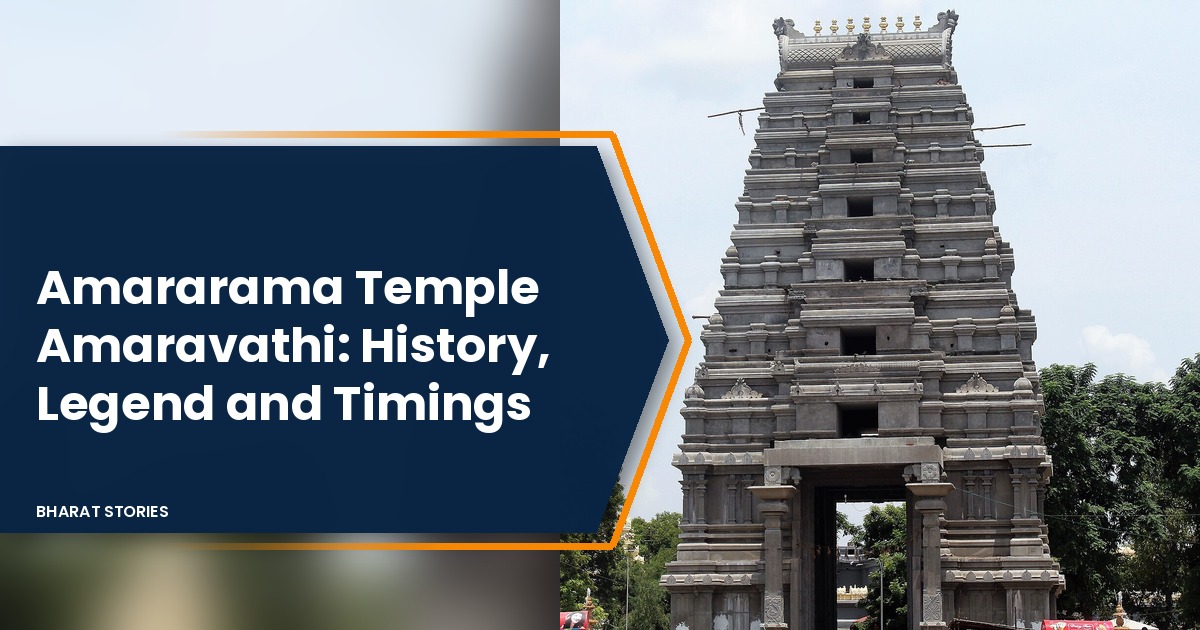
Amararama Temple Amaravathi: History, Legend and Timings
The Amararama temple, also called the Amareswara Swamy or Amaralingeswara Swamy temple, is an ancient Shiva temple in the town of Amaravathi on the banks of the Krishna River in Andhra Pradesh. It is one of the five Pancharama Kshetras, the group of Shiva shrines linked to a single legend, and it is known for its unusually tall white Shiva lingam.
This guide covers the temple’s location, legend, history, architecture, festivals, darshan timings and how to reach it, along with nearby places such as the Amaravati stupa.
Table of Contents
Where is the Amararama temple located?
The Amararama temple stands in Amaravathi village on the southern bank of the Krishna River in Andhra Pradesh, about 40 km from Guntur and roughly 35 km from Vijayawada. After the 2022 district reorganisation, Amaravathi falls in Palnadu district; it was earlier part of Guntur district.
Do not confuse it with Amravati in Maharashtra, or with the new state capital region named Amaravati, which lies about 35 km to the east and took its name from this historic town. According to Incredible India, the nearest airport and major railway station are both at Vijayawada.
Why is Amararama one of the Pancharama Kshetras?
Amararama is one of five temples where, according to legend, pieces of a single Shiva lingam fell after it was broken during the battle with the demon Tarakasura. The five shrines together are called the Pancharama Kshetras.
| Pancharama temple | Town | District |
|---|---|---|
| Amararama | Amaravathi | Palnadu |
| Draksharama | Draksharamam | Konaseema (Dr. B.R. Ambedkar Konaseema) |
| Somarama | Bhimavaram | West Godavari |
| Ksheerarama | Palakollu | West Godavari |
| Kumararama | Samalkot | Kakinada |
Amararama is the only one of the five on the Krishna; the other four are in the Godavari delta region. Read more in our guide to the Pancharama Kshetras, and in our pages on Draksharamam and the Somarama temple.
What is the story behind the Shiva lingam at Amaravathi?
Legend says the demon king Tarakasura held a powerful lingam that made him unbeatable, and when Kumaraswamy (Kartikeya) destroyed it, its pieces fell at five places, one of them Amaravathi. The gods are said to have worshipped Shiva here, which gave the place the name Amaravati, the city of the immortals.
In the local telling, the lingam here kept growing, and a nail was driven into its top to stop the growth, leaving a red mark that devotees still point out. The Shivalinga is also said to have been installed by Indra, the king of the gods, as Incredible India notes. These stories are matters of faith and are told differently by different priests and texts.
How tall is the lingam in the Amararama temple?
The lingam of Amareswara is a white stone pillar about 15 feet tall, the tallest among the Pancharama lingams, so priests perform abhishekam from a raised platform. Devotees climb steps to the upper level of the sanctum to see the top of the lingam.
The goddess here is Bala Chamundeswari, worshipped as the consort of Amareswara. Shrines to other deities stand around the inner courtyard.
What is the history of the Amareswara temple?
The temple has a long history, with inscriptions from the twelfth century onward, patronage from the Kota chiefs and later rulers, and a major renovation in the late eighteenth century by Raja Vasireddy Venkatadri Nayudu.
- Early history: Amaravathi and nearby Dharanikota were important centres under the Satavahanas, and the area was a major Buddhist site long before the present temple.
- Medieval period: the Kota dynasty of Dharanikota and later the Reddi and Vijayanagara rulers supported the temple; Krishnadevaraya is credited with adding a mandapam.
- Eighteenth century: Vasireddy Venkatadri Nayudu, the zamindar of Chintapalli, moved to Amaravathi, rebuilt and expanded the temple and gave land for its upkeep.
The temple’s architecture blends Dravidian gopurams with older local traditions. Four gopurams mark the entrances to the complex, and the main vimana rises above the sanctum.
What are the Amaravathi temple timings?
The temple is usually open from about 6 am to 12 noon and from about 4 pm to 8 pm, according to Incredible India; timings change on festival days, so confirm locally before you travel. Abhishekam and special pujas are performed at set times each day.
- Arrive early in the morning for a quieter darshan and to watch the abhishekam.
- On Mondays, Karthika month days and Maha Shivaratri, expect long queues.
- Dress modestly and follow temple rules on photography inside the sanctum.
Which festivals are celebrated at Amararama?
Maha Shivaratri is the biggest festival at Amararama, followed by the Karthika month celebrations, Navaratri and the annual temple chariot festival.
| Festival | Usual time | What happens |
|---|---|---|
| Maha Shivaratri | February or March | All night worship, large crowds, special abhishekam |
| Karthika month | October to November | Lamps, holy dips in the Krishna, Monday worship |
| Navaratri | September or October | Worship of Bala Chamundeswari |
| Kalyanotsavam and Rathotsavam | Around Shivaratri | Divine wedding rituals and chariot procession |
During the Pancharama yatra season in Karthika month, the state transport corporation often runs special buses that cover all five temples in a day or two.
How do you reach the Amararama temple?
Most visitors travel by road from Vijayawada or Guntur, both of which have frequent buses and taxis to Amaravathi. Vijayawada has the nearest airport and the main railway junction.
- By air: Vijayawada International Airport at Gannavaram, then by road.
- By rail: Vijayawada and Guntur are the closest major railway stations.
- By road: APSRTC buses run from Vijayawada and Guntur; the drive passes the capital region around Thullur.
What else can you see near the Amararama temple?
Amaravathi is also home to the ancient Amaravati Buddhist stupa, the ASI Archaeological Museum and the large Dhyana Buddha statue, all within a few minutes of the temple.
- Amaravati Mahachaitya: the ruins of a great Buddhist stupa from around the second century BCE, famous for its carved limestone panels.
- Archaeological Museum: displays sculptures and relics from the stupa site.
- Dhyana Buddha: a tall seated Buddha statue on the riverfront.
- Undavalli Caves and Kanaka Durga temple: on the way back to Vijayawada.
Shiva devotees may also enjoy our list of the tallest Shiva statues in India.
What does the name Amararama mean?
Amararama combines “Amara”, meaning immortal and referring to the gods, with “arama”, meaning a garden or retreat, so the name means the retreat of the immortals. The deity is called Amareswara, the lord of the immortals.
The same root gave the town its name, Amaravathi, the abode of the immortals in Hindu tradition. The Telugu form Amararamam is often used on signboards and in local speech.
What should you know before visiting the temple?
Plan for crowds on Mondays and festival days, carry little, and keep a few hours to see the Buddhist sites nearby. A half day trip from Vijayawada is enough for most visitors.
- Dress: traditional or modest clothing is expected; remove footwear at the entrance.
- Offerings: flowers, coconuts and bilva leaves are sold at stalls on the temple road.
- Special darshan: paid quick darshan and abhishekam tickets are sold at the temple counter; check current rates there.
- River ghat: many pilgrims take a dip in the Krishna before darshan; follow safety advice, as currents can be strong after rain.
- Weather: carry water and a cap, since the stone courtyards heat up quickly in the afternoon.
Frequently Asked Questions
Which district is the Amararama temple in?
Amaravathi is in Palnadu district of Andhra Pradesh. Before the 2022 reorganisation it was part of Guntur district, so many guides still list Guntur.
Is Amararama the same as the Amaravathi temple?
Yes. Amararama, Amararamam, Amareswara Swamy temple and Amaralingeswara Swamy temple are names for the same Shiva temple in Amaravathi.
Can you visit all five Pancharama temples in one day?
The four Godavari temples can be covered in one long day, but Amaravathi is far to the south west, so most pilgrims need two days for all five.
What is the best time to visit Amaravathi?
October to February has the most comfortable weather. Summers are very hot, with temperatures often above 40 C in April and May.