

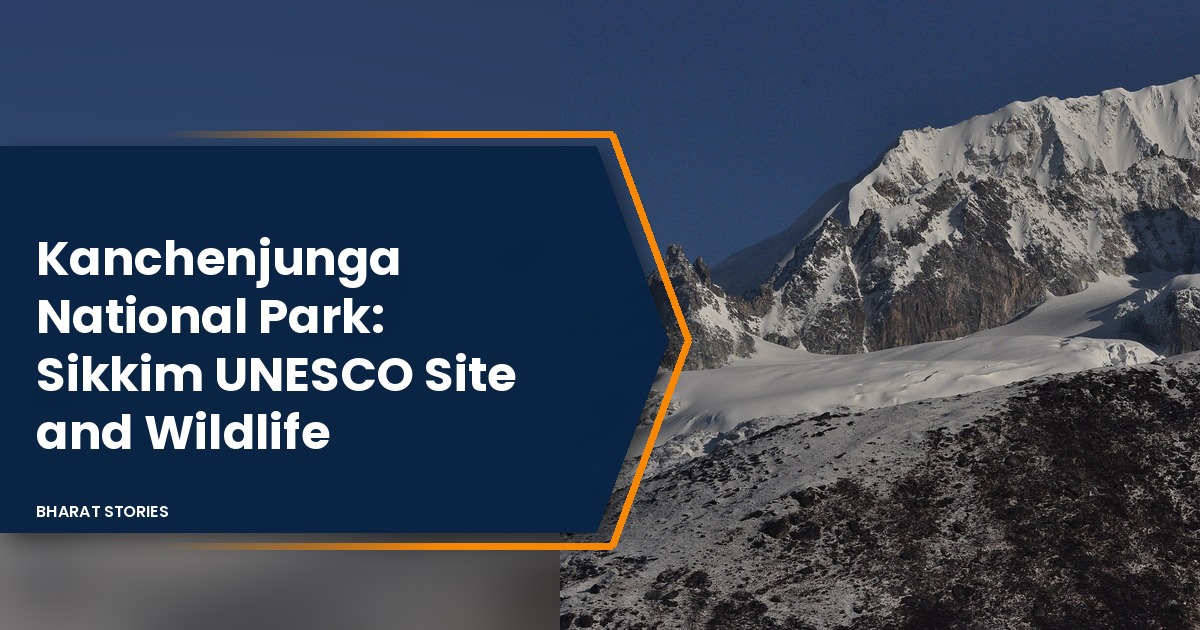
Kanchenjunga National Park: Sikkim UNESCO Site and Wildlife
Kanchenjunga National Park, officially Khangchendzonga National Park, is Sikkim’s largest protected area and India’s first mixed UNESCO World Heritage Site. It stretches from forested valleys to the snow fields of Kangchenjunga, the third highest mountain on Earth, and it is sacred to the people of Sikkim. This guide covers where the park is, why it is famous, its wildlife, permits, treks and the best time to visit.
Table of Contents
Where is Kanchenjunga National Park located?
Kanchenjunga National Park is in Sikkim, in Mangan and Gyalshing districts, along the state’s borders with Nepal to the west and Tibet to the north.
The park covers about 1,784 sq km, which is roughly a quarter of Sikkim. On its western side it adjoins the Kanchenjunga Conservation Area in Nepal, and to the north it borders the Qomolangma National Nature Preserve in Tibet. Yuksom, a historic town in western Sikkim, is the main gateway for treks into the park.
| Fact | Detail |
|---|---|
| Official name | Khangchendzonga National Park |
| State and districts | Sikkim; Mangan and Gyalshing |
| Established | 1977 |
| Area | About 1,784 sq km (core of 178,400 ha) |
| Altitude range | About 1,220 m to 8,586 m |
| UNESCO status | World Heritage Site (mixed), 2016 |
| Highest point | Kangchenjunga, 8,586 m |
Why is Kanchenjunga National Park famous?
It is famous for Mount Kangchenjunga, its huge altitude range, rare Himalayan wildlife and its status as India’s first mixed natural and cultural World Heritage Site.
The park was inscribed on the UNESCO World Heritage List in July 2016 under both natural and cultural criteria. According to UNESCO’s listing, it has one of the widest altitude ranges of any protected area in the world, a vertical sweep of more than 7 km within a relatively small area. That range packs subtropical forest, temperate woods, alpine meadows, glaciers and high peaks into a single park.
How was the park created and expanded?
The park was set up in 1977 with an area of about 850 sq km and was later expanded to about 1,784 sq km.
Its larger landscape forms the Khangchendzonga Biosphere Reserve, which was added to UNESCO’s Man and the Biosphere network in 2018. The biosphere reserve includes buffer and transition zones where villages and farms sit around the protected core. More background is on the Khangchendzonga National Park page.
Why is Kangchenjunga sacred to the people of Sikkim?
The mountain and its valleys are revered as a hidden sacred land by Sikkimese Buddhists and as Mayel Lyang by the Lepcha people.
UNESCO notes that the caves, lakes, rivers and rocks of this landscape carry deep religious meaning, and that the shared respect of Buddhist and Lepcha traditions is part of Sikkim’s identity. This is why the park was listed under cultural criteria as well as natural ones. Out of respect, mountaineering expeditions approaching from the Sikkim side have traditionally been restricted, and by tradition many climbers stop just short of the true summit.
What glaciers and peaks are inside the park?
The park holds many glaciers, including the 26 km long Zemu Glacier, and peaks such as Kangchenjunga, Pandim, Siniolchu and Narsing.
The Kangchenjunga massif rises to 8,586 m and has five main summits, which is where its Tibetan name, the five treasures of the snow, comes from. The Zemu, Talung and Rathong glaciers feed rivers that flow down to the Teesta, Sikkim’s main river. High lakes and moraine fields fill the upper valleys.
Which animals are found in Kanchenjunga National Park?
The park is home to the snow leopard, red panda, clouded leopard, Himalayan tahr, bharal, musk deer and about 550 bird species.
Six species of wild cat live here: snow leopard, clouded leopard, common leopard, Asian golden cat, leopard cat and jungle cat. Other mammals include the red panda, which is the state animal of Sikkim, as well as the Himalayan black bear, dhole, Himalayan wolf, goral, serow, bharal (blue sheep) and two kinds of musk deer.
- Birds: blood pheasant (Sikkim’s state bird), satyr tragopan, Himalayan monal, Tibetan snowcock, lammergeier, Himalayan griffon, snow pigeon and many sunbirds.
- Plants: oak, fir, birch, maple and willow forests, dozens of rhododendron species that bloom in spring, alpine flowers and many medicinal herbs.
To see how this wildlife compares with other regions, read our page on the top wild animals of India.
Which communities live around the park?
Lepcha, Bhutia and Nepali communities live in the villages around the park, and their farms, monasteries and grazing grounds are part of the wider biosphere reserve.
Old monasteries such as Dubdi near Yuksom and Pemayangtse near Pelling are linked to the founding of the Sikkim kingdom. Dzongu, a protected Lepcha area in Mangan district, lies on the eastern side of the park. Local people work as guides, porters, cooks and homestay hosts, so choosing local services helps the communities that look after this landscape.
What are the main threats to the park?
Climate change, retreating glaciers, poorly managed trekking waste, grazing and the loss of habitat along the edges are the main concerns.
Warmer temperatures are changing the snow line and the timing of flowering in the high meadows, and glacier lakes can grow and become a flood risk downstream. Rising tourist numbers bring litter and pressure on campsites. Trekkers can help by carrying all waste back, using kerosene or gas instead of firewood, keeping to marked trails and never buying wildlife products.
Can tourists visit Kanchenjunga National Park?
Yes, mainly as trekkers. Entry requires permits from the Sikkim Forest Department and, for some routes and for foreign nationals, additional protected area permits.
There are no jungle safaris here as in central Indian parks. Most visitors walk in with a registered trekking operator and a guide, starting from Yuksom. Rules can change, so check the latest permit requirements with Sikkim Tourism or the forest office before booking. Our guides to Sikkim’s history and tourism and Gangtok help with planning the rest of the trip.
What is the Goecha La trek?
Goecha La is the most popular trek in the park, a high pass of about 4,600 m that offers close views of the east face of Kangchenjunga.
The trek usually takes eight to eleven days from Yuksom, passing through rhododendron forest to Tshoka, the meadows of Dzongri and the lake at Samiti. It is a demanding high altitude trek, so good fitness, gradual acclimatisation and an experienced team are essential. The shorter Dzongri trek is a good alternative for those with less time.
When is the best time to visit?
March to May and October to November are the best months, with clear mountain views in autumn and rhododendrons in bloom in spring.
The monsoon, roughly June to September, brings heavy rain, leeches and landslides, and many routes are closed. Winter, from December to February, is very cold, with snow at higher camps. Always carry warm layers, rain gear and a basic medical kit, and learn the signs of altitude sickness before you go.
How do you reach Kanchenjunga National Park?
Fly to Pakyong or Bagdogra, or take a train to New Jalpaiguri, then travel by road to Yuksom in western Sikkim.
From Bagdogra or New Jalpaiguri, the drive to Yuksom takes most of a day. Many travellers break the journey at Pelling or Gangtok. Shared jeeps and private taxis run on these routes.
For more parks across India, browse our list of national parks of India.
Frequently Asked Questions
Kanchenjunga National Park is located in which state?
It is in Sikkim, in the north and west of the state, in Mangan and Gyalshing districts.
Which animal is Kanchenjunga National Park famous for?
It is best known for the snow leopard and the red panda, along with the blood pheasant and Himalayan tahr.
In which year did Kanchenjunga National Park become a UNESCO site?
It was inscribed as a World Heritage Site in July 2016, becoming India’s first mixed natural and cultural site.
Which is the largest national park in Sikkim?
Khangchendzonga National Park is the largest, at about 1,784 sq km.