

Kanjivaram Saree: Weave, Zari, GI Tag and How to Check It
A Kanjivaram saree is the heavy silk saree woven in Kanchipuram, Tamil Nadu, and it is the one many South Indian families still buy for a wedding. It is also one of the most copied sarees in the country. Plenty of sarees sold under the name were never near a Kanchipuram loom. This guide explains what makes a Kanjivaram saree what it is, how the zari works, what the GI tag really promises, and how to check a saree before you pay for it.
Table of Contents
What is a Kanjivaram saree?
A Kanjivaram saree, also spelt Kanjeevaram and called Kanchipuram silk saree, is a silk saree made in the Kanchipuram region of Tamil Nadu from pure mulberry silk, usually with a zari border and pallu. According to Wikipedia’s entry on the Kanchipuram silk sari, these sarees are worn as bridal and special occasion sarees by most women in Tamil Nadu, Kerala, Karnataka and Andhra Pradesh.
The Geographical Indication application describes a typical Kancheepuram saree by three traits: heavy weight, bright colours and solid zari borders with a pallu. Heavy is the word to remember, and that weight comes from the way the yarn is twisted and woven.
Which place is famous for Kanjivaram sarees?
Kanchipuram, a temple town about 70 km from Chennai, is the home of the Kanjivaram saree. Our short profile of Kanchipuram as a city of temples covers the town itself. Silk weaving there is a centuries old tradition, and a 2005 Frontline report counted more than 60,000 silk looms and 22 weaver cooperative societies in the town.
Weaving is local, but the raw material is not. The same report says the silk comes mainly from Karnataka, and about 75 per cent of the zari comes from Gujarat, with the rest from Tamil Nadu Zari, a government owned factory. If you want the wider picture of the state, our guide to Tamil Nadu, its history, economy and crafts covers it.
How is a Kanjivaram saree woven?
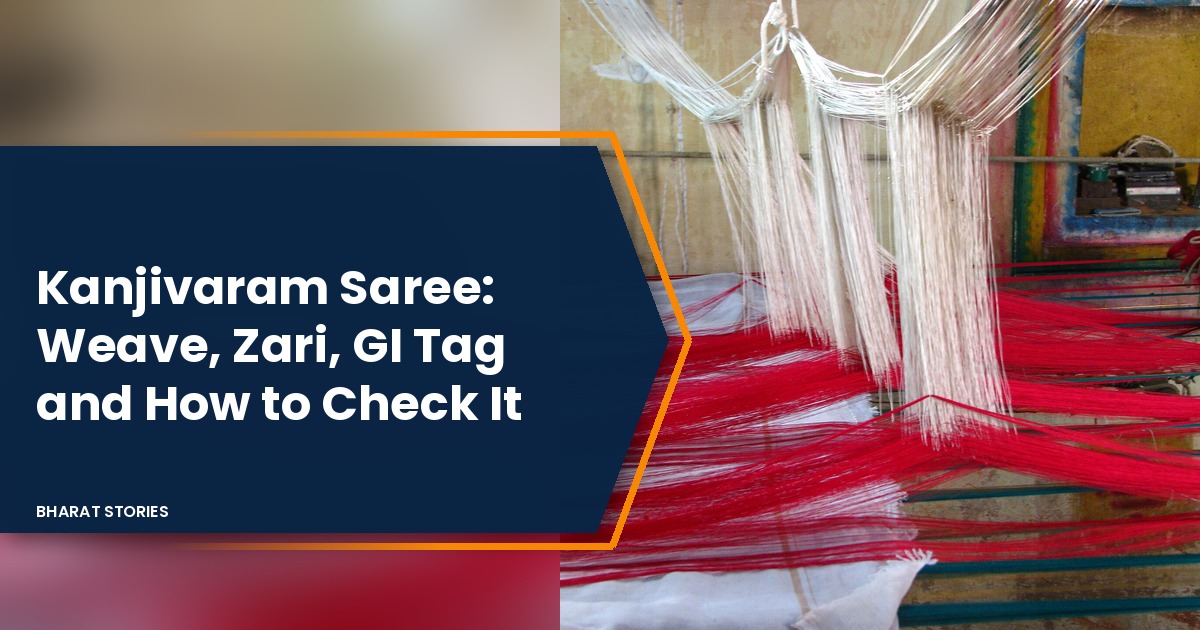
It is woven on a loom with three shuttles, with the body and the border woven separately and then interlocked, which is why a good Kanjivaram border does not come away from the body. Wikipedia describes the weaver working on one side while an assistant works the shuttle on the other, and the border colour is usually quite different from the body.
- Two part weaving: Frontline calls it the pitni technique. The pallu and border are woven as one unit in one colour and attached to the body, which is woven separately in another colour.
- Three thread silk: The silk thread is made of three single threads twisted together, which gives the saree its strength and weight.
- The joint: The place where body meets pallu is often marked by a zigzag line. The joint is woven so strongly that even if the saree tears, the border will not detach.
What is zari, and how much gold is in a Kanjivaram?
Zari is the metallic thread in the border and pallu, made of silk twisted with a thin silver wire and gilded with pure gold, and the traditional norm for Kanchipuram zari is 57 per cent silver and 0.6 per cent gold by weight. That norm comes from the Frontline report. A cooperative official quoted there said that most sarees in 2005 carried zari with less than 0.2 per cent gold and less than 40 per cent silver, and that some borders mixed silk with polyester.
The rules have also moved. A 2023 report by the intellectual property law department of the Tamil Nadu Dr. Ambedkar Law University says the state government eased the requirement to 40 per cent silver and 0.5 per cent gold for producers. Treat that as a reminder that zari content varies. Two sarees that look alike on a hanger can carry very different amounts of precious metal.
Frontline also reported a zari testing unit in Kanchipuram that measures the gold and silver in a saree. I could not confirm whether it is still open to the public, so ask the local handloom office before relying on it.
What designs and motifs make a Kanjivaram?
Wide contrast borders, temple borders, checks, stripes and small floral buttas are the traditional Kanjivaram designs, and many motifs are taken from South Indian temples. The Law University report names the Yali, a mythical elephant and lion creature, the Ganda Berunda, a two headed bird, and the temple border called reku. Wikipedia adds that some pallus carry paintings by Raja Ravi Varma or scenes from the Mahabharata and Ramayana.
Frontline lists three types in modern production, and the choice matters when you shop:
- Contrast: the traditional saree, where border and body are interlocked.
- Semi contrast: the border uses a different warp and weft colour, but the warp runs from the body into the border, so nothing is interlocked.
- Plain: body and border are the same colour.
The report notes that plain silk sarees are the ones most often copied by powerlooms, which can sell them at a third of the cost.
What does the GI tag on Kanchipuram silk mean?
The GI tag means a saree sold as a Kanchipuram saree must be woven in the Kanchipuram region and follow the registered weight, quality and zari norms. Wikipedia records that the Tamil Nadu government applied for the tag in 2005 and that the Government of India recognised it in 2005 to 2006. The application was filed by the state’s Department of Handlooms and Textiles, which is listed in the GI application for Kancheepuram silk.
A tag is not a quality certificate for every saree in a shop, though. The 2023 student report noted that weavers make Kanchipuram sarees without awareness of the GI and its benefits. So a seller who says “GI tagged” has told you where the saree should come from, not that this particular piece has been tested.
How do you check if a Kanjivaram saree is original?
Check the Silk Mark label, the border joint, the zari and the silk itself, and buy from a source that will put the details on the bill. No single test settles it. Use several together.
- Look for the Silk Mark label. Wikipedia explains that Silk Mark is a certification mark for pure natural silk, run by the Silk Mark Organisation of India. It is advisory and not legally enforced, so it proves the fabric is silk but not that it was woven in Kanchipuram. The Silk Mark site has a label authentication page where the number can be checked.
- Study the joint. Find the zigzag line where the body meets the pallu. A genuine contrast saree is interlocked there, and the border should not look stuck on.
- Feel the weight. The GI application lists heavy weight as the first trait of a typical Kancheepuram saree, so an unusually light, thin piece deserves questions.
- Ask about the zari. Ask what it is made of and whether the seller can show a test result. A cooperative official told Frontline that the societies use only pure zari and silk.
- Try the flame test on a loose thread. The Silk Mark purity test says silk burns slowly, leaves a black bead that crumbles between your fingers and smells like burnt hair, while polyester burns fast and melts into a hard bead. Pull a thread from an edge. Never burn the saree itself.
- Get a proper bill. It should name the fabric, the weaver or society and the zari type.
The flame test only tells you the yarn is silk. It does not prove the saree was woven in Kanchipuram or that the zari is real, so keep the other checks too.
How much does a Kanjivaram saree cost?
There is no fixed price. Cost depends on the weight of the silk, the amount of real zari, the intricacy of the design, the colours and the time taken to weave. Wikipedia says Kanchipuram sarees vary widely in cost for these reasons.
I have not quoted a price range because I could not find a current published one from a reliable source, and zari costs move with silver and gold rates. Compare sarees of similar weight and zari claims, and be wary of a price far below the rest.
Which is better, Banarasi or Kanjivaram?
Neither is better. They are different sarees from different cities, and the right one depends on the occasion and how heavy a drape you want. A Banarasi saree is made in Varanasi and is known for gold and silver brocade, fine silk and dense floral motifs. Wikipedia says its detailed designs make it relatively heavy, and that a single piece can take from 15 days to a month, and sometimes up to six months.
A Kanjivaram is woven in Kanchipuram with strong contrast borders, temple motifs and a heavier, firmer hand. Banarasi sarees carry their own GI tag, granted in 2009 for six districts of Uttar Pradesh. If you are still choosing between regional silks, our guide to different types of sarees in India compares them side by side.
How do you care for a Kanjivaram saree?
Dry clean it for the first three washes, then wash by hand in lukewarm water with a neutral soap, dry it flat in the shade and iron it on the reverse at low to medium heat. This is the advice on the Silk Mark care page.
- Do not wring or squeeze silk hard.
- Do not spray water on silk before ironing, because it can leave water spots.
- For a stain, take the saree to a dry cleaner who handles silk instead of rubbing it with water.
The care page is about silk in general. If your saree has heavy zari, ask the cleaner about it too, since metal thread can react differently to treatment.
Quick answers
Is Kanjivaram saree pure silk?
A genuine one is woven from pure mulberry silk with zari. Many sarees sold as Kanjivaram are blends or art silk, so check the label and the bill instead of the name.
Is Kanjivaram the same as Kanchipuram silk saree?
Yes. Kanjivaram, Kanjeevaram and Kanchipuram silk saree all refer to the same family of sarees. The GI registration uses the spelling Kancheepuram.
Why is a Kanjivaram a bridal saree?
Its weight, deep colours and gold bordered pallu give it a festive look, and families in South India have long chosen it for weddings. Our list of must have sarees also calls it the queen of all sarees.
Does the GI tag guarantee a saree is good?
No. It sets where the saree must be woven and which norms it should meet. You still need to check the piece itself.