

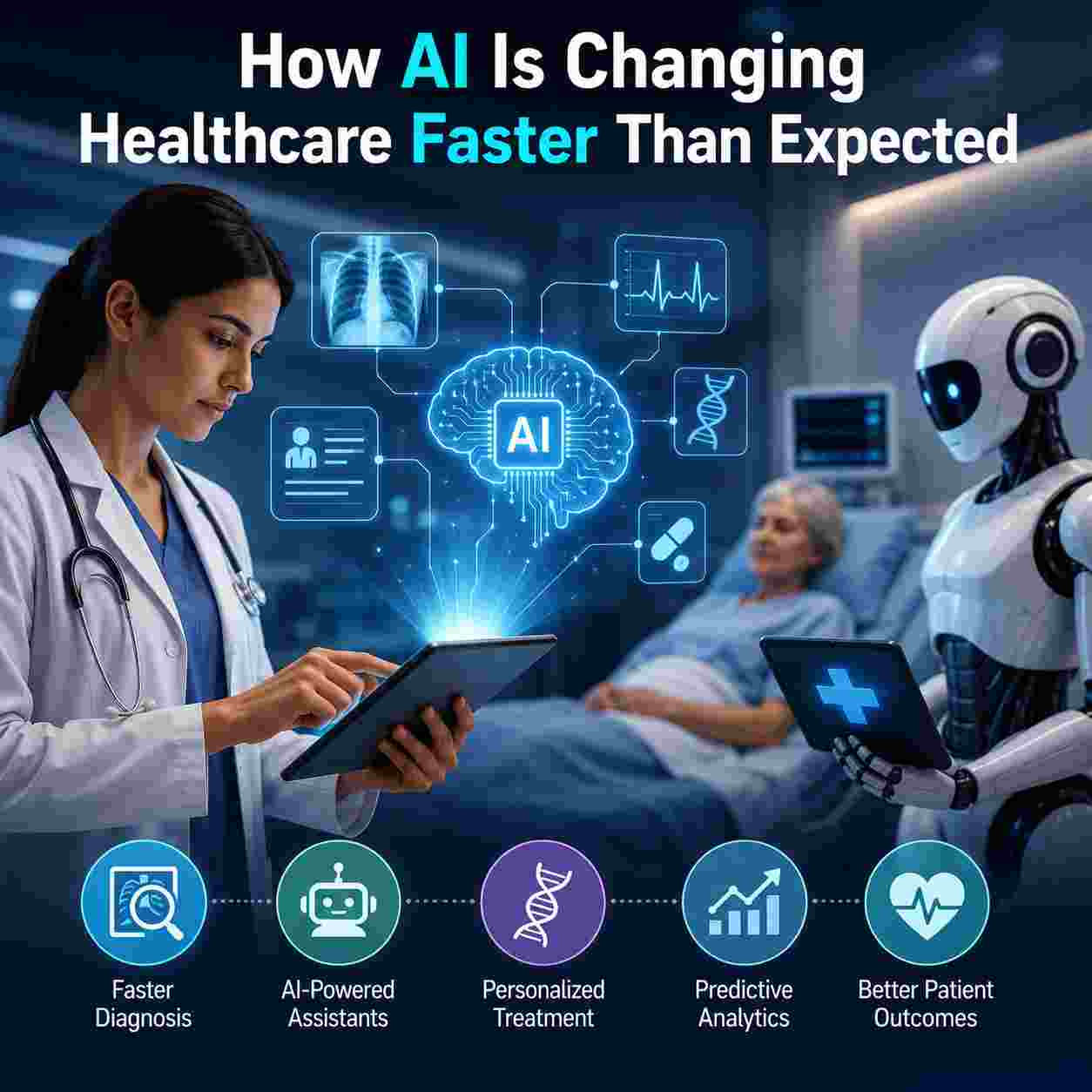
How AI Is Changing Healthcare Faster Than Expected
A few years back, most people figured AI in hospitals meant some far-off, sci-fi version of medicine, still decades away from actually mattering. That’s not how it played out. AI healthcare tools are already sitting inside radiology departments, pharmacy systems, and the apps people check before deciding whether a headache is worth a doctor’s visit.
What’s caught a lot of doctors off guard isn’t that this happened — everyone expected it eventually, sooner or later. It’s how fast it happened. Medical AI moved from research papers to actual patient care in a handful of years, not the slow, decade-long crawl most new technology usually takes inside future medicine. Even people working in healthcare admit they didn’t see the pace coming.
Table of Contents
Why AI Healthcare Is Moving Quicker Than Anyone Predicted
A few things lined up at once. Hospitals had mountains of patient data sitting around unused. Computing power got cheaper. And during stretched-thin periods — staff shortages, overloaded emergency rooms — anything saving a doctor even ten minutes per patient suddenly became worth trying, no questions asked.
That pressure pushed adoption faster than careful, cautious rollout plans usually allow. Once one hospital showed measurable results with an AI healthcare tool, others followed quickly. Nobody wanted to fall behind on something that visibly worked.
What Medical AI Actually Does in a Hospital Setting
It helps to get specific here, since “AI in medicine” sounds vague until someone sees what’s actually happening on the ground. Medical AI right now mostly handles three kinds of work: spotting patterns in scans, predicting risk before symptoms appear, and cutting down paperwork that used to eat into doctors’ time with patients.
A radiologist reviewing hundreds of chest X-rays a week often has software flagging the scans that look suspicious first. That doesn’t replace the radiologist’s judgment, not even close. It just means the most urgent cases get human eyes on them sooner, instead of sitting in a queue behind routine scans.
Nurses and doctors lean on it for other things too, like predicting which patients are likely to be readmitted within thirty days, so care teams can step in earlier rather than reacting after something’s already gone wrong.
Diagnostics AI: Catching Problems Before Symptoms Show
This is probably where the change feels most real to patients, even if they never see the software directly. Diagnostics AI looks for patterns across thousands of past cases — patterns a single doctor, however experienced, simply hasn’t seen often enough to notice alone.
Skin lesion screening is a good example here. Some diagnostics AI systems can flag a mole that looks concerned with accuracy that rivals trained dermatologists, which matters a lot in areas where seeing a specialist takes weeks of waiting. The same goes for early signs of diabetic retinopathy, picked up from a simple eye scan before a patient notices any actual change in vision.
None of this means a screen replaces a doctor’s final call. It means doctors get a second opinion that never gets tired, never has an off day, and doesn’t skip a detail just because it’s the fortieth scan reviewed that shift.
Healthcare Technology Tools Patients Are Already Using
A lot of this isn’t locked away in hospital basements somewhere. Plenty of healthcare technology built on AI sits right in a patient’s pocket already:
- Symptom-checker apps that ask follow-up questions before suggesting whether to see a doctor
- Wearables that track heart rhythm and flag irregularities worth checking out
- Chatbots handling appointment scheduling and basic prescription refill requests
- Apps that remind patients to take medication and quietly track whether doses got missed
- Virtual triage tools used before emergency room visits, sorting urgent cases from ones that can wait
None of these are perfect, far from it. But compared to a decade ago, when most of this meant a phone call and a long hold, the shift is hard to ignore.
Where Future Medicine Is Heading Next
Looking further ahead, future medicine seems to be aiming at something more personal rather than just faster. Right now, a lot of treatment still follows a one-size-fits-most approach. AI models trained on genetic data, lifestyle factors, and treatment outcomes are starting to suggest which specific drug or dosage might suit an individual patient best, not just the average one walking through the door.
Drug discovery is another area worth watching closely. Testing new compounds used to take years of trial and error inside a lab. AI models now narrow down promising candidates much faster, cutting the number of dead ends researchers have to chase one by one.
Surgery is shifting too, with AI-assisted robotic systems giving surgeons more precise control during delicate procedures. A human surgeon is still very much the one making the actual decisions in that room, though — the technology assists, it doesn’t take over.
Limits and Honest Concerns Around AI in Medicine
It’s worth being upfront about where things still fall short, since plenty of valid concerns sit right alongside the genuine progress:
- AI models trained mostly on one population’s data can perform poorly for other groups, raising real fairness concerns
- A wrong or missed diagnosis from software still needs a clear line of accountability, and regulations are still catching up
- Patient data privacy stays a real worry, especially as more health information moves through cloud-based systems
- Over-reliance on AI suggestions can dull a clinician’s own judgment over time if it’s not managed carefully
- Smaller clinics and rural hospitals often can’t afford the same tools as large city hospitals, which widens existing care gaps further
None of this means the technology should get avoided altogether. It means rollout needs to happen with eyes open, not blind enthusiasm.
What This Means for Patients Today
For someone sitting in a waiting room right now, most of this probably feels distant, almost abstract. But it’s already showing up in small, practical ways — a faster scan result, a chatbot catching a symptom worth flagging, a wearable nudging someone toward a doctor’s visit they might’ve otherwise put off for months.
Patients don’t need to understand the technical side of AI healthcare to benefit from it. What’s worth knowing is simple: a faster result or an automated flag doesn’t replace asking a doctor direct questions. The technology supports the conversation; it doesn’t end it.
A Balanced Closing Thought
Medicine has always adopted new tools cautiously, and that caution exists for a reason — mistakes in healthcare carry real consequences for real people. What’s different this time is the pace, not the direction. AI healthcare and medical AI tools aren’t arriving instead of doctors. They’re arriving alongside them, handling the repetitive, pattern-heavy parts of the job so people can focus on the parts that genuinely need a human in the room.
Whether someone trusts the technology fully or still feels a little unsure about it, it’s already woven into how care gets delivered now. That’s unlikely to slow down anytime soon, and pretending otherwise probably isn’t the most useful way to think about it.
Frequently Asked Questions
-
Is AI healthcare technology actually being used in hospitals today, or is it still mostly experimental?
AI healthcare technology is genuinely in use already, not just running in trials somewhere. Many hospitals use AI for imaging analysis, appointment scheduling, and risk prediction. Adoption varies by region and hospital size, but it’s well past the experimental stage in plenty of places.
-
Can diagnostics AI replace a doctor’s diagnosis completely?
Not at this point, and most experts don’t expect that to happen soon, if ever. Diagnostics AI flags patterns and supports decision-making, but a qualified doctor still reviews and confirms any diagnosis before treatment decisions actually get made.
-
How accurate is medical AI compared to human doctors?
It depends heavily on the specific task at hand. For narrow jobs, like detecting certain patterns in scans, some AI tools match or slightly exceed average human accuracy. For broader clinical judgment involving context and patient history, human doctors still hold a clear edge.
-
Will future medicine make healthcare more expensive because of all this technology?
It could go either way, honestly. Some tools add upfront costs, but many are designed to cut down on unnecessary tests, hospital readmissions, and wasted time, which can lower overall costs in the long run if they’re adopted properly.
-
Is patient data safe when healthcare technology relies this much on AI?
Reputable healthcare providers follow data protection regulations and encryption standards, but no system is completely risk-free, and it would be misleading to claim otherwise. It’s reasonable for patients to ask their provider directly how their data gets stored and who has access to it.